
More Food Brands and Industries Stepping Up Traceability and Authentication Drive

In the September 2023 issue of Authentication & Brand News™, we examined how Parmigiano Reggiano, the iconic Italian cheese, has embraced modern technology by embedding edible microchips into its 40kg cheese wheels to combat counterfeiting.
Let’s now look at a few more developments as individual food brands and government authorities alike continue to drive the implementation of anti-counterfeiting and traceability systems.
QR codes for pasta and pesto
Premium Italian pasta maker Pastificio Liguori has implemented blockchain- powered QR code packaging in its products.
According to the company, the information contained in the QR code guarantees a complete tracking system of the entire production process.
Pastificio Liguori pasta is exemplified by its certified slow drying process, which the company says improves its organoleptic properties and retention of its nutritional content. Pastificio Liguori has a history of more than 200 years. Its products are the first dry pasta to have EU Protected Geographical Indication certification, designed to protect consumers and the brand from counterfeiting and abuse.
Another Italian food brand, Barilla, has introduced a QR code on jars of its Pesto Alla Genovese sauce to ensure supply chain traceability. The project was developed in collaboration with Connecting Food, a platform for food traceability and transparency. The system involves all the players in the basil supply chain – comprising 50 operating units, 19 farms, and six suppliers.
Guaranteeing food authenticity is big business in Europe and Italy. Over two- thirds of ‘Italian’ food products worldwide are fake, and the global turnover of counterfeit ‘Italian’ food products has increased to an annual €120 billion, according to Italian farmers’ group Coldiretti. Cheeses are among the most ‘cloned’ products, led by Parmigiano Reggiano and Grana Padano. Other top bogus brands are iconic cold cuts like Parma and San Daniele ham and mortadella from Bologna.
Tags for any product
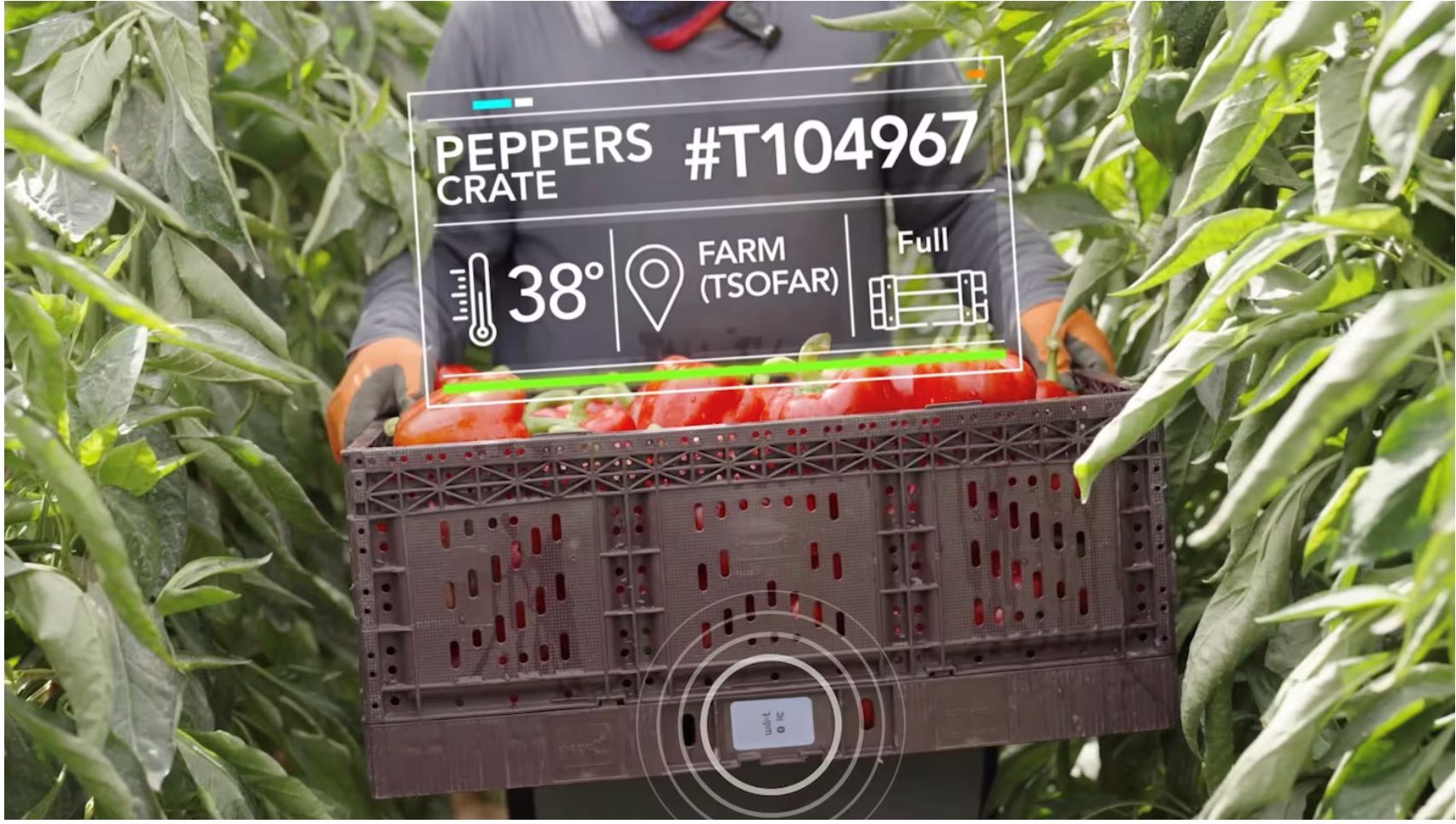
In 2022, startup company Wiliot, a developer of IoT technology for supply chains and asset management, launched flexible tags the size of postage stamps that can attach to any food product or packaging. The tags connect the product to the internet and embed it with intelligence, using energy harvested from radio waves to track things such as temperature, moisture, light and precisely where a product has travelled.
Photonics and AI for honey
In another research development, Aston University and the Scottish Bee Company are teaming up to develop technology to detect honey adulteration using photonics and artificial intelligence. The British Beekeepers Association and Honey Authenticity Network UK support the research, led by Dr Alex Rozhin, a reader in nanotechnology at Aston Institute of Photonic Technologies.
Honey samples will be examined using fluorescence excitation-emission (FLE) spectroscopy and machine learning techniques to create a fast and reliable testing method. These techniques can identify the chemical constituents of honey samples, assess their ratios, and determine quality markers.
By combining the rapidity, precision, and optical capabilities of FLE spectroscopy with machine learning algorithms, the project aims to surpass existing methods for assessing the quality of honey, such as chromatography, nuclear magnetic resonance and sensory analysis, which are considered expensive and time- consuming.
Filling the traceability gaps for US pork
The US pork industry is taking a slow but steady approach to an improved traceability system. Now, the National Pork Producers Council (NPCC) has developed draft standards in response to a request by the US Department of Agriculture (USDA) for the industry to advise on a mandatory traceability programme for swine.
NPCC will collect industry feedback on the draft before presenting it in the form of a ‘Swine Traceability Standards’ resolution for voting at the 2024 National Pork Industry Forum. If approved, NPCC will submit the resolution to USDA for consideration.
The US pork industry already has a swine traceability programme in place at both the national (interstate) and state (intrastate) levels, but there are gaps in the programme which need filling. Specifically, the industry is looking to address the following:
Breeding stock, cull animals and show pigs, whose individual movements are difficult to track, giving each a unique ID number.
Premises registration for all producers, cull and breeding operations, and show- pig farms.
Movement reporting for all pigs to a centralised database available to animal health officials.
According to pork producers, traceability is necessary for the US pork industry, as it exports 25-30% of its total production. Tracing pigs in a disease outbreak is critical to locating the affected populations and rapidly implementing control strategies to reduce pathogen spread. In addition, as more consumers participate in authentication and want to know the journey of the food product they are purchasing, the call for traceability is growing.
Subscriber content
Read the full article
Full access to Tax Stamp & Authentication News™ articles, newsletters and archives.