
Nanobrick Carving a Market with its Active Nano Platform


Nanobrick, the South Korean company founded in 2007 by its current CEO, Jae-Hyun Joo, is building a presence in the security and authentication field with what it calls its ‘active nano platform’ (ANP). Tax stamps are one of its target markets.
The company specialises in developing and producing nano-scale particles in two families – electrically or magnetically activated – which are incorporated into carriers such as inks and substrates. It has supply and development agreements with two significant players in the secured document sector, SICPA and China Banknote Ink, an indication of the high quality of its security materials.
The company states that its nanomaterials, which it characterises as ‘delicately controlled to express colour or transmittance expressions’, are globally unique, but is cautious about explaining what makes them so. However, it has been awarded, or applied for, 86 domestic and 44 international patents, although these include several utility model patents (ie. minor improvements to existing patented inventions or processes).
Nanobrick is a public company traded on the South Korean KOSDAQ stock exchange, with a market capitalisation of KRW 40 billion (€27 million) and 2022 sales of KRW 7 billion (€4.9 million). It operates as both an OEM (original equipment manufacturer) and developer and producer of its own finished products. And while it has focused on security applications as its core product, it is now developing products for colour-changing cosmetics, smart windows (ie. controlling the entering light) and visual displays.
It has three lines of its own security products: M-Print, M-SecuPrint and M-Currency, the last two reserved for government or government agency customers. It has 18 Chinese patents for its security materials.
Nanobrick refers to its core security technology as MTX, describing it as ‘photonic crystals delicately arranged’, which when stimulated by an external magnetic field ‘express iridescent reflective colours’.
Its M-Tag product line uses MTX in what appear to be small, dull patches on a document or product package, with a size ranging from under 1cm2 to several cm2, which exhibit a clear pattern when a magnet is brought close to the patch. That magnet may be a small custom-designed pocket item that NanoBrick supplies for use by, say, tax stamp inspectors, or the magnet in a mobile phone. Indeed, the company has written M-Check, a smartphone app which can check the M-Tag and read an adjacent 2D code to reveal information about the location of the item and its path through the supply chain.
M-Tag is supplied in five configurations – Basic, Lite, Standard, Premium and Barcode, in ascending order of security – but it is also supplied as an OEM powder for appropriate customers. In a parallel set of configurations, M-Pac is the product packaging version and M-Secuprint is the version for high security documents, including tax stamps.
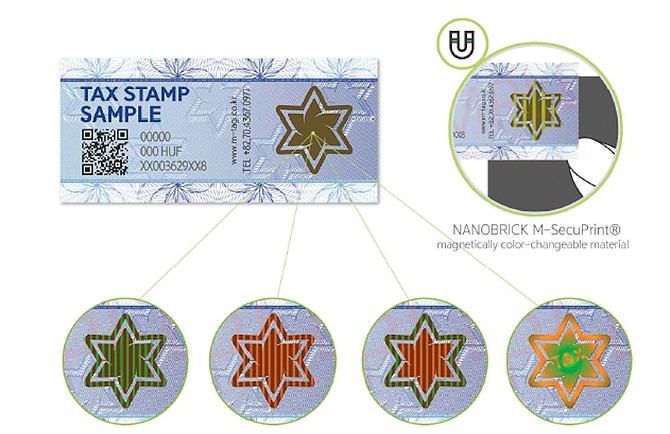 The illustration shows Nanobrick’s tax stamp demonstration sample. As its name implies, M-Currency is reserved for banknotes.
Subscriber content
Read the full article
Full access to Tax Stamp & Authentication News™ articles, newsletters and archives.