
SICPA and UbiQD Partner for Quantum Dot Security

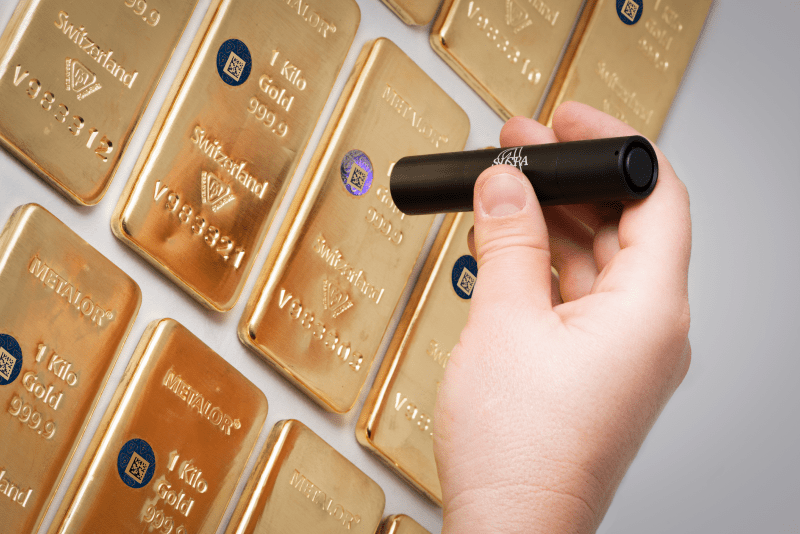
Swiss-based SICPA and New-Mexico nanotechnology company UbiQD have announced an expansion of their partnership to develop security inks based on the latter’s quantum dot technology.
Quantum dots (QDs) are semiconductor nanoparticles that exhibit high efficiency photoluminescence over a wide range of tunable colors, making them effective at imparting unique optical properties. As a result, security features based on QDs are inherently very difficult to reproduce and can be used to combat counterfeiting and strengthen security applications, said SICPA.
The two companies have been co- developing QD-based security features for the past six years. Having completed a number of technical milestones in a multi-phased joint-development effort, they are now expanding their partnership to commercialise several security applications based on the novel characteristics of UbiQD’s technology through an exclusive supply and licencing agreement.
UbiQD (the name stands for ubiquitous quantum dots and is pronounced ‘ubiqity’) was founded in 2014 by Hunter McDaniel, and raised $7 million in 2020 for the technology. It employs 25 people at its Los Alamos facility and focuses on using quantum dots in greenhouse roofs and windows. The development of the technology for use in security inks is a smaller, but growing, part of the business, according to McDaniel, and will be a key driver of revenue growth, contributing up to a quarter ($1 million) of projected sales of $3.5 million in 2022.
He commented that commercialising quantum dotes is usually limited, because they can be expensive and toxic to make. But the company has developed a way of manufacturing them more safely and at a lower cost.
‘This partnership with UbiQD has enabled us to develop cutting-edge optical and machine-readable features that we will be able to add to our robust portfolio of security inks and solutions for our clients,’ commented Scott Haubrich, R&D Director of SICPA US.
While SICPA and UbiQD’s partnership was, at first, ‘narrowly defined’, added Hunter McDaniel, UbiQD will now supply large amounts of quantum dots for SICPA for a wider range of purposes, broadening the scope of the partnership into areas such as supply chain integrity, sensitive document security or counterfeit pharmaceutical deterrence.
‘Counterfeiting is ubiquitous and there’s all sorts of efforts to prevent it’, he said. ‘This is really exciting opportunity for us to actually develop quantum dots at a large scale’.
New solution for bullion
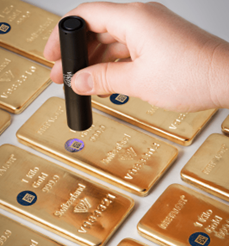 SICPA's BullionProtect® security solution for the gold market.
 Separately, SICPA has announced BullionProtect®, its security solution for the gold market, which is now being used by Indonesian bullion producer Hartadinata to provide more confidence in gold bar trading.
Despite recent volatility, the price of gold has gone up in recent years, giving criminals an opportunity to capitalise on the increase by introducing counterfeit products into the market. The most common way to counterfeit gold bars is to plate base metal with real gold, and fraudulently stamp these with the logos of legitimate refineries. Alternatively, counterfeit kilobars are made with high purity gold, but with forged serial numbers and hallmarks imitating reputable manufacturers.
BullionProtect® is designed to prevent faked or counterfeited gold bars that could be mistaken for genuine ones. It has been jointly developed with the Swiss-based refiner and coating specialist Metalor Technologies in line with LBMA (London Bullion Market Association) guidance, and is an integrated solution comprising a security image applied directly to the bar and bespoke validation devices.
The security image, or seal, is based on SICPA’s OASIS®, an ink solution based on liquid crystal pigments, which produces a colour-changing design effect when viewed under a polarising filter. The ink adds negligible weight (<20 mg) to the bar. Verification can be made in seconds, with a credit sized validator with two polarising lenses; under one the design turns green and under the other the pattern brightens.
The visual authentication can also be performed with a specific flashlight – which is best suited for poor lighting conditions or large volume verification and which reveals, through two alternating beams, the same colour and pattern changes as the credit card-sized validator. With the flashlight option, up to 100 secure seals can be validated per minute.
In addition to the visual elements, a unique QR code is also embedded in the image, readable by any smartphone.
According to SICPA, the solution enables all actors within the supply chain to authenticate precious metal products. Since 2020, more than 400,000 kilobars of gold have been marked with BullionProtect® globally.
Subscriber content
Read the full article
Full access to Tax Stamp & Authentication News™ articles, newsletters and archives.