
Mary Poppins to Help Thwart Pharmaceutical Counterfeiters

Pharmaceuticals are among the most heavily counterfeited goods on the planet and, according to the OECD and the European Union Intellectual Property Office (EUIPO) 1, are ‘attractive for counterfeiters given the high profit margins, low risks of detection and prosecution, weak penalties, and the ease with which consumers can be deceived into believing that the counterfeit products are genuine.’
A genuine pill is a highly regulated product whose efficacy depends on delivering a precise and unadulterated dose of high- quality ingredients. Not surprising then, that many technologies that have been devised to protect drugs from fraud focus mostly on coding the packaging rather than the tablet itself.
Unique identifiers (IDs) already play an important role in defending the pharmaceutical distribution chain. Manufacturers routinely print unique codes on medication packaging, which criminals try to get around by reusing authentic codes in the hope that the duplication will not be spotted.
But what if the code on the drug could be devised to have minimal effect on its efficacy and have other benefits beyond anti-counterfeiting? That was the objective for University of California, Riverside’s Prof William Grover when he set out to develop something much simpler yet just as effective as trace elements or numerical codes.
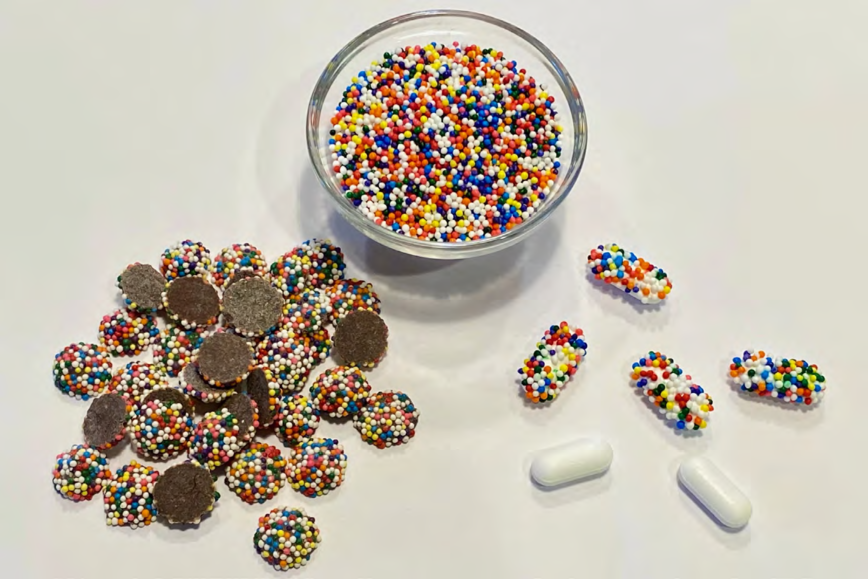
The paper ‘CandyCodes: simple universally unique edible identifiers for confirming the authenticity of pharmaceuticals’, published in Scientific Reports 2, describes the system he devised. It involves applying a food-grade adhesive to individual pills, then coating those pills with a random assortment of CandyCodes – multi- coloured decorative confectionery of tiny balls made with sugar and starch, such as the sprinkles you might find on top of an ice cream. Each pill is then photographed, and its image data is stored in a database.
When a consumer subsequently wants to check that their medication is genuine, they start by using their smartphone to take a picture of one of the pills. They then access an online portal, where that photo is compared to the image data on the drug company’s server. If a match for the pill’s specific colour combination and pattern of sprinkles is found, then the consumer is told that the pill is authentic. If no match is found they’re warned that it’s likely to be a counterfeit.
Many pharmaceutical factories already utilise quality control systems in which each pill is imaged as it goes past on a conveyor belt, so the image processing of the randomised sprinkles is not as onerous as you might imagine.
To demonstrate the feasibility of using random particles as universal identifiers, he performed a series of experiments using both physical CandyCodes and simulated CandyCodes (generated by software). He also developed a simple method for converting a CandyCode photo to a set of data strings for convenient storage and retrieval in a database. Even after subjecting CandyCodes to rough handling to simulate shipping conditions, the CandyCodes were still easily verifiable using a mobile phone camera.
The paper proposes that a manufacturer could produce at least 1017 CandyCoded pills – 41 million for each person on Earth – and still be able to uniquely identify each CandyCode.
Researchers have already shown that random physical patterns can serve as unique IDs, and several have demonstrated the use of esoteric materials such as fluorescent silk and nanoparticles to produce patterns that are highly unlikely to be duplicated by chance. These ‘physical one-way functions’ (PUFs) are generating interest as an approach to uniquely identify a pill, but require specialised equipment for reading the pill’s ID; equipment like lasers and microscopes which are not available to most consumers.
By providing universally-unique IDs that are easy to manufacture but hard to counterfeit, require no alteration of the existing drug formulation and minimal alteration of the manufacturing process, and need only a camera phone for verification, CandyCodes could play an important role in the fight against fraud in pharmaceuticals and many other products.
What’s more, when experimenting with coating pills with the sprinkles, Grover discovered an added bonus of the CandyCode system.
‘Anecdotally, I found that CandyCoded caplets were more pleasant to swallow than plain caplets, confirming Mary Poppins’ classic observation about the relationship between sugar and medicine,’ he said.
1 - www.oecd.org/gov/trade-in-counterfeit-pharmaceutical-products-a7c7e054-en.htm
Subscriber content
Read the full article
Full access to Tax Stamp & Authentication News™ articles, newsletters and archives.