
Pakistan Contemplates Track and Trace on Beverages

The manufacturing and sale of counterfeit beverages is alarmingly high in Pakistan, particularly in Punjab, the country’s most populated province. This illegal activity is continuing unabated, despite raids and confiscation of machinery carried out by the Punjab Food Authority (PFA).
According to the PFA, the number of counterfeit cold drink factories is extremely high, to the extent that original products have almost become rare in the market.
Fake beverages are being prepared with prohibited and harmful chemicals and unclean water, for supply to small shops, vendors, low-class hotels, and marriage halls.
Beside counterfeits, various international beverage companies operating in the country are involved in tax evasion activities, in collaboration with domestic sugary drink/ beverage makers, who mostly import chemicals and concentrate used to manufacture local beverages.
The Federal Board of Revenue (FBR) has begun investigating these activities, directing its field offices to assign staff to beverage factories. The staff conducts daily monitoring of the manufacturing and dispatch of concentrate by manufacturers, and the subsequent usage of that concentrate by bottlers.
According to local sources, the FBR has also started mulling over the possibility of implementing a real-time production monitoring and track and trace system on beverages, during the 2023-24 fiscal year. An announcement is expected to be made on this initiative in the government’s next budget speech.
The FBR envisages an end-to-end solution enabling the government to collect sales and excise taxes on beverages in a controlled manner. The solution would comprise a secure mark/stamp with unique identifying code, applied to unit-level beverage containers. The code would be activated inline and verified through scanning. Production reports would be made available to the tax administration system in real-time.
As frequently reported over the last few years, track and trace systems (including, in some cases, the use of tax stamps) were already rolled out in Pakistan on tobacco, cement, sugar, and fertilizer, between fiscal years 2020-21 and 2022-23, with a view to enhancing tax revenue, reducing counterfeiting, and preventing the smuggling of illicit goods.
However, the results so far of these systems in terms of increased compliance and reduced illicit trade have been mixed, at best. Therefore, the FBR would do well to apply what it has learned from track and trace implementation in these various sectors before proceeding with implementation in a fresh new industry.
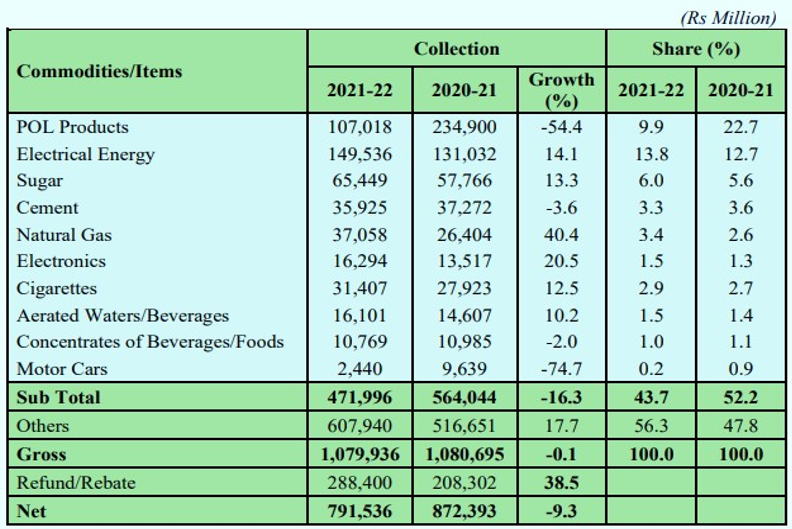
A major chunk (around 44%) of Pakistan’s domestic sales tax comes from ten sectors, including petroleum products (POL), electrical energy, sugar, cement, natural gas, cigarettes, aerated water/beverages, and concentrate of beverages/foods, which are presented here in million PKR (100 PKR = $0.36) (© Federal Board of Revenue).
Subscriber content
Read the full article
Full access to Tax Stamp & Authentication News™ articles, newsletters and archives.