
All That Glitters Is Not Shrimp


Bangladesh is known for having one of the fastest growing populations, but probably not so well-known is the fact that it is also one of the largest exporters of prawns (shrimp) in the world.
Shrimp farming in Bangladesh has been going on for centuries. However, beginning in the 1980s, shrimp production boomed, and it became known as ‘white gold’.
Today, Bangladesh boasts almost 300,000 hectares of coastal shrimp production, with huge numbers of farmers switching from rice to shrimp farming over the last 50 years. Yet, according to Seafood Network of Bangladesh, exports have been declining steadily in recent years, not only due to the global recession and the war between Russia and Ukraine – who were large buyers of shrimp – but also due to issues with shrimp fraud.
Shrimp fraud is the only one of the aforementioned issues that the Bangladesh government can at least attempt to control, which is fortunate because, left unchecked, such fraud could further threaten Bangladesh’s export market.
In 2014, Oceania, an NGO active in the fishing industry, published a study showing that at least 30% of all shrimp imported and sold internationally was not what its packaging claimed it to be. Similarly, the Guardian newspaper published a study in 2021 and found that in 30 countries, an average of 36% of all imported seafood was mislabeled so it could be sold at a higher price.
Yet another issue is that farmed shrimp is likely to contain chemicals and hormones that are not in line with regulations established to ensure imports comply with US and EU standards.
Bangladesh took in $300.3 million from frozen shrimp exports in the last fiscal year (2022-23), and $407.3 million in the year before that, representing over 70% of total seafood exports, according to the Dhaka Tribune.
As most of us in the traceability and tax stamp industry are aware, where there are profits, there are opportunities for illicit activity. Shrimp farming is no different.
One of the more common types of shrimp fraud involves injecting gelatin or other non-food substances into shrimps to increase their weight. This is not only fraudulent – since increased weight means a higher purchase price – but also a potential health risk to consumers.
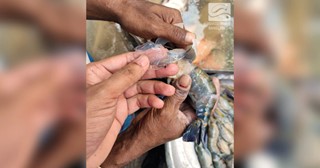
Gelatine, rice starch and other non-food ingredients are frequently used to increase the weight of shrimp before supplying to market (photo: Md Hedait Hossain Molla, Khulna, Bangladesh).
Government officials have been planning wide-scale traceability initiatives since at least 2016 to reduce the possibility of food fraud as well as safeguard the reputation of Bangladeshi shrimp world-wide.
However, therein lies the difficulty: where does the fraud take place? On the farms, at the trade intermediaries’ warehouses, or at the large exporters’ processing plants? It is very hard to pin-point a location for such activity, with one reason for this being that most of the farms are individually owned and hard to inspect on a regular basis.
Although law enforcement organizations routinely raid fish warehouses and impose fines on corrupt dealers, contamination has continued. In the last semester of 2022, alone, mobile inspectors recovered almost 2,000kg of shrimp injected with gelatin in just one small location (Bagerhat). As a result, shrimp exporters are now in fear of losing their global markets.
Enter the QR code
The good news is that, in June 2023, the Bangladesh shrimp industry decided to use QR codes as part of the e-traceability program envisioned by the government for facilitating the sharing of appropriate processing and quality information with end customers.
The project, named the Sustainable Coastal Marine Fisheries Project (SCMFP), has been led by Saroj Kumar Mistry since 2018 on behalf of the Bangladesh Department of Fisheries. Mr Kumar Mistry, who actually invented the cluster-based farming system in 2013, whereby 25 ponds (farmers) form a cluster to facilitate the measuring and control of the shrimp production process. The SCMF Project was supported by a World Bank line of credit to help develop sustainable marine fisheries, community empowerment and product monitoring.
The final QR code will carry information about the individual shrimp farmer, the shrimp cluster, the product, supply chain and, ideally, safe food certification. By using their smartphone to scan the code on the shrimp packaging, any customer can trace all participants in the pond-to-sale cycle of that shrimp product.
Both shrimp producers and the government of Bangladesh hope that the e-traceability initiative using the QR code will assure the global community that Bangladeshi shrimp is safe and of the highest quality.
Subscriber content
Read the full article
Full access to Tax Stamp & Authentication News™ articles, newsletters and archives.