
New Study Compares Four Major Illicit Trade Hubs

In 2023, Sovereign Border Solutions (SBS) wrote a series of three articles for Tax Stamp & Traceability News™ focusing on free trade zones (FTZs) and how they have become ‘hotspots’ for the illicit economy.
During our extensive research, across hundreds of resources, we discovered a new academic study1 on illicit trade in FTZs, which provides a unique perspective on the topic. The study stands out because it incorporates a broad view of illicit trade through the lens of geographic ‘hubs’, focusing on the drivers, activities, and enablers common to the FTZs identified (in this and other studies) as havens for the illicit economy.
The study identifies four geographic hubs of illicit trade and details how each of the hotspots share a conducive environment for organised crime to thrive. The four hubs are: South America (the Argentina- Brazil-Paraguay tri-border area), Central America (Panama, Guatemala, and Belize), the Middle East (Dubai, UAE), and Eastern Europe (Ukraine).
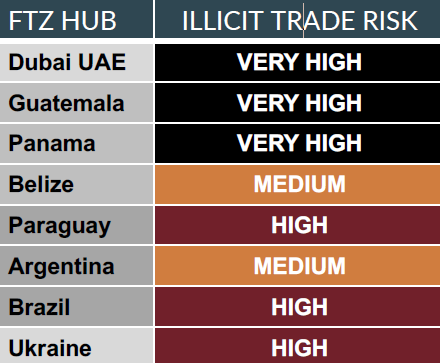
What caught our attention in this study was the comparisons between hubs, highlighting the key enablers they have in common (as illustrated in Fig 2). Dr Yulia Krylova, lead author, told us that although research into hubs has been done before, this study was a pioneer in that it added an ‘enabling function’ as a component in the research.
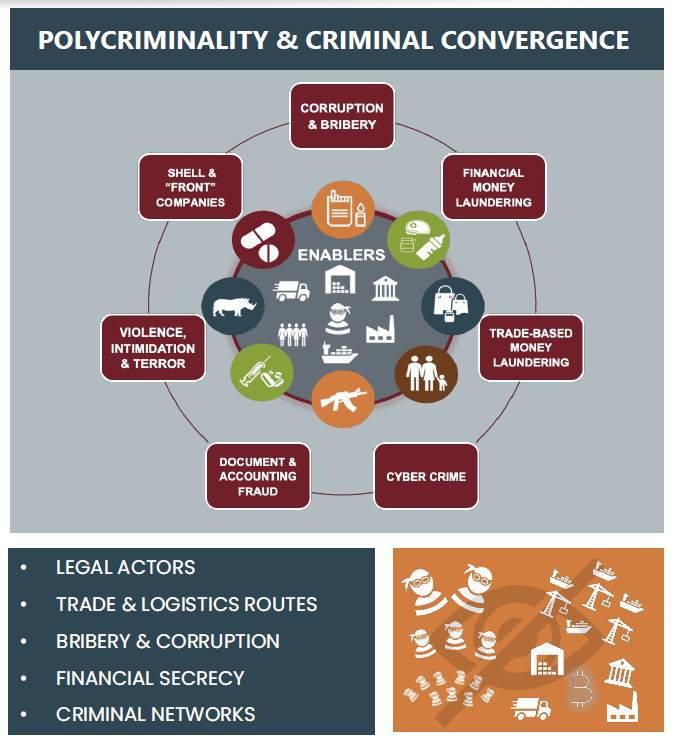
One such enabler is legal actors. As stated in the study, illicit trade relies on a wide range of shipping and logistics services and related companies from the legitimate economy, including those located outside the hubs.
For example, as shown in Fig 3, taken from the study, key US FTZs are identified as supporting shipments of illicit cigarettes through Central America.
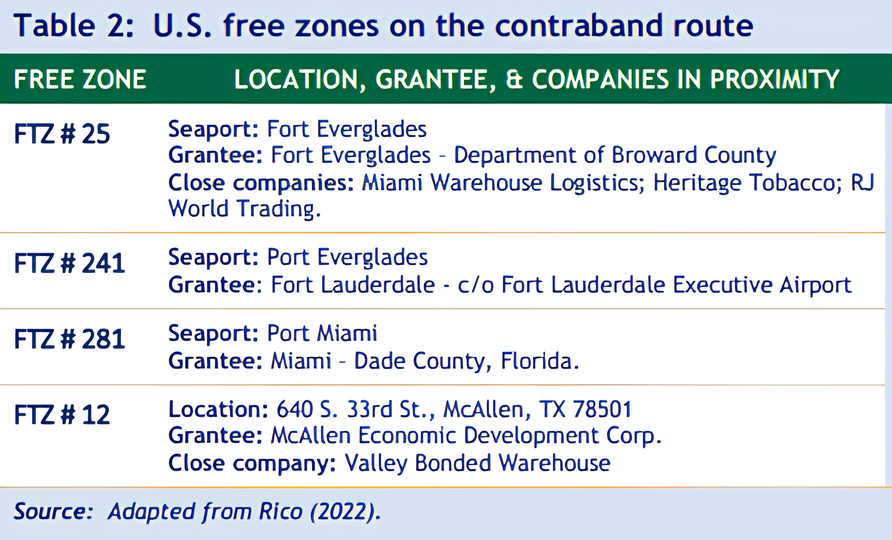
Fig 3 US free zones on the contraband route (source: ‘Smugglers’ Paradises in the Global Economy: Growing Threats of Hubs of Illicit Trade to Security and Sustainable Development’).
‘After arriving in Panama, the cargo is forwarded to intermediary free trade zones in other countries, including the United States as well as Central American free zones,’ said the study.
‘The movement of cigarette containers between different free zones has a common denominator: the cargo is always declared as ‘in transit’. The authorities in transit ports do not exercise any control over this cargo as it is the responsibility of the authorities in the final destination port. In reality, most of this illicit cargo is rerouted somewhere else along the path to avoid customs control in the destination port.’
Another enabler refers to trade and logistics routes. David Luna, Co-Director of the Anti-Illicit Trade Institute (one of the organisations behind the study), and Founder and Executive Director of the International Coalition Against Illicit Economies, told us that 90% of global trade moves through maritime routes and various criminalities use the same routes as legitimate trade. Of the 500 million containers shipped every year in the global supply chain, less than 2% are inspected by any Customs authority.
Other commonalities
Some of the other key commonalities between hubs, as identified by the study, include:
A more prominent role for illicit trade hubs in sanctions evasion, following a recent increase in international and national sanctions imposed on various countries. Sanctions evasion schemes often rely on complex business structures, multiple front companies registered in offshore havens, and various levels of ownership and management that are constantly changing to avoid detection.
A negative spillover effect on trading partners and countries situated along illicit supply chains, in the form of drastic increases in criminal violence, illicit consumption, corruption, poverty, socioeconomic inequality, reduced public health, and environmental degradation.
Provide a fertile ground for smuggling and counterfeiting – illicit hubs operate with little transparency, limited due diligence and limited background checks on companies. There is also a lack of proper technology to identify and detect illegal merchandise. Many businesses in free zones accept large volumes of cash for wholesale trade, while banks and money transfer services in these zones facilitate money laundering activities.
Disrupting the hubs
The study outlines several steps for disrupting illicit trade hubs, based on a foundation of enhanced international cooperation at the policymaking and enforcement level.
These steps consist of supply chain management policies; capacity building and training for anti-illicit trade actors (including customs and border guards); anti-money laundering policies; free trade zone regulations; public-private partnerships to address illicit supply chains; awareness raising and education; and trade analytics, technology, and innovation (such as artificial intelligence and blockchain).
International cooperation
Of the nine countries featured as hubs in the study, Argentina, Belize, Brazil, Guatemala, Panama, Paraguay, Ukraine, and the UAE are working towards international cooperation, ratifying major international conventions and treaties regulating illicit trade in drugs, arms, engendered species, hazardous waste, and cultural property.
On the other hand, only Panama, Brazil, and Paraguay have ratified the World Health Organisation’s Framework Convention on Tobacco Control (FCTC) Protocol to Eliminate Illicit Trade in Tobacco Products (ITP). In general, the study finds that the impact of the ITP on illicit tobacco trade has been limited, due to a relatively low ratification rate. As of April 2023, compared to 182 parties of the FCTC itself, the ITP had only been ratified by 66 countries, including the European Union.
In terms of coordinated policies, the study highlights areas where countries should come together to develop harmonised penalties for smuggling, uniform customs rules, and harmonised tax policies that remove incentives for smuggling goods between countries. For example, in 2016, the countries of the Gulf Cooperation Council agreed to implement a harmonised excise tax rate of 100% on all tobacco products.
The study also notes the importance of international organisations such as the World Trade Organisation and World Intellectual Property Organisation, in promoting transparency and strengthening border and regulatory controls through enhanced cooperation. Furthermore, international development organisations such as the World Bank and International Monetary Fund increasingly use good governance practices and anti-corruption policies as conditions for financial aid.
Law enforcement cooperation through mutual legal assistance and extradition treaties, joint operations, technical assistance, and information sharing is also critical for the disruption of cross-border illicit trade transactions, advises the study. A good example is the Trade Transparency Unit programme under the US Department of Homeland Security’s Immigration and Customs Enforcement, which exchanges trade data with similar units in Argentina, Brazil, Guatemala, Panama, and Paraguay.
Supply chain management
Another key area for disrupting illicit trade hubs relates to the management of product supply chains.
The study observes that private-sector companies use a wide variety of supply chain management solutions to tackle the diversion of goods from legitimate supply chains. These include due diligence and know-your-customer policies, licensing, record-keeping requirements, and technologies for ensuring supply chain transparency and product traceability.
Track and trace systems are used in sectors such as aviation, retailing, pharma, and tobacco. However, as far as the study is concerned, the track and trace systems currently in place for tobacco products have ‘multiple inefficiencies’.
First, very few of them are interoperable, meaning that information cannot be shared between countries.
Second, they are rarely used effectively, as evidenced by the European Union track and trace system, which came into operation in 2019. Although the system collects information on the legal supply chain of cigarettes and roll-your-own tobacco, it was criticised in the European Parliament for not providing information on illicit tobacco products and their diversion from the legal supply chain. According to the study, although the EU system works across multiple jurisdictions, it does not cover the majority of illicit products identified in this region.
Ongoing work to expand the study
Dr Krylova explained there are currently four research teams working in different languages around the world and partnering with universities to expand the research capacity needed for the second stage of the study. Possible regions for inclusion are Sub-Saharan Africa, Southeast Asia/ China, Caucasus, and the Amazon Basin. A book is also in the works that will be a collection of the regional reports compiled for the study.
Meanwhile, the original study is currently being launched across the globe. In September 2023, its findings were shared at the INTERPOL International Law Enforcement Intellectual Property Crime Conference, to be followed, in April 2024, by a presentation at the OECD Working Party on Countering Illicit Trade. The US launch is planned for 2024 at the George Mason University, which is home to the two organisations behind the study: the Terrorism, Transnational Crime and Corruption Center and the Anti-Illicit Trade Institute.
A final word from SBS
In SBS’ last article, we focused on the current ‘stovepipe’ paradigm with respect to efforts to combat illicit trade, highlighting the lack of strategy, collaboration and coordination across the many illicit trade archetypes and related stakeholder entities. We likened the current state to a football team with no playbook, where each player does their own thing, and opined that if a disruptive change is not made, illicit trade will become a permanent and increasingly dangerous fixture in the global economy.
We also identified six building blocks necessary to enable the paradigm shift needed to counter illicit trade in FTZs, which align with the steps laid out in the study. These are: policy development and alignment; standards and best practice; knowledge archive and fact base, innovative technologies; market-based drivers, incentives, and dis-incentives; and collaboration amongst key stakeholders across all illicit trade archetypes.
We believe this multi-faceted approach is critical but also think that technology can serve as a disruptive accelerator for the change that is so desperately needed.
The study adds a new facet to the extensive body of evidence regarding the illicit economy. Nevertheless, what is still needed is something that change guru John Kotter would describe as ‘a compelling event’ or ‘burning platform’ to serve as a catalyst for marshalling all the efforts, resources and innovations needed to drive transformative change and address this growing threat.
1 - ‘Smugglers’ Paradises in the Global Economy: Growing Threats of Hubs of Illicit Trade to Security and Sustainable Development’, published September 2023 by the Terrorism, Transnational Crime and Corruption Center and Anti-Illicit Trade Institute, at the George Mason University’s Schar School of Policy and Government, Virginia, USA. https://traccc.gmu.edu/wp-content/uploads/2023/09/HIT-Final-Report-4.pdf
Sarah Smiley is the Director of Trade Policy and Regulatory Compliance of Sovereign Border Solutions (SBS), a global consultancy specialising in trade, customs policy, and related systems and technology.
Subscriber content
Read the full article
Full access to Tax Stamp & Authentication News™ articles, newsletters and archives.