
Sustainable Colour for a Sustainable Authentication Industry

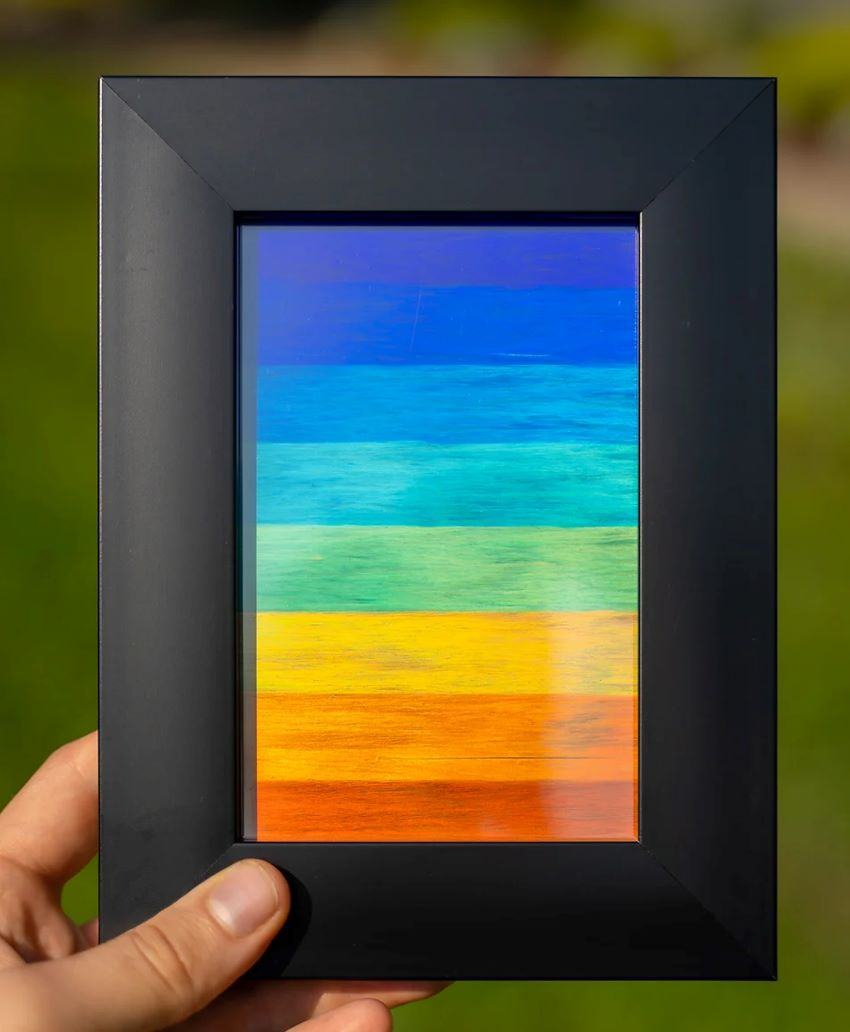
Authentication and anti-counterfeit technologies rely heavily on inks and surfaces that produce colour, sending visual signals to the viewer to help differentiate between real and fake products. But in a world where toxin additives in manufacturing processes are becoming increasingly unacceptable, we take a look at two companies that are developing a new generation of sustainable colour.
The colour we perceive from inks and surfaces made in the traditional way from dyes and pigments are acting like a reflective colour pass-band filter. A portion of the spectrum of colour in the visible light falling onto the ink is absorbed by the organic dye or chemical pigment and the remaining part is reflected back, imparting the apparent colour to the surface that the ink is printed on.
But nature has found another way to create colour (see AN August 2021). Pikaia is a species of extinct marine animal that 500 million years ago evolved structures to reflect specific colours rather than the full spectrum of white light.
This was not colour from pigments or dyes that selectively reflects certain wavelengths of light while absorbing others, but structural colour which arises from the periodic structure of molecules and compounds. Naturally occurring structural colours also account for the markings on fungi to defend against attack and on birds to attract mates.
Meta Materials
The first company to consider is Meta Materials Inc (previously Nanotech Security Corp), which has been a pioneer in optically variable devices (OVDs) for the past decade.
In a recent webinar hosted by Reconnaissance International (see sister publication Holography News®, May 2023), Meta explained how it has taken microscale structures to create the foundations of 3D display pixels, and then combined them with nanoscale plasmonic structures that filter out light it doesn’t want. This allows it to capture and select the colour of light it does want to use.
Plasmonic structures are engineered to control optical waves along the boundary between a dielectric (an insulator whose electric charge can be shifted without flowing) and a metal (a conductor whose electric charge can flow).
Meta’s process results in a sandwich structure that is applied to a surface, allowing the light that falls on the surface to be controlled in terms of its wavelength (allowing you to control the colour) and amplitude (giving rise to the intensity, or brightness) of the colour generated.
Cypris Materials
Cypris Materials, a company based in California, is developing a new generation of sustainable structural colour that, it claims, broadens the colour gamut while simplifying manufacturing, application, and formulation.
While the paint, inks and coatings industry has made significant strides to improve its environmental footprint, it still has some way to go to improve upon how it creates colour in its products.
That’s where Cypris has stepped in. The company began in Berkeley, California after co-founders Matt Ryan and Ryan Pearson were awarded Activate Fellowships to join the Cyclotron Road programme at Lawrence Berkeley National Laboratory.
Harnessing the potential of structural colour, Cypris’s coating platform helps companies and individuals redefine the capabilities of colour. According to the company, their polymers are backed by an extensive patent portfolio that can unlock customisable colours and effects that can only be achieved through their formulation.
Having the ability to create bespoke designs and imagery that are both eye- catching and technically challenging to simulate or copy is a cornerstone of authentication technology – making it easy for the viewer to recognise and difficult for the fraudster to counterfeit.
A good place to finish this article is with one of Cypris’s product statements: ‘the first safe and sustainable structural colour palette, free of toxic pigments and dyes’. Perhaps that sentiment could be extended to the whole authentication industry.
Subscriber content
Read the full article
Full access to Tax Stamp & Authentication News™ articles, newsletters and archives.