
Round-Up – Brands, Traceability and Sustainability


CSM Tech Signs Deal for Gabon Timber Traceability
CSM Tech, an Indian IT consulting company, has signed a multi-million-dollar contract with the Ministry of Economy and Recovery in Gabon to implement a forest e-governance system, along with log timber traceability and an electronic timber trade platform.
The goal of the system is to ensure the continual tracking, monitoring, availability, and supply of logs to the 84 wood processing companies in the Nkok Special Economic Zone (SEZ), a multi-sectoral industrial park situated on 1126 hectares of land. The system will also be able to forecast timber provenance over a 20-year period, CSM Tech said in a statement.
As an initial step, the Gabon government has introduced radio frequency identification (RFID) to identify legally produced logs and wood products, in collaboration with SEZ.
Gabon is a predominantly forest-covered nation where timber is an important export item after oil and manganese, accounting for 9% of exports in value terms. The illegal production and trade of timber are at the root of environmental degradation, leading to the loss of habitats and biodiversity, and an increase in greenhouse gas emissions. It is therefore critical for the Gabon government and SEZ to ensure an uninterrupted supply of raw materials and keep a vigil on the traceability of logs.
Guerlain Partners with Sidel to Prevent Counterfeiting
Guerlain, one of France’s oldest perfume and cosmetics houses, is using the latest traceability technologies from French machine makers Sidel to fight counterfeiting.
Sidel, which is a subsidiary of global packaging company Tetra Pak, has supplied Guerlain with its robotic packing/palletising combi solution for bottles in cartons.
‘Sidel embedded every aspect of product labelling, control and rejection that we requested and adapted the end-of-line process to suit our traceability needs,’ said Aurélien Bernier, Investment Capacity Project Manager at Guerlain.
Each carton, case and pallet is tagged using barcodes and labels which are read, recorded and aggregated into the Guerlain central database.
According to Sidel, the champagne and cognac industries have also selected the technology for its traceability and aggregation capabilities, as has the pharmaceutical industry, which uses even more complex and stringent serialisation and track and trace systems, with real-time marking, tracking and aggregation.
proteanTecs Collaborates with BAE Systems for ‘Zero Trust’ Electronics Supply Chain
proteanTecs, which works in deep data analytics for the monitoring of advanced electronics, has announced a collaboration with BAE Systems (a British multinational arms, security, and aerospace company), to enable a ‘zero trust’ supply chain for defence and critical infrastructure.
When asked what ‘zero trust’ meant in this content, Uzi Baruch, Chief Strategy Officer for proteanTecs, explained that ‘basically it is the ability to understand that the device you are using is actually as intended. It uses the original design, it was assembled properly, and it went through the entire verification process’.
Typically, proteanTecs’ Universal Chip Telemetry (UCT) has been used for predictive maintenance. But, in this case, BAE Systems wanted to apply it to component integrity and as an anti-counterfeiting measure.
‘Our technology is not limited to the production stages, you can actually use it over the lifetime of the device. Meaning in actual application, you can measure and monitor how the device is performing, so we give full coverage from different aspects,’ said Baruch.
‘One aspect is ensuring the supply chain, the way you build, test and produce the devices is secure. You are able to track the device performance over the production and assembly stages, and make sure that it is built, used and verified exactly as intended.
‘Another aspect is around device authenticity, making sure that when you ask the device who it is, you always get the same answer, based on the device DNA.’
According to Paul Karazuba from Semiconductor Engineering: ‘the counterfeit chip market is sizeable and growing with a worldwide value estimated at $75 billion in 2019. Those counterfeits are believed to have been integrated into more than $169 billion worth of electronic devices. Recent confirmed incidents of counterfeit parts found in electronic systems include defibrillators, airport landing lights, and braking systems for high-speed trains’.
Co-op to Employ Phygital Recycling Solutions for Water Bottle Traceability
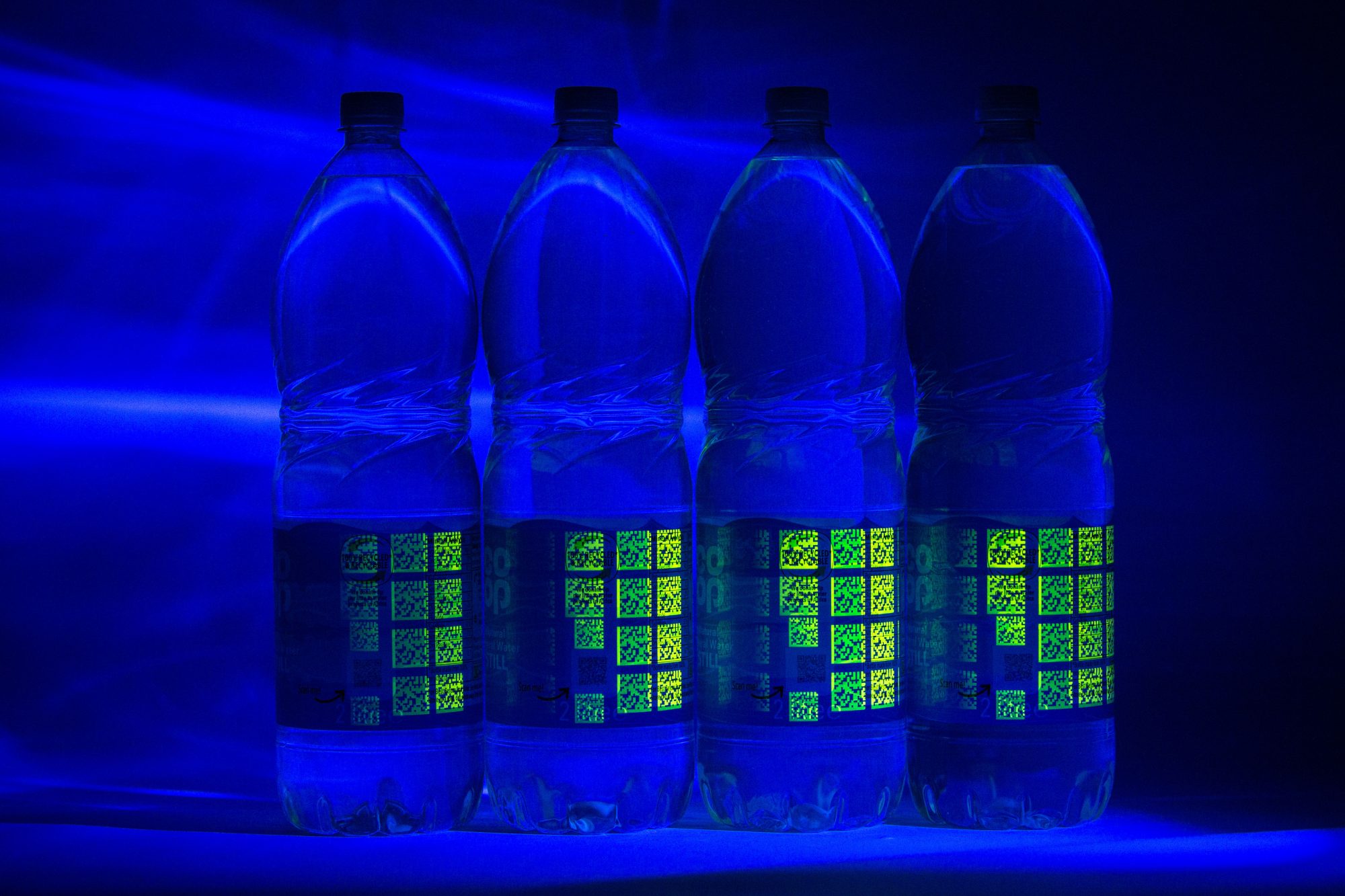
While the UK government’s deposit return scheme will not come into effect in England, Wales, and Northern Ireland until 2025, brands are gearing up to improve the nation’s recycling rates. In a latest initiative, UK retailer Co-op is set to apply UV-based QR code tags to its PET 2-litre spring water bottles.
Developed by recycling start-up Polytag, the technology offers brands, retailers, and legislators data about packaging lifecycles in the circular economy, enabling them to identify the location of where their packaging is being disposed of and where it is being recycled.
The QR codes are GS1-compliant and will be applied to the pack labels by Co-op’s bottled water supplier at standard label application speeds. The codes take consumers to a Co-op landing page detailing information about the retailer’s sustainability and charitable commitments. Within the code there is a serial number which can be used to handle fraud-proof rewards, assign loyalty points and secure deposit redemptions.
A UV tag layer, invisible to the human eye, and printed by Tipografic using UV flexographic inks, is also applied across the label. This layer enables barcode level information to be captured in the recycling centre and uploaded to Polytag’s cloud-based analytics dashboard, providing the retailer with real-time insights on whether packaging is recycled, and in what volumes.
According to estimates, out of 13 billion plastic drink bottles consumed in the UK every year, only 7.5 billion are recycled.
FibreTrace Working with Circular Systems for Cotton Traceability
FibreTrace, the traceability provider, and textile innovation company Circular Systems are working together to implement traceability into Texloop cotton globally.
Launched by Circular Systems in 2018, Texloop is a worldwide textile recycling platform. Texloop Recycling upgrades post-industrial and pre/post-consumer cotton textile waste into recycled cotton fibre.
According to Circular Systems, recycled cotton from Texloop uses up to 99% less water than conventional cotton, 54% less energy, and emits 20% less carbon. In 2022, the European Commission announced a principal strategy to improve textile products’ social and environmental impact on the EU market by 2030.
TÜV SÜD Announces Collaboration with Applied DNA Sciences
TÜV SÜD America Inc, the testing, inspection/audit, and certification body, has announced a new collaboration with Applied DNA Sciences to offer their scientific traceability services as a complement to TÜV SÜD’s product traceability solution.
Through Applied DNA’s CertainT® platform, provided as a complement to TÜV SÜD’s traceability services, clients can access a portfolio of services, including factory audits, supply chain mapping, product verification at various supply chain entities, and cotton source verification.
Subscriber content
Read the full article
Full access to Tax Stamp & Authentication News™ articles, newsletters and archives.