
Encounters with Counterfeits of Digital Security Features
The Switzerland-based Thymaris group is a second-generation family business that has been operating since 2000. The business provides integrated authentication technologies (software and machines) on a global scale. Its mission is to close the security gap in existing barcode serialisation infrastructures.
Thymaris’ solutions are based on the principle of integrating serialisation and authentication into every barcode. For example, its AMACENA® Secure product authentication technology for high-volume security printing combines a full-stack serialisation suite with anti-counterfeiting technologies integrated as an additional layer into the barcode.
This technology is currently being used for a tax stamp programme, for an annual production of multiple billions of stamps, all of which carry an AMACENA Secure barcode.
In addition to the physical security features applied to the tax stamp by the security printer, the barcode itself carries two levels of security: a top level and a base level (Fig 1). The top level carries digital, barcode- based features for traceability and rapid, high-volume screening in the field. These features are accessible to all users via the use of a smartphone app.
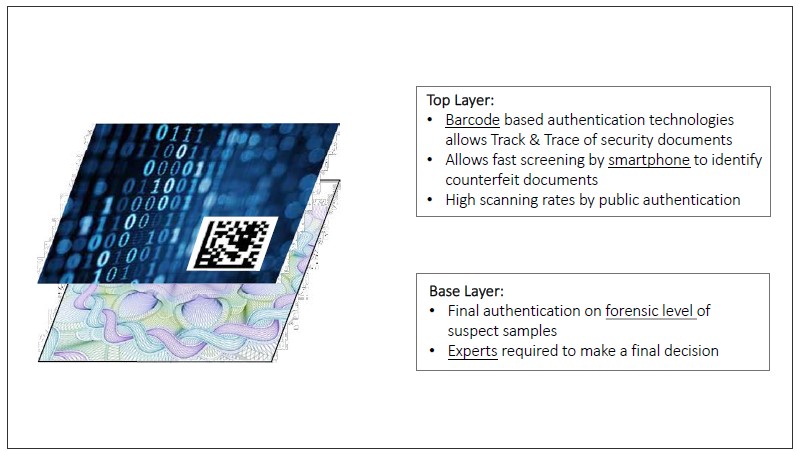
On the base layer are material-based forensic features, used by experts in cases where a final decision is required on the authenticity of a stamp.
These tax stamps are produced by a security printer in the UK. To process the high data flow related to the billions of produced stamps, a high- performance computer, located on the printing premises, is used for data volume compression.
When the codes are applied to the tax stamps, an image of each code is captured with a camera, and it is from this image that the computer creates a signature containing a small fraction of the data held in the full code. The signature is then uploaded to the cloud, which users can access by means of a smartphone app.
The system also comprises a dashboard for data queries, as well as for analysing the different counterfeit codes found in the market.
Types of counterfeits found
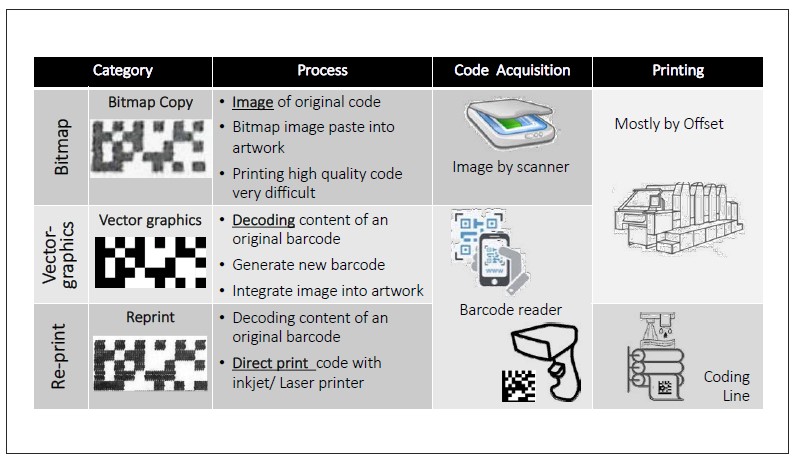
The first type of counterfeit codes that have been picked up in the market are bitmap copies (Fig 2). These consist of scanned copies of real codes pasted into an artwork and, usually, printed by offset. This method is used for rather low-end counterfeits given that the resulting quality is poor.
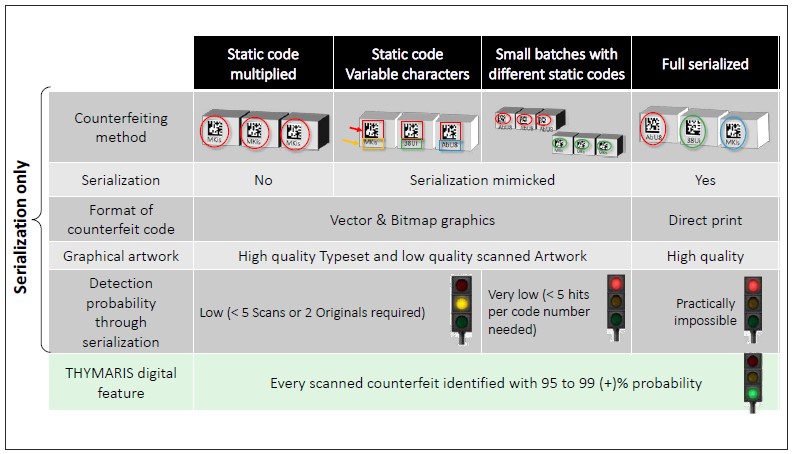
A second possibility are vector graphics, which consist of decoding the content of an original barcode, generating a new barcode, and integrating it into the tax stamp artwork. The decoding can be done via a barcode reader on a smartphone.
For a higher quality copy, the whole artwork, including the code, needs to be typeset as a new vector graphic. Printing is also usually carried out by an offset print press.
The third method of counterfeiting involves decoding the content of an original barcode via a barcode reader, and then directly reprinting the code with a variable printer such as inkjet or laser within a code printing line.
Counterfeiting equipment
What equipment does the counterfeiter need for high-end serial code printing?
They prefer equipment which is cheap, even though we have found the printing quality of counterfeits to be rather good. Coding time is not so important, even if it takes 10 seconds to make one code. Such operations usually take place in low-cost countries with several people working in parallel. Counterfeiters prefer equipment to be portable, so they can take it with them if they need to make a quick getaway.
In terms of printing presses, a simple Google search comes up with dozens of companies offering low-cost, good quality laser printers, but handheld inkjet printers also do a decent job. For really high-end counterfeits, roll-to-roll or higher quality equipment can be obtained.
Counterfeit detection
How difficult is the detection of counterfeits based on serialisation only? As Fig 3 shows, very difficult – in fact, in some cases virtually impossible.
While counterfeiters know that the product should be serialised, the act of serialising is not so easy. So they usually concentrate on making the label look good, using vector or bitmap graphics, with high quality artwork and typeset. The barcode, however, remains unchanged and static.
Some counterfeiters do mimic the serialisation, however. They keep the barcode as is, but create fantasy numbers and letters for the human-readable text that is usually found next to the barcode. These fantasy numbers have the effect of duping lazy inspectors who don’t use their scanners into thinking that the code is serialised, and therefore legitimate.
A more sophisticated way of mimicking serialisation is to create a whole series of serial numbers. For instance, counterfeiters could bribe someone in a distribution centre, download serial numbers from the system, or scan a series of codes, and then make small batches of 50-100 different fake codes. Before shipping the codes, the counterfeiter can mix them up in the container so that the inspector, at first glance, thinks they are serialised. With this method, it becomes almost impossible to identify fake codes based on serialisation.
And then there is full serialisation, which means that counterfeiters again collect a whole range of genuine serial numbers and reproduce them on a printing line, as described earlier. This makes fake codes impossible to detect based on serialisation alone.
The situation changes, however, when the Thymaris digital feature is used, since this allows for the screening of a high volume of codes to identify counterfeits. Additionally, the physical features allow every scanned counterfeit to be identified with almost 100% accuracy.
Counterfeit data
Using a dashboard, we are able to classify and cluster the different volumes and characteristics of counterfeit codes found in the market, in order to create counterfeiter profiles.
Currently, the dashboard consists of manual entries, but we will shortly introduce an electronic version that provides a management cockpit for operating the entire system. The dashboard incorporates various functions, including a map for geographically locating different queries, and a filter for querying by numbers, locations, times, types of equipment, etc.
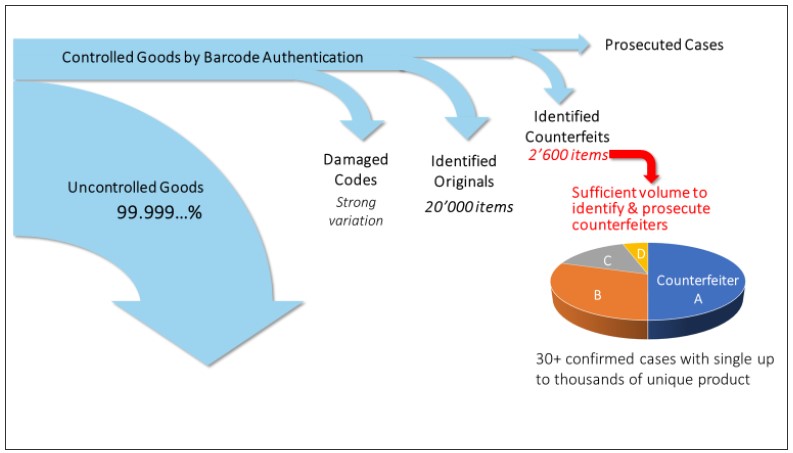
Fig 4 provides a breakdown of the scanning data we collected between February 2022-23.
Most of the codes in this multibillion-code market are unscanned – they just go through. Of the codes that were checked, we identified 20,000 original codes, and 2,600 counterfeits – which is a huge volume compared to the usual one or two counterfeits that are picked up. Such a large volume allowed authorities to identify and prosecute the culprits, with more than 30 operators having so far been taken out of business, whether because of a single counterfeited item or because of thousands of fake items.
The implementation of such a comprehensive tax label infrastructure requires time. Therefore, the volume and effectiveness of scans is still rising, with more and more identified counterfeits making the life of the criminals harder.
How many counterfeits?
How big a number of counterfeits should be identified in order to ensure effective outcomes? The answer depends on your objective.
If the objective is to take counterfeiters out of business, a relatively low scan rate is already sufficient – you just need enough counterfeits to be able to do a profiling of the culprits, which would correspond to a 0.5-5% scan rate.
But if the objective is to protect the customer you need a very high scan rate, such as in the pharmaceutical industry where no counterfeit must land in the hands of a patient. In this case, the required scan rates can only be achieved if it is a legal requirement to perform scans.
Counterfeiters are permanently striving to improve their ‘products’. But we are monitoring the scanning data coming in from inspectors on a daily basis, in order to quickly identify counterfeit cases and be in a position to help implement effective countermeasures.
Subscriber content
Read the full article
Full access to Tax Stamp & Authentication News™ articles, newsletters and archives.