
A World First – 3D Structurally Coloured Objects

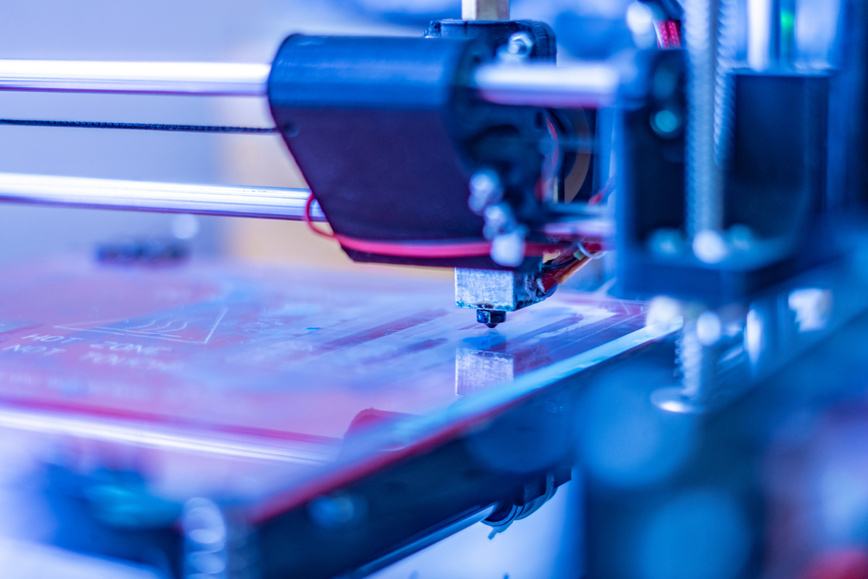
Professor of Polymer Chemistry Markus Gallei and his doctoral student Lukas Siegwardt, from Saarland University, Germany, have created ‘perfect polymer particles’ (ie. particles of an identical size and shape) with a hard centre and soft shell, for building 3D-printed structurally coloured objects – something that has not up to now been possible.
Methods to artificially fabricate materials showing structural colours have been around since 2001 but have been restricted to ultrathin films of fractions of a millimetre thick.
‘Conventionally, these materials are processed in industrial presses or film rolling equipment, to produce thin polymer films that can change colour,’ explained Professor Gallei. The colour of the film can be changed by pulling the material, applying an electric voltage across it, changing the temperature, or modifying the pH. ‘You can essentially control the colour of the material on demand,’ he said.
Additionally, these materials are almost infinitely transformable, something that until recently was limited by the fact that they could only be produced as ultrathin films.
In the form of 3D objects, however, they could be used in a wide range of applications, including anti-counterfeiting features or measurement sensors. The particles can be manufactured with highly specific properties, while also being easy to shape.
Underlying chemistry
The starting material for the research consisted of standard polymers, such as polystyrene or poly(ethyl acrylates), which are commercially available as a white, tacky powder.
During the printing process, the perfect particles of the polymer arrange themselves into regular patterns, with different colours depending on the spacing between the particles.
The soft shells of the individual particles melt to create a flowable mass that surrounds the hard cores. Pulling on an object changes the distances between the individual core particles, which affects the way the material interacts with visible light, thus changing the observable colours.
The hard perfect particles move within the soft surrounding medium and arrange themselves into a new pattern. Markus Gallei described this molecular-level rearrangement as being like ‘squeezing honey from out between the individual particles.’
A lot of lab work
But preparing such materials for 3D printing involved a lot of lab work for Lukas Siegwardt. ‘I modified the material so that it could actually be printed. It took me months to find the right composition and the right recipes,’ he said.
There were two tough nuts to crack in the process. First, Siegwardt had to modify the flow properties of the powdery starting material so that the particles didn’t clog the printer’s nozzles and the material could be printed with as little residue as possible.
‘The second issue was the material’s thermal properties. In an industrial press, the starting material must withstand about 120°C. But in a 3D printer, the material experiences temperatures of 140°C and sometimes as high as 200°C,’ said Siegwardt, explaining the demands placed on the material. ‘Many of the materials I tested during those months were simply not up to the job.’
The research is published under the title ‘Complex 3D‐Printed Mechanochromic Materials with Iridescent Structural Colors Based on Core–Shell Particles’, by Advanced Functional Materials (2023).
Structural Colour
Structural colour is different to traditional dyes or pigments. While the latter are mostly based on the absorption of light, structural colour is derived from microscopic structures that reflect specific light wavelengths. Unlike organic-based dyes and pigments, inorganic-based structural colour does not fade.
Structural coloration in nature is found on microscopically structured surfaces that are fine enough to interfere with visible light, with some structural coloration occurring in combination with pigments.
For example, peacock tail feathers are pigmented brown, but their microscopic structure makes them also reflect blue, turquoise, and green light, and they are often iridescent.
Industry tries to mimic structures found in nature to apply in different applications. However, such structures are complex and reproducing them is complicated and time-consuming.
Subscriber content
Read the full article
Full access to Tax Stamp & Authentication News™ articles, newsletters and archives.