
Chemists Develop a New Chiral Structure Creation Method

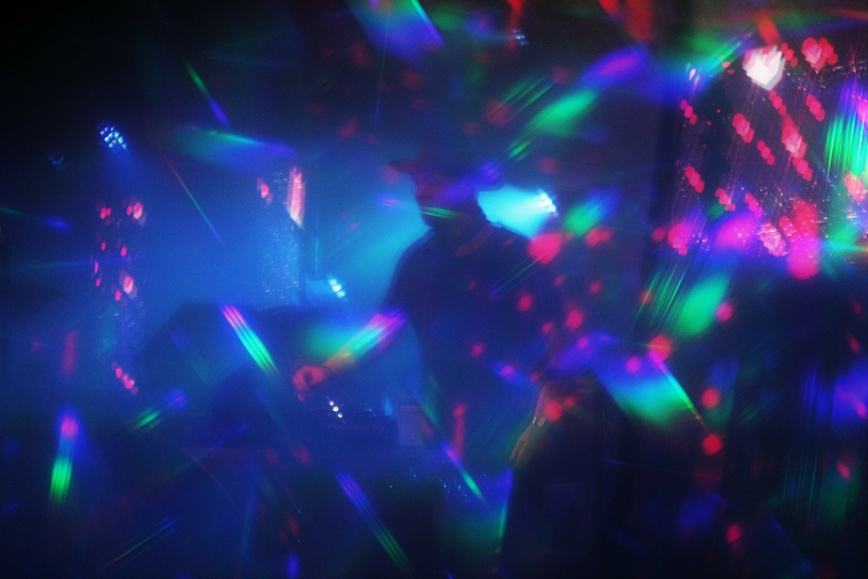
A strange feature of the molecular building blocks of human (and other species) biology is that at a molecular level they exhibit a behaviour called ‘chirality’ – from the Greek word for handedness. Just like your right hand mirrors your left but will never fit comfortably into a left-handed glove, amino acids and sugars come in both right- and left-handed versions.
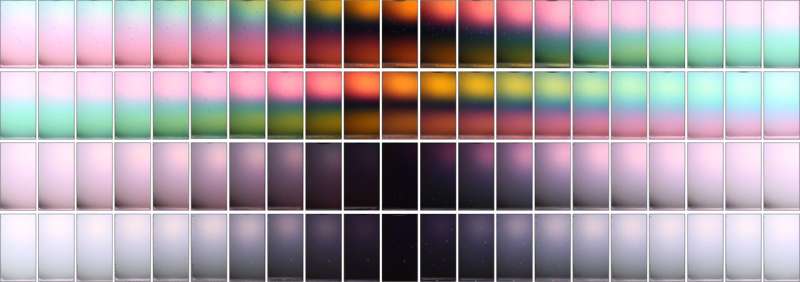
Vibrant colours exhibited by a dispersion of magnetic nanoparticles when subjected to magnetic fields with varying chiral distributions, as observed through polarised lenses (© Yin Lab, UC Riverside).
The interaction between circularly polarised light and chiral molecules results in different absorption or scattering patterns for left-handed and right-handed circularly polarised light. This phenomenon is known as optical chirality. Optical chirality has crucial applications in various fields, including chemistry, biology, medicine, and now perhaps as an anti-counterfeiting device.
A team from the University of California, Riverside (UCR), has discovered that the distribution of a magnetic field is chiral in and of itself 1. They found that chirality exists in the magnetic field lines generated by all magnets.
Yadong Yin, a professor of chemistry, who led the team, said, ‘we discovered that the magnetic field lines produced by any magnet, including a bar magnet, have chirality. Further, we could also use the chiral distribution of the magnetic field to coax nanoparticles into forming chiral structures’.
The researchers used the magnetic field’s chiral distribution to induce chiral structures in nanoparticles. In the past, scientists have utilised a process called ‘templating’, which necessitates a chiral molecule taking up a precise location on a device, making it difficult to apply to industrial processes such as anti-counterfeiting devices.
The researcher said, ‘to gain an optical effect, you need a chiral molecule to occupy a particular place on the device. Our technique overcomes this drawback. We can rapidly form chiral structures by magnetically assembling materials of any chemical composition at scales ranging from molecules to nano- and microstructures’.
The researchers’ method uses permanent magnets that rotate in space to generate chirality. They transfer chirality to achiral molecules (molecules that do not express chirality) by means of doping, ie. incorporating guest species such as metals, polymers, semiconductors, and dyes into the magnetic nanoparticles that induce chirality.
The findings could have applications in anti-counterfeit technology, sensing, and optoelectronics. The method can rapidly detect chiral or achiral molecules as a means to differentiate between authentic and fake products.
The research was funded by a grant from the National Science Foundation in the US, and the UCR Office of Technology Partnerships has filed a patent application related to the work.
Subscriber content
Read the full article
Full access to Tax Stamp & Authentication News™ articles, newsletters and archives.