
Structural Colours Tell Their Own Stories


Structural colours (surfaces structured to control the interference of light), featured strongly in the ‘New Optical Techniques for Security’ section of the Optical & Digital Document Security™ conference (ODDS), which took place in Prague, Czech Republic, in April 2023.
OVD Kinegram
In the paper ‘Structural Colours – Powerful & Self-Explaining Design Elements’, Eduard Miloglyadov from OVD Kinegram told the story of his team’s work to make colours without using inks.
The structural colours created cover the whole visible spectrum and can be made part of a transparent security feature as well as being observable in reflection on metal layers. The motivation for the research is not only to remove the reliance on inks but to create distinctive security features that are perfectly integrated with the design, without the need for mechanical registration.
Eduard presented three examples of structural colours. Two are based on sub-wavelength cross gratings, exploring engineered profiles with either a transparent high-refractive index layer or an embedded aluminium layer to realise non-rainbow colours. The third example utilises binary structures.
The first example consists of nanostructural colour that uses crossed subwavelength gratings, but with an asymmetric grating profile (Fig 1). Combining this with a thin aluminum layer and embedding it in a higher refractive medium generates a defined colour.
Due to the grating asymmetry, both structures show different colours and the final effect makes use of crossed grating properties and a plasmonic reflection spectrum, which both depend on the feature size.
Eduard and his team have created a whole palette of colours depending on grating period and absolute grating height. As the plasmonic behaviour affects the colour, it is strongly dependent on the asymmetry of the grating. A mirrored version of the same palette shows significantly different colours in some cases.
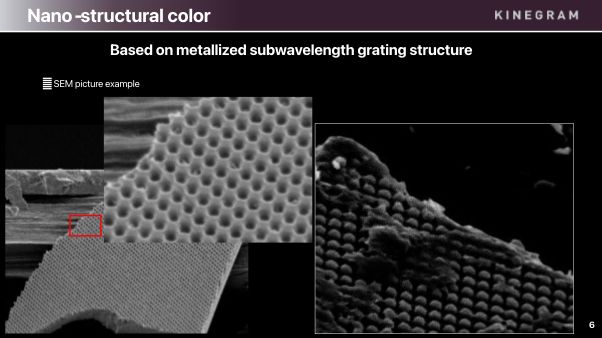
Fig 1 – nanostructural colour (© OVD Kinegram).
The second colour effect case (stable colour) uses random microstructures with an extremely well-defined binary profile. The effect is somewhat similar to interference in a thin layer, but with the difference that interference happens not between two reflecting layers but as an interference of two reflections from a single binary structure. The wavelength at which the constructive interference occurs is defined simply by the height of the binary structure and refractive index of the embedding media.
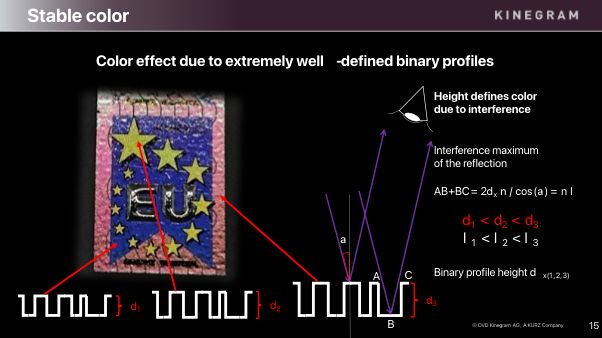
Fig 2 – stable colour (© OVD Kinegram).
The generic example in Fig 2 shows design elements in the magenta, yellow and blue. They are combined with an achromatic 3D effect showing the letters ‘EU’ appearing to protrude from the plane of the sample.
The final method of creating colour with a transparent structure uses a special version of refractive index changes. The effect is based on linear subwavelength diffraction gratings in combination with a transparent high-refractive index layer.
There are several instances in security print design where colour change is not desired when the document is rotated. In this case, crossed gratings will have the advantage that the obtained colour will remain nearly constant when the security document is rotated (Fig 3).
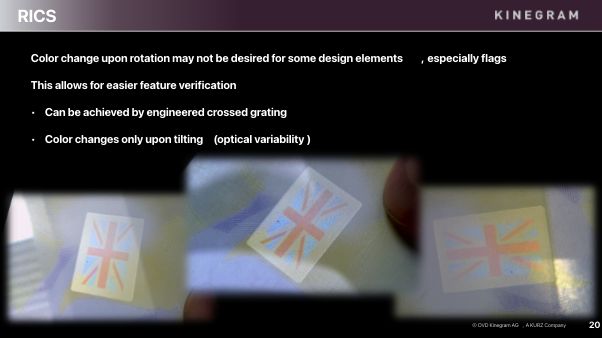
Fig 3 – refractive index changes (© OVD Kinegram).
This is key for use in depicting national flags where a design element requires well-defined colours, such as the generic example in Fig 3 illustrating the Union Jack embedded in a polycarbonate card. The colour does not change on azimuthal rotation of the design, keeping it recognisable at any azimuthal orientation.
While each of the three techniques would make a powerful choice for integration in a self-explaining and story-telling design, there is also the option for combining two technologies in the same design to realise unique secure optical variable colour elements for image verification.
Chromatir
Caleb Meredith described a method for making iridescent security films exhibiting tuneable colour-shifting appearances with wide angular colour separations.
Caleb has since spun the research out of Pennsylvania State University and started Chromatir with Lauren Zarzar. Their work was awarded a Phase I SBIR grant ($275,000) by the National Science Foundation in 2022.
This year at ODDS 2023, Caleb gave an update on his work on iridescent OVDs with structural colour produced by cascading reflections with concave microstructures. He outlined the methods deployed to fabricate moulds for mass-replication and highlighted the efforts of two researchers from his group to develop features with enhanced colour vibrancy (Fig 4).
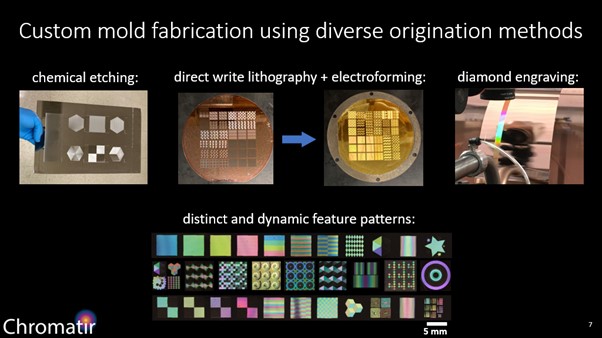
One of the researchers Caleb reported on, Nate Sturniolo, ran an experimental investigation and optical model of the structural colouration produced from total internal reflection interference within 3D microstructures. Ray-tracing simulations coupled with colour visualisation and spectral analysis techniques were used to model, examine, and rationalise the iridescence generated for a range of microgeometries, including hemicylinders and truncated hemispheres, under varying illumination conditions.
An approach to deconstruct the observed iridescence and complex far-field spectral features into its elementary components and systematically link them to ray trajectories that emanate from the illuminated microstructures was demonstrated (Fig 5).
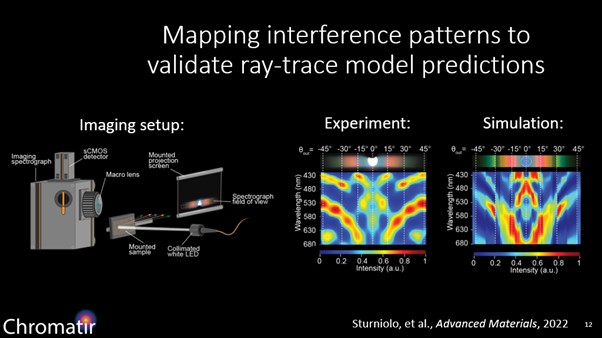
Fig 5 – mapping and predictions (© Chromatir, Nate Sturniolo).
The results were compared with experiments wherein microstructures were fabricated with methods such as chemical etching, multiphoton lithography, and grayscale lithography.
Microstructure arrays patterned on surfaces with varying orientation and size lead to unique colour-shifting optical effects and highlight opportunities for how total internal reflection interference can be used to create customisable reflective iridescence.
Nate’s work was published in Advanced Materials (2022) 1.
Another researcher whose work Caleb highlighted was Krista Hirsch and her work on tuning reflected colour through evanescent wave absorption within microstructures.
Here, structural colour generated by total internal reflection (TIR) interference at microscale concave interfaces is tuned via evanescent wave absorption by dyes. Using quantitative angle-resolved spectral analysis combined with ray tracing simulation, Krista demonstrated that the multibounce TIR trajectories enhance the efficiency of dye absorption and usefulness in modulating the reflected colours. Depending on the absorbance spectrum of the dye used, and the amount of dye coated at the TIR interface, the angle-dependent reflected colours can be predictably altered 2.
Like many before him, Caleb recognises the benefit of using the ODDS conference series as the ideal testing ground for sharing innovations with like-minded technical colleagues in a supportive environment.
The next ODDS will take place in April 2024 in Lisbon, Portugal.
www.opticaldigitalsecurity.com
1 -https://onlinelibrary.wiley.com/doi/full/10.1002/adma.202210665
2 - Hirsch, K., et al., ChemRxiv (2023).
Subscriber content
Read the full article
Full access to Tax Stamp & Authentication News™ articles, newsletters and archives.