
Diamonds are a Counterfeiter’s Worst Enemy

Exploiting the uniqueness derived from the inherent randomness of industrial processes is not a new approach for anti-counterfeiting technologies, but a new breed of physically unclonable functions (PUFs) might just be a step too far for counterfeiters to spoof.
In previous editions of Authentication & Brand News™, we have reported on random variations in gold nanoparticles (June 2022), minuscule dots of silk-based material (May 2023), and fluorescent nanofilms (July 2023), as the basis for PUF research. And now a group of researchers, led by Dr Zhiqin Chu of the Department of Electrical and Electronic Engineering of the University of Hong Kong (HKU) has used diamond-based PUFs to create anti-counterfeiting labels.
The team, which also includes Prof Lei Shao of the School of Electronics and Information Technology of Sun Yat-sen University, and Prof Qi Wang from Dongguan Institute of Opto-Electronics of Peking University, made these labels by planting tiny artificial diamonds – known as diamond microparticles, on a silicon plate using chemical vapour deposition (CVD). CVD, which is used in the semiconductor industry to produce thin films, is a vacuum deposition method used to produce high-quality, high-performance materials.
Optical PUFs have attracted growing attention as anti-counterfeiting tools because of their inherent randomness, controllability, and diversity in tuning their optical features. Their colour, intensity, and lifetime can be modulated by a range of external stimuli, making them promising candidates in preventing product fraud.
Despite their potential, most optical PUFs show unsatisfactory stability in complex environments, according to the researchers, and most of them are produced by wet chemical synthesis in solution, which might be incompatible with industrial manufacturing.
The diamond microparticles, which are processed in their solid state, are produced in a full range of shapes and sizes, and form a unique pattern when scattered on the silicon substrate. The researchers claim that the patterns created are impossible to replicate and therefore scatter light in a random way. In other words, they form a unique ‘fingerprint’ that can be scanned using a phone.
The second level of uniqueness, and hence security, comes from the fact that these diamond microparticles have defects known as silicon-vacancy (SiV) centres.
SiVs give diamond microparticles a unique optical property: they emit near-infrared photoluminescence when a green light is shone on them, which makes them easily identifiable. These unique optical signatures can then be combined and digitised into codes of very high complexity and security that can be read by a simple smartphone scanner or a confocal fluorescence microscope.
Importantly, these diamond-based labels are highly suitable for use in commercial products as they are extremely tough – in the trials they withstood heat, the action of chemicals and physical damage. They are also relatively inexpensive, costing $1 to make 10,000 labels of dimensions 200 µm × 200 µm.
The labels are ready to be used commercially, says Dr Chu, adding that the team›s next step is ‘to focus on the practical application’.
Because of the perceived value associated with the rare mineral, ‘diamond anti-counterfeiting will be favoured in various high-end products such as jewellery, luxury goods, electronic products, and automobiles,’ said Dr Chu.
The paper is published in the journal ‘Nature Communications’ 1.
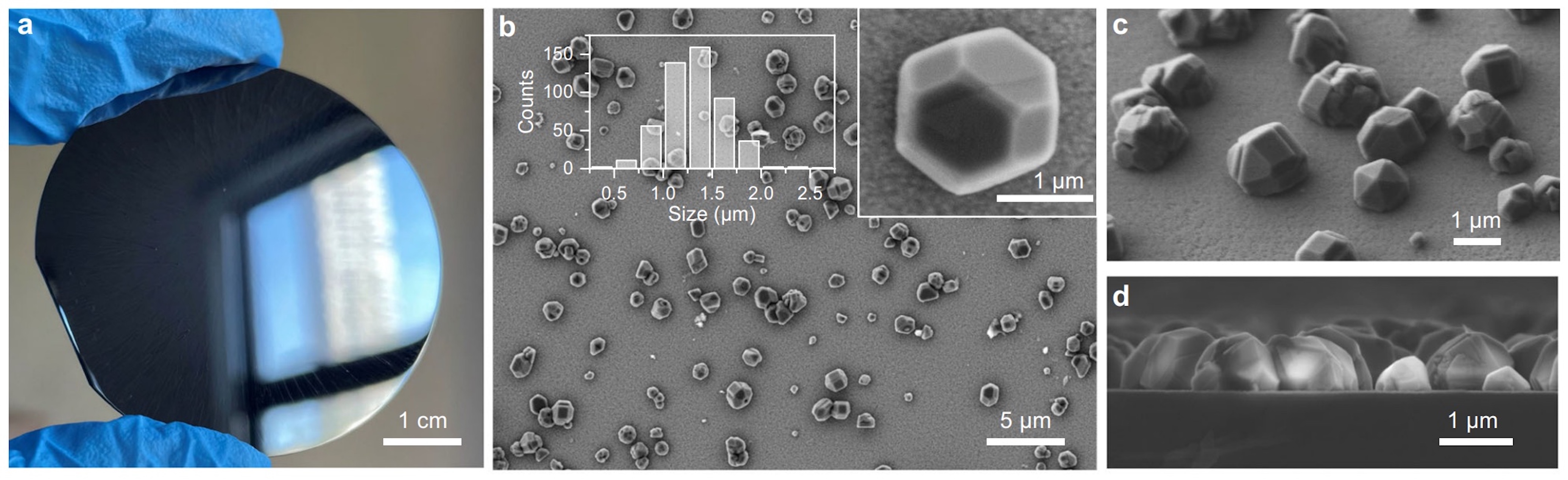
Diamond PUF label (© University of Hong Kong).
Subscriber content
Read the full article
Full access to Tax Stamp & Authentication News™ articles, newsletters and archives.