
News in Brief


OVS Offers ‘Game Changer’ for Celebrity Fashion Collections
Nitches Inc, a designer and manufacturer of high-end clothing and accessories, has announced the launch of its patent-pending Owner Verification System (OVS) to prove the authenticity of its exclusive capsule collections created with celebrities and influencers. Nitches also plans to make OVS available to other businesses that want to protect their merchandise from counterfeiting in the near future.
Nitches sews a unique QR code into every item it manufactures. Buyers can scan these codes to register their products with a phone number and/or email address on Nitches’ proprietary mobile app to verify ownership and originality. The app works on both iOS and Android devices.
After the QR code is scanned, the OVS stores the information on a blockchain to ensure the transaction is completely safe and secure. Blockchain will also allow Nitches to protect its NFTs (non-fungible tokens) of its clothing items in the digital world, leading to increased interactivity and more secure ownership.
‘Because we are working with celebrities and our collections only include 200-300 select clothing items, it was paramount that we safeguard our intellectual property and luxury brand,’ said John Morgan, Nitches’ CEO. ‘We believe our verification technology will be a game-changer for other companies worried about counterfeit products in industries from fashion to sports equipment to home furnishing.’
Amcor Invests in PragmatIC for Sustainable Packaging
Multinational packaging firm Amcor has made a strategic investment in lowcost electronics company PragmatIC Semiconductor. The $5 million investment is part of Amcor’s ongoing efforts to identify and develop advanced sustainable technologies for the packaging industry.
UK-based PragmatIC focuses on developing ultra-low-cost electronics based on flexible and integrated circuit solutions.
Its ConnectIC family of radio frequency identification and near-field communications (RFID/NFC) integrated chips has the potential to store and transmit information to various devices, including smartphones, when added to product packaging.
The technology can be used to deliver smart packaging applications across the product lifecycle, from manufacturing and supply chain management to consumer engagement and even material recovery.
The investment from Amcor forms part of PragmatIC Semiconductor’s Series C funding round, in which the company raised more than $90 million.
HP Indigo Secure and Jura Install First Digital Secure Press
HP Inc has installed its newly imported HP Indigo 6K Secure Digital Press in Nepal, for the local production of tax stamps, ID cards and other secure documents. This marks the first installation of the press for a government authority.
The press, which was launched in 2021, combines a set of digital features originated by Jura, which can create multiple security layers and variable elements in one pass. This includes the application of unique identifiers in multiple locations on a label, package, or tax stamp, for a full authentication and track and trace solution.
The press is built upon HP Indigo’s proprietary liquid electrophotography (LEP) digital colour printing technology and uses the largest set of inks available to the security digital printing industry (including HP Indigo’s spot colour, silver, digital-colour-shifting, invisible UV, MICR and tagged inks).
With this technology, Nepal will generate an estimated savings of NPR 9 billion ($75 million) a year, said Bikal Paudel, Executive Director of Nepal’s new Security Printing Centre.
Next Generation Barcoded Postage Stamps
Lake Image Systems, a leader in print quality and variable data verification and camera inspection solutions for the security, labels, and commercial print industries, has implemented its in-line camera inspection system at the Dutch security printer, Royal Joh Enschedé, to validate variable data matrix codes printed on the new, trackable postage stamp for Deutsche Post.
By printing a unique, two-dimensional data matrix code on every stamp, Deutsche Post can now easily detect reused or forged stamps to prevent fraud, track a letter throughout its network, and provide customers new digital and philatelist services with the barcoded stamp.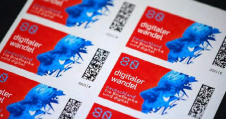
In early 2021, Royal Joh Enschedé was one of the few select security printers to print these revolutionary new stamps and selected Lake Image Systems and its parent company, Domino Printing Sciences, to print and inspect the variable matrix code on every stamp during the production process.
Domino implemented its K600i inkjet printing system to print variable matrix codes on sheets containing 90 stamps, whilst Lake Image implemented its DISCOVERY Multiscan3 camera inspection system to read, verify and grade every code according to the required specifications.
Both systems were mounted inline onto a Mabeg sheet feeder, running at 2,000 sheets per hour. If a variable matrix code on a stamp failed the inspection, the entire sheet is automatically diverted and discarded.
At the end of every run, DISCOVERY Multiscan3 produced a detailed report on the status of every stamp, allowing Royal Joh Enschedé to check for possible duplicates and to generate a manifest file which would be sent to Deutsche Post.
This file enabled Deutsche Post to release the stamps knowing precisely which codes were active and, more importantly, which were not.
A more detailed case study on the project can be found here www.lakeimage.com/casestudies/royal-joh-enschede/.
IBM Files US Patent for AIBased Dilution Detection
Tech giant IBM has filed for a US patent (Application No 20210326900) on a method for detecting when a medicine has been diluted, a well-established method for carrying out pharmaceutical fraud.
The method relies on the use of artificial intelligence and machine learning to analyse various physical, spectral, optical and/or chemical characteristics of a sample.
It could be used to detect counterfeits as well as incorrectly prescribed doses at the point of administering a drug, according to the patent, which describes various detection devices that could be developed from the concept.
There have been multiple incidents in which counterfeiters have taken a genuine medicinal product, watered it down and produced many times more vials or bottles of a drug, some in the original containers and some in fake or re-used packaging.
The presence of the active ingredient and legitimate packaging can make this sort of falsification hard to detect, generally requiring forensic examination of the contents.
Subscriber content
Read the full article
Full access to Tax Stamp & Authentication News™ articles, newsletters and archives.