
SICPA’s New Platform for Mobilising Excise Revenue


After more than 15 years’ experience in developing and operating SICPATRACE® – a leading product authentication and traceability solution for government authorities – SICPA has launched its latest technology platform: SICPATRACE® Evo.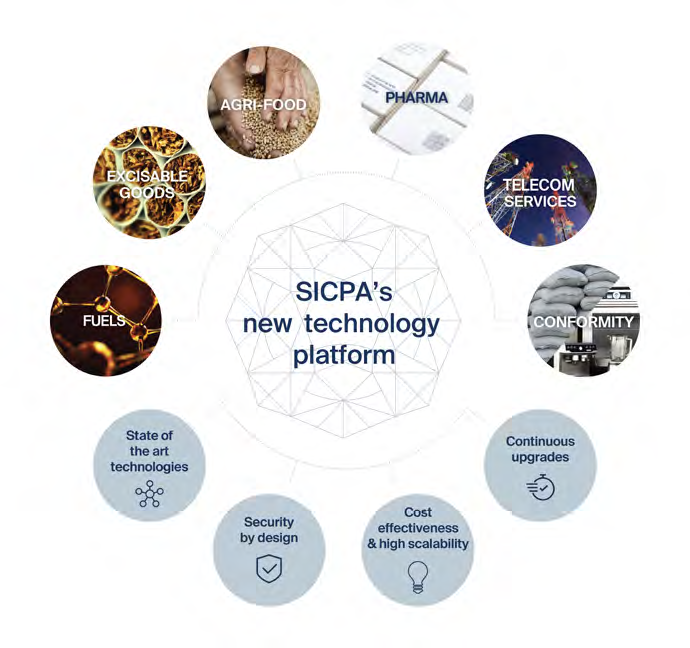
The platform is based on what SICPA describes as the most advanced and reliable software for data services, applications, production monitoring equipment and inspection devices. It supports authorities by immediately detecting non-compliant products and operators, thereby enabling informed decision-making and quick response times by enforcement teams.
The ultimate goal of the platform is to mobilise revenue on excisable goods and other regulated products by reducing revenue gaps, broadening the taxpayer base, and lowering the level of illicit trade.
The name ‘SICPATRACE Evo’ refers not only to an evolutionary step in the SICPATRACE product authentication and traceability system, but also to the ability of the new platform to continuously evolve, thus offering revenue authorities the benefit of regular upgrades.
‘Traceability contracts often last for five or 10 years so it is important that authorities don’t get stuck with a system that does not evolve,’ explained Ruggero Milanese, Director, Product Marking and Traceability Solutions, SICPA, speaking at the recent Tax Stamp & Traceability Forum™ in Malta. ‘We are planning to have a process in place so that new features developed for one customer can be automatically available for all our customers according to a release management process.’
The platform’s ability to continuously evolve, as well as to be highly scalable, are due to the use of microservice architecture.
‘Instead of having monolithic software solutions, we provide lots of small components that work together and, wherever possible, we can add or modify components in an agile way,’ said Ruggero.
Beyond tobacco and alcohol
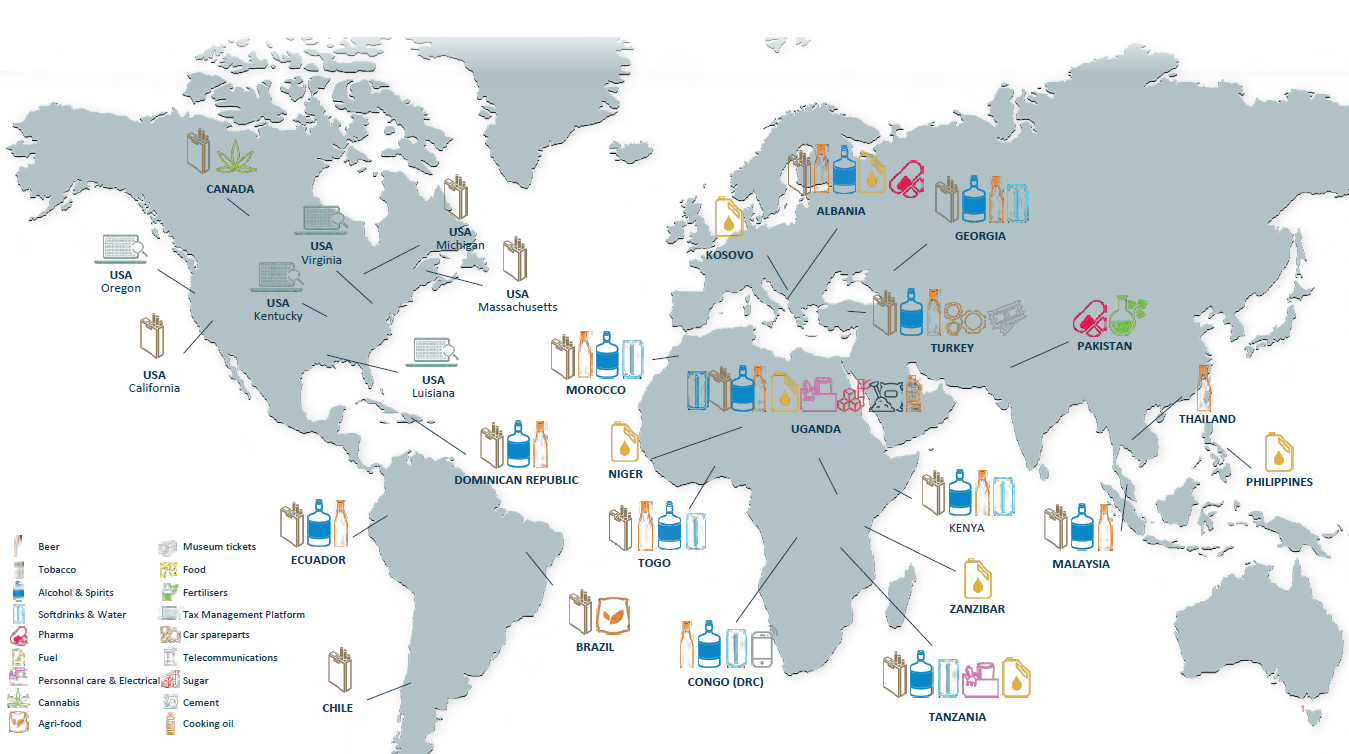
The platform aims to extend the range of goods to be tracked and traced beyond the usual goods subject to excise duties, such as tobacco and alcohol. The solution already includes label formats and other marking technologies suited to products such as bottled water, soft drinks, cosmetics, sugar, cement, cooking oil, fertilisers, and fuel, which are subject to very different and sometimes challenging production environments.
Such a broad universe of products is effectively illustrated in Fig 1, which shows the wide variety of product categories and geographical areas currently covered by SICPA tax stamp and traceability systems.
Multiple users – multiple system integration
SICPATRACE Evo offers both an on- premises solution (where software is installed and operated on computers located on the government authority’s premises), or a cloud-based multi-tenancy solution. With multi-tenancy, the platform can host both revenue agencies and other interested government entities wishing to benefit from the solution – protected by strict data segregation protocols.
SICPATRACE Evo can also integrate with existing revenue authority systems for tax management and electronic invoicing, using APIs (application programming interfaces) to create connections between different programmes. SICPA has developed a set of APIs for different functionalities, which allow revenue authorities to compare and reconcile data, as well as identify cases of non-compliance.
To illustrate this capability, Ruggero described how integrating the SICPATRACE Evo production monitoring system with the revenue authority’s sales/tax declaration system could reveal under- declaration cases.
The three reports in Fig 2 show a series of vertical bars indicating month-by-month production data, overlaid by a green line representing sales/tax declarations.
.png) Fig 2: integration of SICPATRACE Evo with revenue authority’s tax return system.
Fig 2: integration of SICPATRACE Evo with revenue authority’s tax return system. The report on the left shows that while production data is not fully correlated with sales/tax returns due to sales seasonality, it will likely be ironed out over time. So, no instances of non-compliance can be discovered in this case.
In the middle report, however, we clearly observe a sudden drop in the green line, indicating that the taxpayer is selling less product. However, the vertical bars show no corresponding drop in production levels, thereby implying that the taxpayer may be building huge amounts of stock, which seems suspicious. Such a scenario would likely trigger a visit by inspectors to the taxpayer’s premises to observe actual stock levels and ascertain whether an under- declaration of sales has occurred.
In the third report, we observe slowly declining tax returns, overlaid on slowly increasing production levels. The declining tax returns alone would not necessarily trigger suspicions of non-compliance, but their combination with the corresponding production data reveals that further investigation is warranted.
Beyond borders
Apart from facilitating the exchange of information between different government entities and systems within a country, SICPATRACE Evo enables information sharing across authorities in other countries.
‘We are building this solution because we currently provide systems to countries among which there is a significant amount of cross-border trade,’ explained Ruggero. ‘The solution consists of carrying out product marking and accounting for the country of origin, and then automatically sending the data generated from this exercise, via the SICPATRACE Evo server, to the authority of the destination country. So the destination country has full, real- time visibility of the products that are being manufactured abroad and imported into its territory.’ He added that such a solution could also be considered a precursor for the global information exchange requirements of the WHO FCTC Protocol to Eliminate Illicit Trade in Tobacco Products.
‘The ability to exchange data with other authorities, wherever there is cross-border trade, is the fundamental element of the FCTC Protocol, which is perhaps missing in some of the programmes in place today, so it is important to take steps to initiate this exchange,’ said Ruggero. ‘The FCTC Secretariat plans to provide some tools to do that, but, in the meantime, revenue authorities should take measures to ensure their systems are equipped with the ability to generate, capture and share traceability data on imported and exported products.’
Subscriber content
Read the full article
Full access to Tax Stamp & Authentication News™ articles, newsletters and archives.