
Nano-Structured Features – Research Continues


Brand owners of mass-produced goods have for some time had access to a range of anti-counterfeit devices, such as holograms, security inks and nano-optic effects that provide clear visual signals of authenticity to consumers.
But now, a Swiss research group is challenging these overt techniques with nano-structured surfaces that are designed to be invisible in natural light and only searchable with specific techniques such as ultra-violet or laser illumination.
The team, based in Switzerland, has published a feasibility study in the journal Applied Nano, titled 'Low-Cost Nanostructured Thin Films as Covert Laser Readable Security Tags for Large-Scale Productions Tracking' 1.
The study describes a fabrication process that makes use of the mature nanotechnology called template synthesis to shape thin track-etched polymer film into covert laser readable tags, combining random self-organised structures with organised patterns. The team has developed techniques to drastically limit the number of fabrication steps and keep fabrication costs low, while remaining open to numerous adjustment parameters.
Reading the tags depends on covert laser readable (CLR) surface structures. A simple laser pointer is all that is needed to reveal hidden information in the form of a speckle pattern. Speckle features then reveal the physical structure of the surface, with the advantage that the lower their structural resolution, the larger the speckle’s resolution. In this way, the laser beam is like a microscope that easily reads structures at micro to nano metric scales.
While CLR holograms are already available that can combine overt images with covert text, logos or designs, the research team claims there are currently no practical CLR structures available for highly mass-produced products such as pharmaceuticals or OEM parts, since they must meet three rigorous criteria:
Their cost must be marginal in relation to the price of the product.
Identification must be simple, fast and cheap.
Adjustable fabrication parameters must be numerous to allow precise coding of the different batches.
The work presents the fabrication feasibility study of a low-cost, easily readable, self-organised nanostructured CLR flexible tag (named n-CLR by the group) with numerous adjustable parameters, which fulfil the above criteria.
The starting materials for n-CLR fabrication, described in the paper, are hydrophilic nano-porous polymer thin films (or membranes) nanostructured by track-etch technology. The most common polymers for track-etched membranes are polycarbonate (PC), polyimide (PI) and polyethylene terephthalate (PET). The parameters available for adjustment are:
1. Polymer materials: PC, PI and PET.
2. Film thickness, ranging from 6 to 50µm.
3. Pore diameter, down to 10nm.
4. Pore density, from a few 109 pores/ cm2 down to single pore structures.
The first processing step is to sputter a gold layer of about 50nm on one side of the membrane by a conventional physical vapour deposition (PVD) technique, under shadow masks if needed.
The second processing step is to fill up the pores by the template synthesis technique, ie. by an electrochemical deposition of metal into the pores. The electrodeposition (ED) itself was performed in a dedicated cell which is presented in the image.
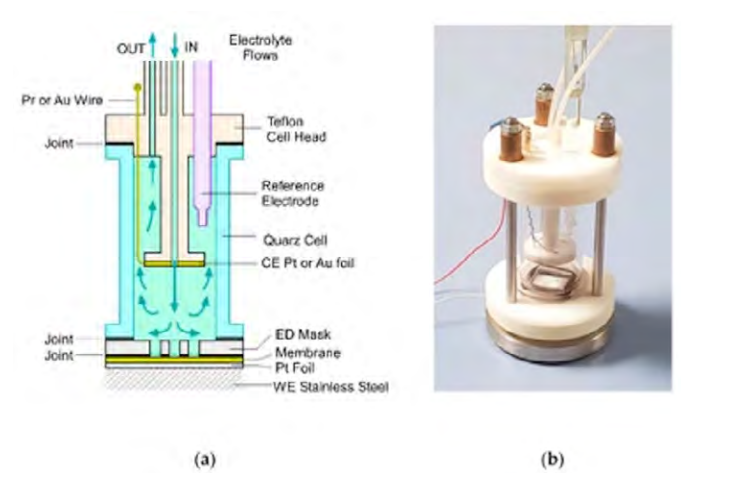 (a) scheme of working principle (b) the ED cell (©MDPI).
The paper concludes that the work conducted demonstrates the feasibility of n-CLRs as low-cost nanostructured flexible tags for the tracking of large-scale fabrication products. n-CLRs fulfil the three rigorous criteria of marginal cost, simple identification, and numerous adjustable parameters.
It also highlights a surprising feature of a ‘blind’ area in which speckle is completely inhibited that suggests a unique, high-contrast optical parameter only achievable in n-CLR thin film structures. No doubt future work will aim at patterning this ‘blind’ area – continuing the research contest between overt and covert!
1 - https://www.mdpi.com/2673-3501/2/4/23.
Subscriber content
Read the full article
Full access to Tax Stamp & Authentication News™ articles, newsletters and archives.