
Jura Workshops Look to the Future of Security Printing


Jura Security Printing recently held a series of practical workshops in Budapest, Hungary to discuss the future of security printing. This was one of the first events in the last year or so that customers and suppliers had physically travelled to in order to meet up in person, so it was filled with plenty of energy and enthusiasm.
The attendees came from Austria, Czech Republic, France, Lithuania, Germany, Netherlands, Slovenia, Oman, Yemen, UAE, Saudi Arabia, UK, and of course Hungary.
The workshops were aimed at designers and business professionals dealing with Jura’s solutions on a day-to-day basis. (Jura is a developer and supplier of security prepress software and hardware solutions, from graphic design to print-ready platemaking. Its patented personalisation techniques and covert security features are designed for banknotes, passports, ID cards, tax stamps and other secure documents. Its latest developments include new features with smartphone apps for security print authentication and brand protection.)
One workshop of particular interest to this newsletter covered the topic of new features in digital security printing for the high and semi-security markets. During this workshop, it became clear to the attendees that a very different approach was needed in the digital domain compared to the conventional security printing domain.
The workshop was presented by Jura’s Takej J Turk, Security Printing Expert & Solutions Architect, and Lior Rubinstein, DSD Operations Manager & Integration Specialist.
They began by setting out the differences between digital and conventional printing, with some of the key benefits of digital printing identified as low setup costs and the possibility to personalise and serialise individual printed items with ease.
The downsides, however, included the limited range of inks available for digital compared to traditional printing, as well as the wide availability of digital printing technologies – which naturally doesn’t lend itself well to security printing.
The presenters stressed that converting commercial digital printing into digital security printing requires the development of dedicated security features that leverage the strengths of digital printing (such as ease of serialisation/personalisation), while restricting access to the technology and workflows used to produce those features.
To this end, Jura has developed a set of variable security features for digital printing, with overt and covert properties, which work together on a document to preserve its overall integrity. In fact, an entire document can be serialised and protected, said the presenters.
The security features can be printed at different stages of the workflow, followed by any required personalisation. Most of the features can be authenticated by a smartphone camera; therefore it is important to position them on the document in a way that they can be captured in one shot.
Here are some of the key features provided by Jura for digital security printing, at the core of which lies the company’s patented composite IQ-R code.
IQ-R – Intelligent Registration (Code)
IQ-R is central to Jura’s offering as it can be linked to several additional security features on the same document.
It consists of a patented unique 2D barcode with encrypted covert layers of information embedded within a standard barcode. The encrypted layers will not reproduce on a copy of an IQ-R code and can be detected offline by the camera of a smartphone using a customised app.
The covert layers of coding are generated from physical imperfections – some deliberate, some random – found in the printed design of the document. In this way, the code is ‘fused’ with the physical characteristics of the document to provide a joint authentication and track and trace tool.
IQ-R Pro is an advanced version of IQ-R, providing additional copy protection based on micro-defects in the IQ-R code that are visible to the naked eye or through a magnifying glass. The position and quantity of these micro-defects vary in each IQ-R.
The fourth generation of IQ-R was launched in 2020 with enhanced security and a module for integrating a third party app.
VTS – Variable Text Screen
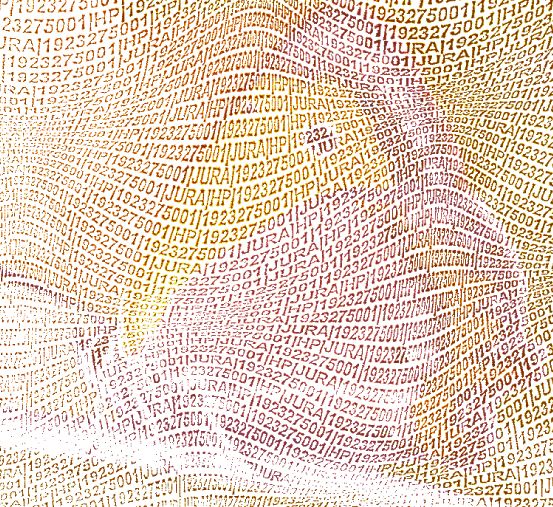 This is a printed screen created from an existing image on a document or product packaging, and composed of wavy lines of uniquely structured microtext, which are ‘personalised’ according to information relating to the image. If even one number/ character in the text changes, this changes the entire wave structure.
VTS can be verified at two levels: the readable microtext is viewed with a magnifier, and the unique wavy structure can be checked automatically with a smartphone camera using Jura’s reader app (Android/iOS/Huawei).
IVI – Invisible Variable Information
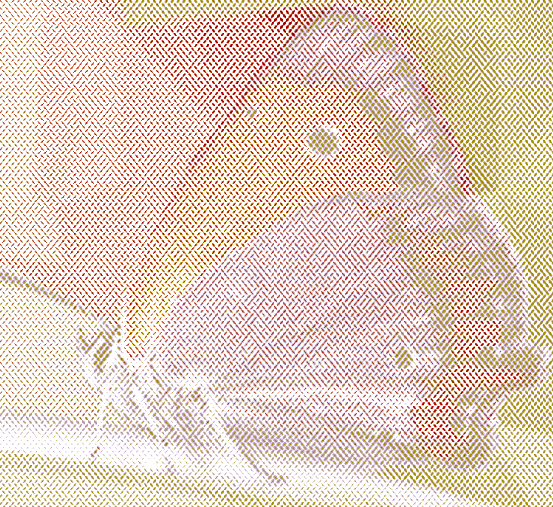 This technology hides encrypted serialised data in an existing image or background, thereby rendering the image itself unique. The feature is automatically verified by a smartphone camera using Jura’s reader app, and offers very strong protection against re-engineering and data substitution.
IVI Pro is an advanced version of IVI, working with a higher resolution that allows for copy protection and that renders the design sharper, smoother, and more cohesive. IVI Pro is linked to the IQ-R code.
VMT – Variable Modulated Text
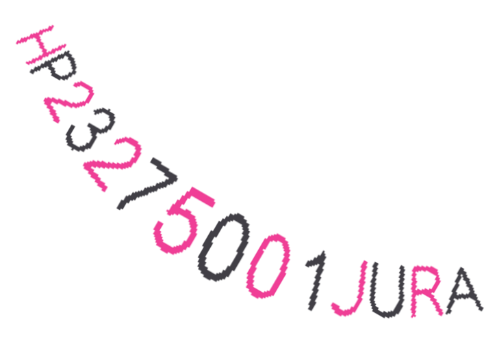
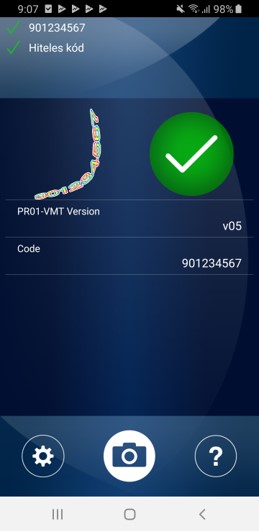 This consists of a personalised line of wavy, distorted microtext that is recommended for use with visually printed serial numbers. The shapes of the characters, the font, and the waves are customised for each item and stored in a database.
The readable microtext is verified by a magnifier and the unique waveshape by a smartphone camera, which matches the shape displayed on the screen with the shape of the printed text on the document, using Jura’s reader app.
VMT Pro is an advanced version of VMT, printed with pixelaccurate precision to gain a sharper, harder-to-copy distorted serial number, and with the possibility to print the number in more than one colour.
MDT – MicroDot Text
This consists of serialised microtext that is available in pixel or line-based form (depending on the ink and calibration used for a particular project).
MDT Pro produces smaller sized text and in multiple colours. It can also be linked to the IQ-R code and authenticated offline using a smartphone.
LIL – Line-in-Line
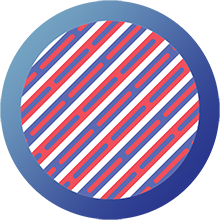 This is a physical security element with very high registration between two colours. Any attempt at copying the element will result in blurring of the colours.
LCI – Linked Coded Information
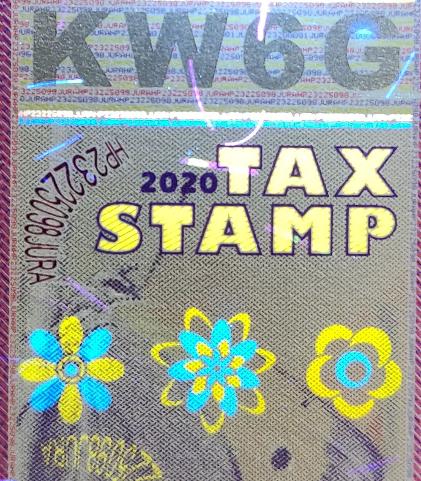
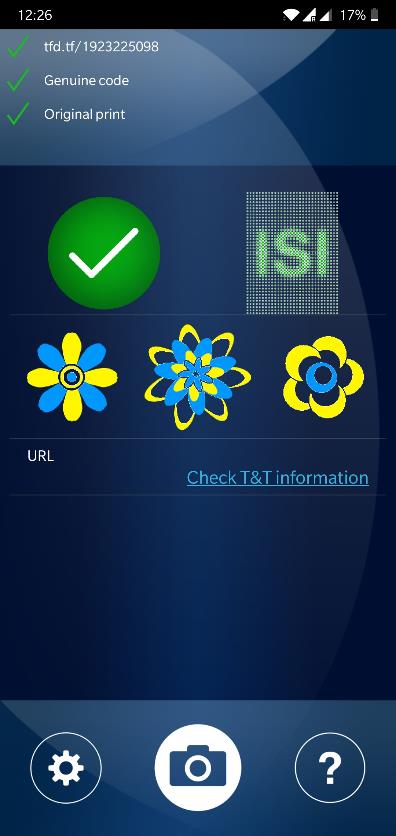 This consists of coded information in the form of prefabricated illustrations that can be visually authenticated by comparing the illustrations displayed on Jura’s reader app to those printed on a label. The feature includes a library of prefabricated illustrations that are printed in a particular order and then predicted by the Jura reader app.
LCI can be worked into an existing layout, with no need for redesign. It can be linked with the IQ-R code or IVI (invisible variable information) on the document, and printed with either UV fluorescent ink or normal visible ink.
SLI – Serialised Latent Image
This is a tactile printed feature that creates serialised hidden images that appear according to the angle of observation. The feature’s tactile effect is achieved by multilayer overprint with perfect registration.
Bringing it all together
.jpg) During the workshop, Takej Turk and Lior Rubinstein demonstrated how some of the features described in this article could be arranged on applications such as a tax stamp, vehicle licence and olive oil label.
During the workshop, Takej Turk and Lior Rubinstein demonstrated how some of the features described in this article could be arranged on applications such as a tax stamp, vehicle licence and olive oil label.
Of particular note with all of these applications is the large number of serialised and variable features that can be almost crammed onto the labels, covering almost the entire surface of the samples.
HP Indigo collaboration
For a number of years now, Jura has been collaborating with digital printing pioneer HP Indigo. The collaboration combines HP Indigo’s proprietary liquid electrophotography (LEP) digital colour printing technology, and the largest set of inks available in the digital printing industry (including spot colour, metallic, colour-shifting, UV fluorescent, invisible, and tagged inks) with Jura’s security design software, digital security features and smartphone authentication expertise.
Earlier this year, HP Indigo launched its 6K Secure label and flexible packaging press, specifically for security printing markets. The press, which was developed in collaboration with Jura, is able to create multiple security layers and variable elements in one single pass, in a secure environment.
Following this launch, OpSec Security announced its investment in Europe’s first HP Indigo 6K Secure press, with the aim of enabling brand owners and tax stamp issuers to integrate highly secure and unique authentication and design features into labels and packaging.
These developments demonstrate that digital printing is rapidly growing and evolving in the field of security printing, and that providers in the security industry are increasingly adopting digital printing techniques, in particular for the production of ‘mid’ level secure documents such as tax stamps and brand protection labels.
Subscriber content
Read the full article
Full access to Tax Stamp & Authentication News™ articles, newsletters and archives.