
Jérôme Pichot, the Second CEO of Advanced Track & Trace

Jérôme Pichot was appointed as Chairman and CEO of Advanced Track & Trace (ATT) in October 2021, following an investment by reference shareholder Capital Croissance earlier that year. Tax Stamp & Traceability News™ interviewed Jérôme to learn more about his approach and aspirations in managing this innovative French company.
Q: Thank you for agreeing to this interview, Jérôme. You’ve now been in the job for 14 months; how have you settled in – do you still feel like the new boy?
A: I feel really comfortable in this role. As chairman and CEO of ATT it’s quite a responsibility, but I’m very proud of the 20- plus engineers we have in the team. Back in 2015/16, when I was at De La Rue and met the ATT team for the first time, I was impressed by the technology. This quality is what motivates me day by day. I’m very happy here now – absolutely.
Q: Previously you worked with major companies in the security industry, including ArjoWiggins and De La Rue. ATT is much smaller and specialised, so how do you find working in a smaller company?
A: First of all, I learned a lot with Arjo back in the early 2000s. I was based in Latin America as the banknote representative for the company. Then, when I moved to Basingstoke, UK, to join De La Rue, I grew my knowledge of the security industry. I had no intention of leaving De La Rue – I was really happy there for five years. But when ATT approached me, I couldn’t refuse this opportunity.
At De La Rue I was responsible for the marketing of authentication products, and I was looking for companies and technologies we could work with. We screened probably 50 companies from around the globe and there were only two that I put at the top of the board as companies to work with; one of them was ATT. Despite its size, ATT has an incredible international reputation, so I couldn’t resist the chance to lead the company.
How is it different? Well, agility is one of the first things that comes to mind – it’s much quicker to make decisions here! Also, of course, we have huge ability and expertise.
Q: And how does ATT position itself in relation to those bigger players in its key markets? Come to that, what are your key markets – current and target?
A: In the security business there is competition and there is partnering – so we see ourselves as a partner, especially a technology partner.
As an example, we will be on almost 1 billion banknotes of the CFA franc, which is being printed this year by the Banque de France for the Bank of Central African States. The notes carry a digital security feature called Sealgn@ture®, which can sit beside other features. ATT has been appointed as a security feature supplier by the Banque de France. So, we can coexist with the largest providers in the field, and we can equally be partners.
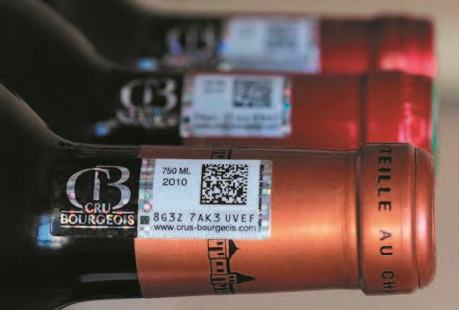
We’re a small company, but we’re profitable, and we’re generating cash. And we’ve just acquired a small company called Media Services Partners, which specialises in authentication for wineries, so we’re consolidating our position in that market.
90% of our revenue – a few million euros – is in brand protection, and you can count on two hands the companies in the world that have a similar turnover in that sector – we’re certainly one of them.
Q: ATT was a one-product company, SealVector® being its founding technology. Given that many new companies offering an authentication feature didn’t last long, congratulations on surviving 20 years! Is SealVector still the core offering?
A: Yes, it is. ATT was founded in 2003 by Jean-Pierre Massicot, Zbigniew Sagan and Alain Foucou. They recognised that secure traceability would be a requirement for branded products, and the invention of SealVector was their solution for this new challenge. So, far from joining the list of failed companies with a new authentication technology, we’re showing growth year after year.
Q: You joined ATT a few months after Capital Croissance became the reference shareholder. Please explain ‘reference shareholder’ as it’s not a phrase used in British or American business. What percentage of shares does Croissance have?
A: The French phrase is ‘actionnaire de référence’, and it means someone who has predominance in board meetings. Capital Croissance owns approximately 40% of the shares but has a voting majority. Lamy SA, the family-owned longstanding shareholder, has a similar shareholding. We also have some individual shareholders – including Hugues Souparis, via ENOWE, his family investment vehicle, who was previously founder and chairman of Surys, which he sold to IN Groupe. The management team also has shares, and we have a family investment group based in New York.
Q: Was your appointment a strategic decision by the new majority voters or was it an element of Jean-Pierre Massicot’s exit strategy?
A: I first met Jean-Pierre in 2015/16. I have a high respect for his entrepreneurial idea to build this company, at a time when no- one was interested in traceability. But yes, he’s – shall I say? – of a certain age so was looking for his exit route. We had an overlap period of several months, so you can see it was an amicable handover.
Q: What is ATT’s core expertise?
A: SealVector and its derivatives, including SealTrack® and SealTIle®, are key products for us. But we have two different strengths.
First, we’re strong in traceability; we can install, from A-Z, a full track and trace system, which we’re doing for many wineries.
Then there is the authentication side, where we’re supplying only digital encrypted codes, among them SealVector, which is applied as a printed or engraved mark on a product or its packaging. We’ve supplied over 1.5 billion codes for branded products and government documents. With the Central African banknote, we’ll see 2.5 billion items carrying our solution.
Q: One thing that your R&D people are working on is physically unclonable functions (PUFs). Please explain this… what stage of development is it at and is it proprietary?
A: We’re working on the next generation SealVector – invisible SealVector. Instead of a visible encrypted code to read with a smartphone, this solution will be completely embedded in the design or layout of the document or package. It will be composed of dots, encrypted, and read by a smartphone.
SealVector is a PUF, which is a copy- sensitive code that can be conventionally or digitally printed. It cannot be accurately copied or reproduced without the original digital file and counterfeiters cannot reverse engineer it or retroactively find the encrypted digital code.
It is patented – we have over 200 patents in 50 countries across the globe, which is another of ATT’s strengths.
In parallel we’re also launching two R&D projects.
One is to secure goods in Web 3, the metaverse. That is to say, bridging the real world and the metaverse, linking the physical item and its metaverse twin.
Our second project is securing banknotes, which can lead to two things: the ‘dematerialisation’ of the note and making it traceable.
So, we’re working in many directions. SealVector is very important for us but it’s not all we’re offering our customers.
Q: You mentioned that brand protection is 90% of turnover but tax stamps seem to be an important market for you now. You’re offering TraceTax®, a keystone suite. Please describe and explain this suite. How does it differentiate from competitors?
A: Our previous big success in tax stamps was in Ukraine in 2014 – a great achievement for ATT, as it’s such a large country. But as you know the country changed its policy and no longer uses stamps.
We have now implemented a full track and trace tax stamp programme in small and medium size countries. In some countries we do it ourselves, in other countries we partner.
Our key differentiator is that SealVector can be integrated in the stamp in different forms; it can be printed as a visible code or in the background of the stamp. This encrypted code can be read by any kind of mobile phone application, so it can be applied to tax stamps or other government documents.
As I’ve mentioned, one of our strengths is in providing origination stamps for wineries, so they are able to prove the provenance of their wine. These are not state projects, although we do work with governments.
We collaborate with the French Ministry of the Interior, which issues visible digital seals (VDS) that can be read with an app on a smartphone. In France, the AIGCEV (Association Internationale de Gouvernance du Cachet Électronique Visible – the Visible Digital Seal International Council), of which the Ministry of the Interior is a member, owns that app, so it can be used with tax stamps or other government-issued items.
For example, we’ve been protecting the ID passport card for Ireland for five years. We also protect the Trinidad and Tobago voter ID card, as well as driving licences in some Asian countries. This is where we believe growth will come for ATT – government projects as well as continuing to grow our brand protection work.
Q: Where is ATT going in the future? What are your aims for the next few years?
A: We have a massive footprint in brand protection In France, with customers like L’Oréal (our biggest customer), another massive luxury brand as our number two customer, and Pernod Ricard as our number three customer. So we plan to build on this success with more overseas customers. We also plan to expand in government revenue solutions – we have some very hot projects in the pipeline.
We’re putting a lot of focus on the banknote industry – our big success with Banque de France could be replicated elsewhere. The banknote industry will require more digitisation of banknote security, which is where ATT has a role to play.
Q: And on a broader level, as you now have experience with two established large security printers, and with the more specific focus of ATT, where do you see the authentication industry heading?
A: Everything is going digital – that’s my strong belief. And that’s one reason I accepted this job. We all now live in the same village; we buy in the same marketplace. We all want to be in the premier league and when you’re buying online you want to be sure that you’re getting genuine product.
I see greater consciousness among consumers, brand owners and governments. Governments, in particular, realise they have a role to play and that they can raise additional revenue by implementing finance schemes. So I do see more and more digitisation of security features everywhere and the digitisation of banknotes.
Q: What have I missed? Is there anything you would like to add?
A: We’ve implemented a CSR policy (corporate social responsibility), covering quality of work, customer service, sustainability in everything we do, even the sustainable quality of servers.
Data management is critical in our business, so we are selecting very carefully who is hosting our data. We strive to have an ethical approach to everything we do.
The last thing I’ll say is that I asked the team what they thought our company values should be: and the answer was customer satisfaction. So, we are more and more focused on our customers and their needs.
Subscriber content
Read the full article
Full access to Tax Stamp & Authentication News™ articles, newsletters and archives.