
News in Brief


Telangana State Goes Hi-Tech to Track Burlap Sacks
The Information Technology, Electronics and Communications Department of the Indian state of Telangana has implemented a pilot project for using RFID tags or QR code-enabled systems to track the inventory of gunny (burlap) sacks used for supplying food grain under the state Public Distribution System (PDS).
The task of ensuring that enough gunny sacks are available for this task has been a challenging one for the Civil Supplies Department. The PDS has 2.83 million beneficiaries and uses about 110 million bags annually for food grain distribution. But at least 30% of the procured bags go missing by either getting misplaced or being sold in the open market by dealers.
To address this problem, the pilot has been implemented in two districts in partnership with the IT and Civil Supplies departments. Under this initiative, each gunny sack is fixed with tamperproof RFID tags or QR codes and tracked through a mobile app. With the app, the users can track sack batch details, source of the gunny sack, delivery point and the purpose for which the sack was used (paddy or wheat or other grains).
Cyber-Physical Watermarks for Medicines
A team of biomedical engineers from Purdue University in the USA has developed a new anti-counterfeiting technology that can turn a smartphone into a potentially lifesaving security device by taking a picture of a cyber-physical watermark to confirm if the medication is real or not.
Young Kim, Associate Head for Research and Associate Professor at Purdue’s Weldon School of Biomedical Engineering, says the continued rise of counterfeit medications, pharmaceutical products and medical supplies can be attributed largely to the increase of online pharmacies, many of which are unregulated.
‘We have technology that can empower patients to check to see if the cyber- physical watermark on the medications they are taking is real or counterfeit,’ Kim said. ‘This allows them to also confirm dose, frequency and information on the medicine.’
The watermark is printed on special fluorescent silk with FDA-approved food dye through an inkjet printer (a common technique that bakers use for placing edible photos on cakes).
The watermark can then be scanned by smartphone to extract a hidden digital key, which validates the medicine, and which can also provide additional information such as interactions with other common medicines, manufacturing details and distribution path.
The smallest size of watermark the team could produce is 5mm x 5mm. Whilst the focus of the development has been on solid pills, the team is also working on developing the technology for liquid pharmaceuticals.
A full description of the technology has been published in Advanced Functional Materials.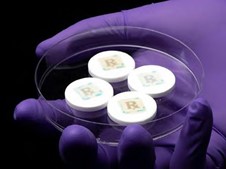
US Bill to Tackle Counterfeit Electronics
A bipartisan bill has been introduced in the US Senate to curb the trade in counterfeit electronics by stopping the flow of waste products to China and other countries.
The Secure E-waste Export and Recycling Act (SEERA) ‘would ensure that electronic waste, or e-waste, does not become the source of counterfeit products that re-enter military and civilian electronics in the US,’ according to the proposed legislation.
SEERA would require domestic recycling of all untested, non-working electronics from the US to end the flow of e-waste to counterfeiters and data thieves who could use the material to undermine national security. It allows for tested, working equipment to continue to be exported to promote reuse.
The UN Global E-Waste Monitor puts the figure of e-waste produced worldwide each year at more than 50 million tonnes. This is up by 21% from 2015, and is set to increase to 74 tonnes by 2030. E-waste, says the Monitor, is the world’s fastest growing domestic waste stream, fuelled by high consumption of electrical and electronic equipment, short life cycles and few options for repair. Less than 20% of the waste is recycled.
De La Rue Publishes SBTi Targets
De La Rue has recently submitted targets to the Science Based Targets initiative (SBTi) to reduce its greenhouse gas emissions, consistent with limiting global temperature increases to no more than 1.5°C.
SBTi is a Net Zero standard and provides an independent assessment of corporate Net Zero target setting. Since 2015 more than 1,000 companies have joined the initiative.
De La Rue has already been certified for ISO14001 in the UK since 2003 and for all its manufacturing sites globally since 2011. Its work in this field has also been recognised externally, being named within the Top 25 of Europe’s Climate Leaders by the Financial Times in both 2021 and 2022.
Its SBTi target is a reduction in all its emissions (scope 1, 2 and 3) by 45% by 2030. In addition, it has committed to achieve carbon neutrality for its own operations by 2030.
Recent initiatives which help towards this goal include the installation of cool roof technology in its plant in Malta, moving its Certify authentication solution from on premises hardware installations to a cloud hosted solution and recycling 100% of the polymer waste from its production process.
Securikett Expands Paper Label Range
Following the launch last year of a new range of paper-based security labels, Austrian security specialist Securikett has extended the PaperVOID range with the addition of an integrated QR code. The unique codes are created in-house at Securikett and supported with an advanced data management system and secure web portal.
These labels provide distinct proof of opening, the so-called VOID effect, and give the manufacturer the ability to communicate further information about the product directly to the customer via a simple scan of the label.
At the same time, they are more sustainable, not only replacing plastic, but are also recyclable and, if applied to paper-based packaging, avoid the need for separation when recycling.
Securikett has also launched PaperStripe seals, which are similar to its PaperLock security tapes and are suitable for smaller cardboard boxes, particularly those used by on-line retailers. Due to the paper- based material of the seals, the packaging including the label can be recycled together.
Subscriber content
Read the full article
Full access to Tax Stamp & Authentication News™ articles, newsletters and archives.