
The New Era Postage Stamps Which Perform Like Tax Stamps

According to high-security printer Royal Joh Enschedé (RJE), the humble postage stamp is undergoing a phenomenal digital transformation. Faced with the growing threat of stamp fraud and forgeries, and the pressure on postal authorities to offer more reliable, transparent delivery services, a new era in postage stamps has emerged.
In fact, one could say that these next- generation stamps closely resemble modern-day excise tax stamps in terms of their look and functionality.
RJE explains in a Deutsche Post case study that by printing a unique, two-dimensional data matrix code on every stamp, postal authorities can track letters throughout their delivery network. Furthermore, customers and businesses can use a mobile telephone app to also track the letters.
In addition, the unique code allows any reused or forged stamps to be immediately detected and rejected by the scanning equipment of postal agency sorting centres, preventing fraud and revenue losses for the postal service.
Deutsche Post was among the first postal authorities to introduce this revolutionary new stamp to its customers and in early 2021, RJE secured the business to print the new €0.80 stamp for the German market.
‘Deutsche Post had two specific requirements we had to satisfy,’ explained Gelmer Leibbrandt, CEO at RJE.
‘The first was to ensure that the matrix code on every stamp was unique and would be readable throughout Deutsche Post’s delivery network, and the second was that each delivered batch of stamps was accompanied by a manifest file, in their required format.
‘When producing over 2 million postage stamps a day, we had to ensure we could meet these requirements consistently, efficiently and with the highest levels of accuracy.’
RJE considered a number of options to overprint the matrix code onto offset- printed stamps, based on equipment availability. The Domino K600i inkjet printer, mounted on RJE’s MABEG MSP Sheet Feeder, quickly became the obvious choice as it provided the throughput, print quality (600dpi) and flexibility RJE needed.
Ensuring that every code was present, readable and accurate was a little trickier, as Frank Uitendaal, Operations Team Lead at RJE explained.
‘Our preferred layout was to print the matrix codes onto 90 stamps per sheet. But then each code had to be barcode graded and if it failed to read or fell below a grade A, then the whole sheet had to be diverted.
‘In addition, we also had to maintain a database of all good and discarded codes in order to report back to Deutsche Post. We had a legacy camera inspection system that could do the job, but this was on our Gremser line, which was constantly being utilised.’
It was clear that RJE needed a separate inline camera inspection system on their MABEG line, immediately after the Domino K600i inkjet printer. The system would need to be capable of reading and grading every matrix code, triggering a divert on an error and then outputting a report that RJE could use to create the all- important manifest file for every job run.
Following a short period of testing and solution validation, RJE selected Lake Image Systems, a producer of automated, vision-based inspection systems for quality control and data verification, for the critical step of inspecting the postage stamps.
Lake Image implemented its DISCOVERY Multiscan3 solution, together with its 8K linescan camera technology, directly on the MABEG line, immediately after the Domino printer.
 MABEG print line with Lake Image camera systems.
Each batch of 1,000 sheets, containing 90 stamps, were overprinted with the unique matrix code by the Domino K600i printer, which was linked to a carefully controlled database containing codes supplied by Deutsche Post. The DISCOVERY Multiscan3 camera system then read and barcode graded every code. If a code failed to read correctly or fell below an ISO grade A, then the whole sheet would be tracked and diverted at the end of the MABEG line running at over 2,000 sheets per hour.
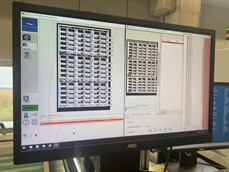 Lake Image’s DISCOVERY Multiscan3 screen showing stamps being inspected.
At the end of every run DISCOVERY Multiscan3 produced a detailed report on the status of each sheet and the matrix codes within them. RJE then used this file to check for possible duplicates and to generate a manifest file which would be sent to Deutsche Post. This file enabled Deutsche Post to release the stamps knowing precisely which codes were active and, more importantly, which were not.
The combined solution has improved RJE’s operational efficiency and enabled greater flexibility when changing stamp designs and layouts. RJE is already widening the print window, allowing more stamps to be printed on each sheet, and is implementing completely new stamp designs, both possible with minimal changes to the Inkjet printer and inspection system.
‘Resolving our inspection issues was the final hurdle we had to overcome. We are already in discussions with other postal authorities around the world who are looking to introduce similar coded postage stamps into their markets,’ remarked Leibbrandt.
Subscriber content
Read the full article
Full access to Tax Stamp & Authentication News™ articles, newsletters and archives.