
Technology, Without Enforcement, is Not Enough

Lately, we’ve been hearing of a growing number of companies that are offering, or expanding on, their market surveillance and product intelligence services as a way of helping enforcement officials and brand owners to quickly identify illicit trade activity in particular markets, and to act upon these activities before it is too late.
Let’s look at three of these companies, some of which offer this service as an integrated part of an excise recovery or brand protection platform, thereby demonstrating that technology alone, without effective enforcement measures, is not enough to combat illicit trade and tax evasion.
ApiraSol: world’s largest network of detectives
The first company is ApiraSol GmbH, which was founded in Germany in 2010 with support from the German private sector.
The company describes itself as the ‘investigative approach to brand protection’, and the ‘missing link between online monitoring and physical investigations’. It also claims to have probably the world’s largest network of detectives, many of whom possess extensive anti-counterfeiting experience.
Essentially, ApiraSol offers three services:
1. Online sales monitoring of finished products, packaging, components and bulk products, using a specially designed web interface to monitor counterfeits, tampered products and grey marketing.
2. The ApiraSol Cluster Analysis service, which combines online intelligence with shipment analytics, uncovering entire illicit supply chains, from producers to shippers, importers, distributors and retailers. The solution identifies manufacturers behind online listings and helps brand owners to translate web-based intelligence into concrete physical seizures and investigation activities.
3. The ApiraSol POSINT (Point of Sale Intelligence) Suite, which is an offline monitoring service that captures product intelligence directly at the point of sale – sometimes through undercover inspections.
With regard to the POSINT solution, ApiraSol works with more than 1,000 partner operators who visit shops and capture intelligence in over 160 countries.
This intelligence is instantly shared with brand owners and enforcement authorities via a single POSINT interface. The operators also capture high-quality product images at points of sale or through waste collection, thereby avoiding the physical handling of samples and consequently reducing investigation costs.
‘With the COVID-19 pandemic, remote work has become a standard practice,’ explained Axel Hein, Managing Director of ApiraSol, speaking to Tax Stamp & Traceability News™. ‘More and more brand protection and product security teams will choose, whenever possible, to avoid receiving product samples at their HQ offices. It is convenient to access product intelligence via a web interface and while working from home. This approach avoids having to store samples and go to the company offices to check them’.
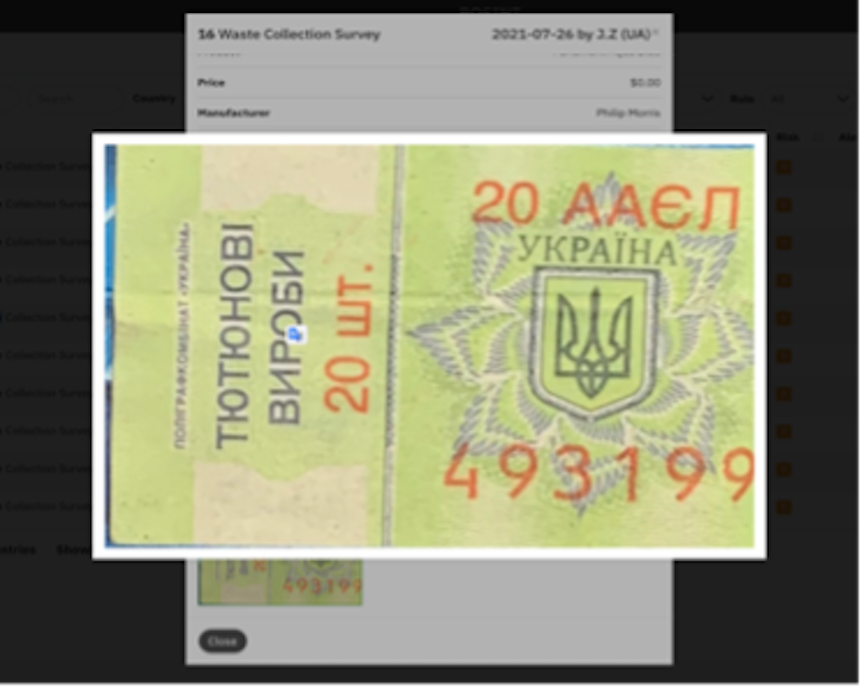
In a recent study, ApiraSol gathered cigarette box samples from the streets in Ukraine, Bangladesh and Vietnam. The product intelligence collected included brand names, geolocation and multiple images, including images of tax stamps.
In particular, the study looked at how the presence (or absence) of tax stamps varied between different cigarette brands in different cities.
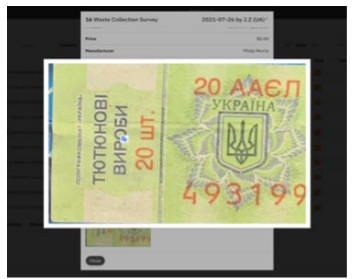 © ApiraSol.
The structured nature of the intelligence gathered from the study allowed for the generation of statistics that would not have been possible to produce with unstructured data, and that provided answers to key questions such as:
What cigarette brands, in which countries, are more likely to be missing a tax stamp?
What illicit producers are associated with product samples that lack tax stamps?
What countries and products are carrying tax stamps that are counterfeit or have been tampered with?
‘Quickly identifying cigarette samples without tax stamps gives an early warning sign to enforcement authorities, providing them with specific intelligence such as geolocation, related products and images of fraudulent tax stamps,’ explained Mr Hein.
‘Furthermore, product intelligence, delivered via a single interface, avoids the complexities of receiving endless emails from multiple detectives, with different report formats and unstructured data. It also reduces investigation times, as the client does not need to wait for a sample to travel to another country. Instead, clients can access product intelligence right after the product has been identified in the market’.
De La Rue expands intelligence catchment area
Moving to the second company featured in this article: De La Rue. This company has partnered with Chkfake (which describes itself as the ‘CRM of brand protection’) in order to integrate two of Chkfake’s solutions with De La Rue’s product traceability platform, Traceology®.
The De La Rue Traceology platform enables brands to track and trace individual products from point of manufacture to end user. The combination of digital twin and De La Rue’s physical holographic labels creates a one-source-of-truth dataset within Traceology.
De La Rue already provides analytics and consumer and enforcement officer mobile apps that utilise the data to enable actionable insights (for example, scan locations, diversion alerts and upload of suspect products). The broadening of the Traceology offer with Chkfake allows De La Rue to cast a wider intelligence catchment net, and enhance the services for enforcement and brand protection teams.
The Chkfake Leadcatch™ solution is a dashboard-based platform for harvesting and centralising intelligence from multiple sources within a brand’s value chain. Such sources include incident logs created by customer service teams as a result of consumer complaints about a particular brand, since some of these incidents could signal a potential counterfeiting threat. Linked with Traceology data and De La Rue’s secure holographic labels, the service workflow is designed to identify fakes and capture wider market intelligence.
The second Chkfake product that is being integrated with the De La Rue traceability platform is Chkfake Enforce™: a streamlined workflow solution for external and internal enforcement teams to record raids and other enforcement activities.
Subscriber content
Read the full article
Full access to Tax Stamp & Authentication News™ articles, newsletters and archives.