
Georgia Opens Invitation for Expression of Interest


Georgia has a remarkably successful tobacco tax stamp programme which has been reported on in Tax Stamp & Traceability News™ (TSTN). Here we interview two managers from the Revenue Service of the Ministry of Finance of Georgia (GRS), Levan Dgebuadze, head of the Service Department, and Samson Uridia, head of the International Relations Department, to find out more about it.
Q: Clearly, congratulations are in order, because Georgia has made tremendous progress in reducing the amount of illicit tobacco products in the country, with parallel increases in tax income. Let’s start with a reminder of the scale of your achievements in the past 10 years or so. What is the reduction in trade in illicit goods and the increase in your tax revenues across each of these products?
A: Before answering the question directly, we have to consider the main challenges in combatting the illicit tobacco trade. This is a quite sophisticated, multifaceted issue which raises severe challenges. Our biggest challenge arises from the fact that two regions of Georgia are occupied, and we are not able to control the trade that is coming in from those regions.
Our new excise management system became effective from 2013, on cigarettes and other tobacco products, using SICPA’s system. SICPA was the selected company to provide this service via open competition. This system allows us to track the goods and to validate the tax stamps, both physical stamps (paper-based) and those obtained through direct marking on the product packaging via security inks.
When we saw success, then we extended the direct marking system to beer and other alcoholic drinks, except wine, which is exempt from any excise duties! Then in 2019, we also introduced an excise duty on fine-cut tobacco (for roll-your-own cigarettes), as we saw the consumption of cigarettes fall.
These measures helped us, on the one hand, to minimise the illegal tobacco trade, and on the other hand to improve our tax revenues. In the last three years our excise tax revenue from tobacco, beer and other alcoholic drinks, has increased by 15%, from 747.7 million lari ($217 million) to 862.4 million lari, with tobacco representing 90-92% of this tax income.
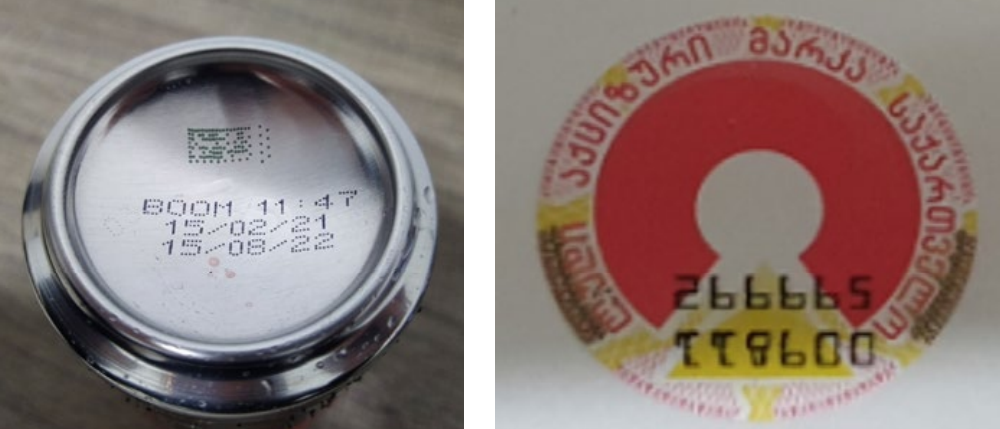 Direct mark on a beer can (left), and beer stamp.
Q: Please describe and explain the structure, responsibilities and relationships of the government or other public sector organisations involved in your excise tax procedures.
LD: There are three departments of the GRS involved in the system.
The Service Department is responsible for administration of the tax stamp and marking system. The taxpayer applies to this department for tax stamps for its products, and if all requirements are met, we give them the right to receive stamps from the supplier – SICPA.
The Customs Department controls the cross-border movement of goods.
The Taxes Monitoring Department controls the production and internal transportation of goods, as well as the storage and sale of tobacco products, and the enforcement of Georgia’s law on tobacco control for selling, packaging and usability. This department has 25-30 people involved in the control process, each equipped with a special reader for identifying and validating one of the tax stamp’s covert features, an invisible 2D barcode.
SU: Our International Relations Department has also played a crucial role in the system, since we are responsible for sharing the information with our neighbouring countries and other international partners. We have also benefited from international technical assistance programmes, which has been invaluable to us.
Q: Which security features on the tax stamps are most used by enforcement officials to authenticate the stamps?
LD: Our officers use a proprietary hand-held scanner to check the validity of the stamps. This authenticates and validates the stamp’s 2D barcode, connects to the central database using a cellular network, and displays information on the date when it was activated, which taxpayer it was issued to and the specifics of production (product brand, date of manufacturing, etc.).
Q: So, you’re only using the SICPA equipment – you don’t use smartphones or other equipment to examine the stamps?
LD: No – we only scan the invisible 2D barcode, which gives us the information we need to validate the stamp.
Q: The stamps you use have track and trace coding on them, but you’re only using the tracing ability at present. Do you have plans to expand to use tracking as well?
LD: You are right, we have only been using the tracing ability – since 2013 – so we can see where the product that the stamp is on was made. We plan to introduce tracking functionality for the new term of the service contract, which will be signed this year.
Q: So, you’re now using tax marks on tobacco products, beer and other alcoholic drinks, except wine. Might you expand the scope of your tax regime to other products? Do you have any firm plans to do so?
LD: At this stage, we are not planning to introduce the excise tax on any other goods. But in future, of course, it is really important to use stamps or direct marking, if such a policy or such a decision will be made.
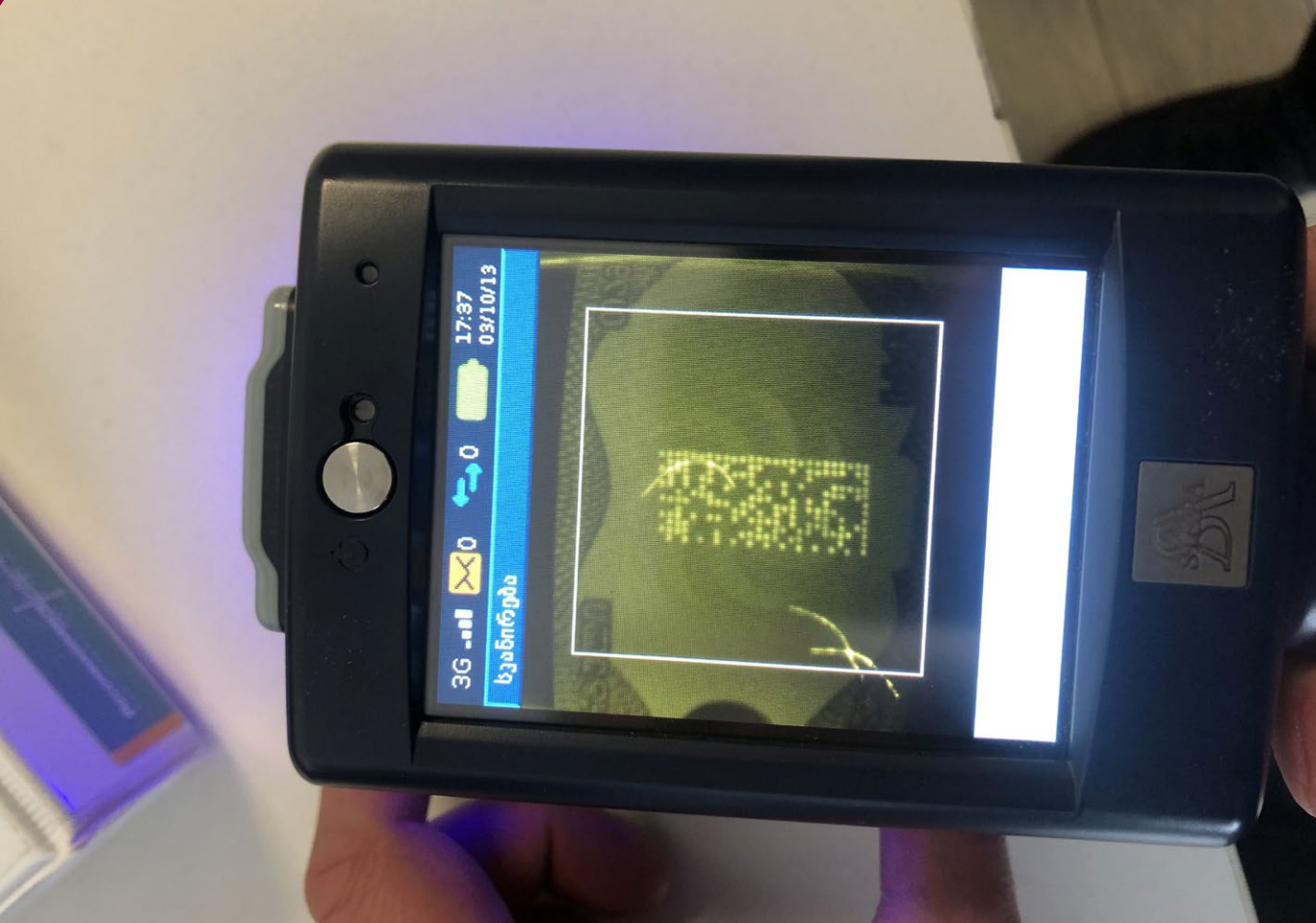 Visualising the hidden mark.
Q: Has the pandemic affected your tax systems in any way? Has it affected public consumption, illicit activity, your tax revenues?
SU: We’ve had quite a high number of infections (editor’s note: 287,000 cases by early April, in a population of 3.7 million), but our mortality rate has been fairly low (editor: 3,860 deaths to date). But obviously it has had a devastating impact on the Georgia economy because of the big decline in tourism and related sectors.
LD: Georgia has increased its role as a tourist destination over the last few decades, but our overall excise revenues have stayed fairly stable because of the increase of the excise rates on tobacco and introduction of excise duty on fine-cut tobacco.
Q: Last December, you co-hosted with the European Commission a virtual workshop to promote accession to the FCTC, and you were due to host the 2020 Tax Stamp & Traceability Forum™ (TSTF). So, we see that you are actively promoting your work internationally; why? What does this achieve for you?
SU: During the last two decades, Georgia has implemented a number of huge and very comprehensive reforms, to improve the quality of life of our citizens and to promote good democratic values in the country. We like to be independent – it’s our spirit, our personalities – but for the last 70 years we were forcefully part of the USSR.
Since we restored our independence, we have needed the assistance of the international community – the EU, USA, Turkey, China and Japan in particular, all of whom we call our strategic partners. We couldn’t have achieved what we have in the last 20 or more years without them.
So we have learned that sharing is caring. Now we want to balance the situation, we want to give back. This has inspired us to be more open, more transparent. We’ve positioned ourselves as the regional host of informational and best practice sharing events. That’s why we hosted the workshop on the Framework Convention on Tobacco Control.
For us, the lesson from our ancient history is that communication is key, and we should do our best to communicate, to be open and not closed.
So, we offered to host the TSTF, which was of course cancelled because of COVID, and would be very delighted to have the opportunity to host it in future.
Q: What would you say to a country that doesn’t use tax stamps, or one which is considering doing so? What key points would you make to encourage them?
SU: We have to start by thinking about why we want a tax stamp. Or rather, a tax system. Is it to raise revenue or to protect the people’s health by reducing consumption of tobacco, of alcohol?
The stamp is not just a physical object to put on something, we have to think about the core goal. So first of all, you have to have a crystal-clear understanding about what you want and what can be possible with a tax system.
There are educational or public knowledge benefits of a visible tax stamp, but in the 21st century we also have to remember that direct marking has become very sophisticated. Perhaps we can use a mix of types of stamp – physical stamps and direct marks.
Recognise, though, that from the outset, the private sector – ie. the tobacco and alcohol producers – will not be in favour of this. We dealt with this by explaining to them that this will be beneficial for them because they would have more precise information about the production cycle.
So in encouraging another country, we would directly mention our experience, where we reduced consumption but increased our tax revenues. Our experience has therefore been very positive.
Also, we’d tell them to talk to solution providers. There are many advanced companies which have a lot of experience and a pragmatic approach to this process.
Q: Is there anything else you’d like to add for our readers?
SU: We’re very pleased to announce a new call for an expression of interest to provide our tax stamp system.
Our contract with SICPA ends this year, so we will be holding an open, transparent, and fair bidding process and we want to invite all the companies worldwide to participate. We’re just finalising the internal paperwork so hope to announce this in the next few weeks, for a company to supply our tax stamp system from the start of next year.
Of course, we hope to get the best product for the cheapest price!
TSTN: Well, that’s interesting news indeed! Thank you for that hot news and thank you for your time today.
Subscriber content
Read the full article
Full access to Tax Stamp & Authentication News™ articles, newsletters and archives.