
New Study Examines Evolving Challenges Posed by Counterfeit and Illicit Trade

A new study focusing on the trends and challenges of counterfeit and illicit trade in the high-tech sector – as well as the technologies for combatting such trade – provides interesting insights that are of relevance to other industries, including excise products.
The study, titled ‘Brand Protection Insights from Industry Leaders in Gray Market, Counterfeit and IP Fraud Mitigation,’ was issued by De La Rue, in partnership with the Alliance for Gray Market and Counterfeit Abatement (AGMA), a non-profit organisation focused on intellectual property protection for the high-tech industry (which, in particular, includes information technology, electronics, semi-conductor manufacturing and telecommunications).
The qualitative research for the study was conducted by an independent consultant, FiveBy Solutions, and consisted of interviews with a number of AGMA members representing some of the largest and most influential brands in the world, including Cisco, Hewlett Packard, Hewlett Packard Enterprise, IBM, Juniper, Microsoft, Tech Data, Texas Instruments, as well as De La Rue itself.
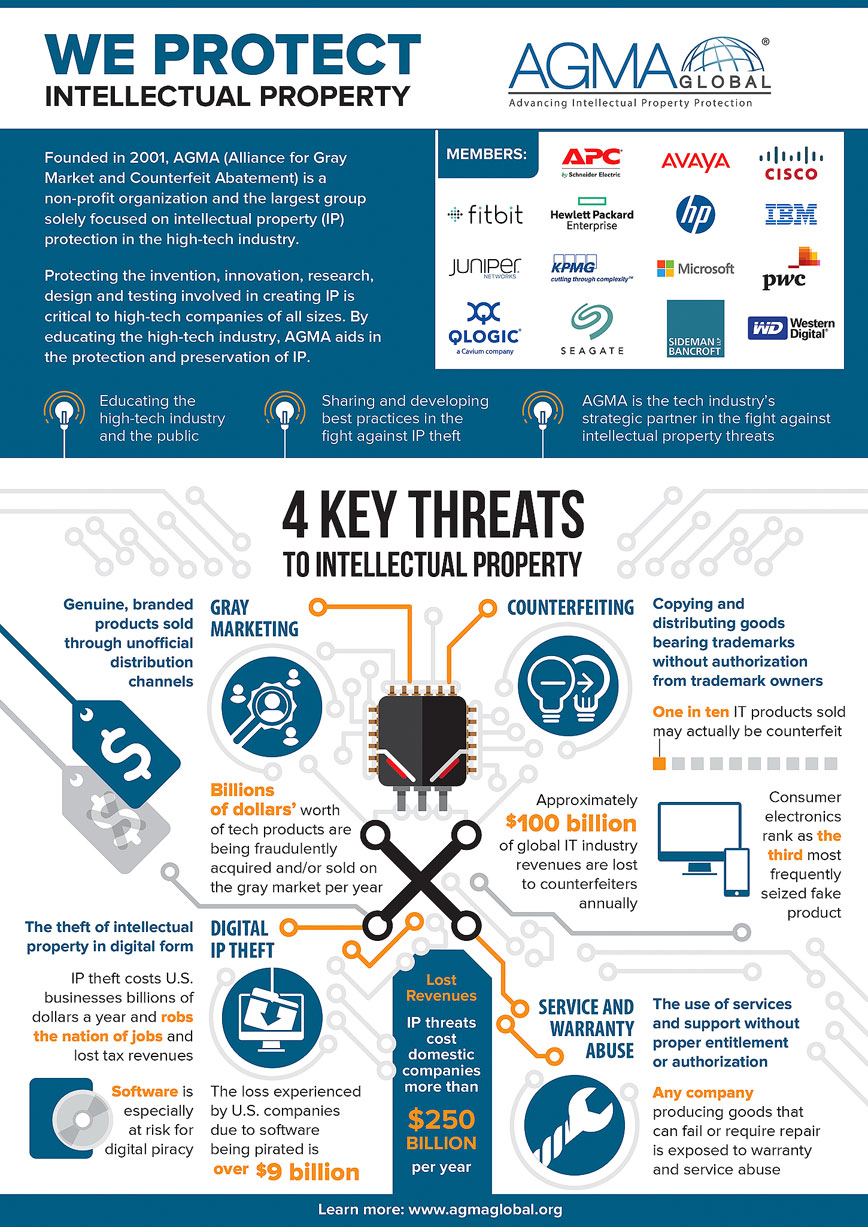 Source: AGMA Global
The study highlighted the trends and challenges related to counterfeit, fraud, grey market risk and prevention, and supply chain security, in relation to the high-technology sector. It also offered insights into how industry leaders are making use of – or how they intend to make use of – techniques such as security labels and related physical and digital solutions and technologies across their brand protection activities.
The study participants identified several global issues that are influencing brand protection in unprecedented ways, including:
Counterfeiters and fraudsters are expanding into new markets, while continuing to advance their capabilities, as fast as, or even faster than, brand owners can address them through current programmes and technologies. Fraudsters are able to consistently produce credible counterfeit security labels in less than six months from the time the legitimate product hits the market. Furthermore, digital transformation is proving to be an accelerator of illicit activity, with counterfeiters having broader access to a larger portfolio of digital data for harvesting and exploitation.
The COVID-19 pandemic has changed the way goods are sold and purchased around the world, with a major shift to online commerce, which is helping to further accelerate counterfeiting and other forms of illicit trade. Brand owners that used to rely on their own distribution partners to sell their products may now find themselves relying exclusively on online channels where they have less visibility and control.
Furthermore, consumers and businesses are facing economic pressures, they are looking for better deals, and they are having to rely on the internet, where online scams are proliferating. Product authentication is proving to be challenging in an online world and this creates broad opportunities for fraudsters.
The participants were universally aligned in their expectations that the impacts of the pandemic will endure for the foreseeable future and this is forcing brands to reassess their priorities and budget allocations.
The technology trends deemed by the participants to be of the highest interest for countering illicit trade included big data and analytics, automated monitoring of online transactions and removal of online fraudsters, blockchain, modular customisation, and intra-component communication.
Macro- rather than micro-level analytics
Universally, participants were most excited about what big data, advanced analytics, machine learning and artificial intelligence could do for their business. Most of them expressed a similar view that there is more value in big data and analytics than can be found in basic tracking technologies in the market. They were less concerned with micro-level tracking of real-time product location and more interested in macro-level analytics pertaining to bigger trends and patterns of activities that could support investigations or identify potential vulnerabilities. The majority of participants pointed to this area as a priority for investment.
Blockchain not mature or secure enough
While blockchain was a hot topic for debate among participants, they agreed that it is not yet mature or secure enough to match its potential. They see the greatest area of opportunity for blockchain in its ability to track the provenance of a product and its components from supply chain through the distribution channel, and throughout a circular economy.
‘Rip and replace’ modular customisation
Modular customisation was defined in the study as a strategic approach for combining, layering, and interchanging different technologies (rather than being a technology in itself). The overarching benefit of modular customisation pertains to its agility, which allows it to rapidly respond to counterfeit threats by ‘ripping and replacing’ layers of technology components in a strategic way. The layers could include a hybrid of overt and covert anti-counterfeiting features, or an interchangeable mix of digital and physical solutions.
Components that ‘talk’ between themselves
The study defined intra-component communication as the ability of components within a particular device to take a self-inventory and thereby validate among themselves whether they are all present and accounted for, as well as whether they are all genuine, authorised components… or not. Intra-component communication technologies were recognised for their ability to enhance digital verification for use in applications related to supply chain security, for example.
The study referred to area- and near-sensory capabilities, such as RFID and NFC, as the methods most evaluated for digital verification purposes. However, these technologies were viewed as relatively costly, and presented certain limitations with regard to some use cases, therefore most participants did not see an immediate practical application for these methods.
‘All digital’ model not viable
Some participants expressed an interest in implementing an ‘all-digital’ model for illicit trade prevention and detection solutions, in order to decrease dependency on physical authentication mechanisms in favour of fully digital verification. However, it was acknowledged that the existence of disparate product types, channel models, brand protection priorities and resource constraints – together with the limitations on digital tracking imposed by GDPR (General Data Protection Rights) regulations – meant that going ‘all digital’ was not viable in the near to mid-term. This being said, it was also recognised that technology bridges may exist to help pave the way to all digital solutions.
A copy of the full report can be downloaded from https://www.delarue.com/authentication/thought-leaderships.
Subscriber content
Read the full article
Full access to Tax Stamp & Authentication News™ articles, newsletters and archives.