
KURZ Talks Tax Stamp Innovation and Motivating Consumers to Buy Tax-Paid

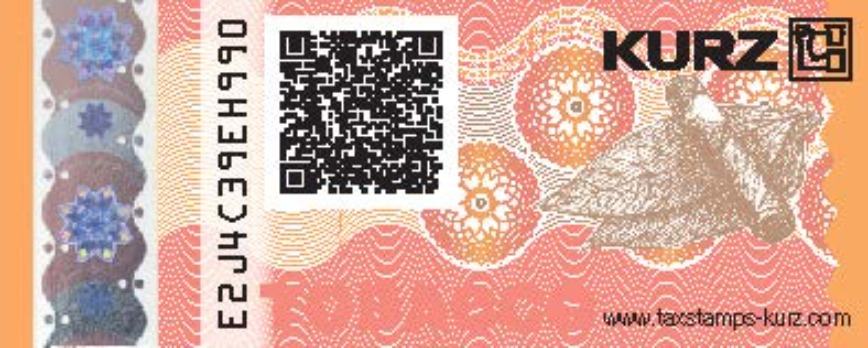
Tax Stamp & Traceability News™ recently spoke to three members of LEONHARD KURZ about the company’s comprehensive tax stamp solution and, in particular, its adoption of visible digital seal (VDS) technology for tax stamps and other secure documents (see TSTN October 2021 for a full description of VDS).
Participating in the discussion were Benno Schmitzer, Managing Director KURZ Digital, Michael Ritschewald, Product Manager Tax Stamps, and Matthias Kronawitter, Global Marketing Manager.
 From left: Benno Schmitzer, Michael Ritschewald, Matthias Kronawitter.
 Q: Could you first tell us a bit about the company in general.
Matthias: We are a family run business established in 1899, in Fürth, Germany, so we have a long history. We develop and manufacture decorative and functional coatings that are applied to carrier foils and employed on a wide variety of products, from automotive components and cell phones to furniture, books, and textiles.
The first product ever created in Fürth was metallised foil with a gold, shimmering effect for the enhancement of magazines and brands such as cosmetics. But as the world evolved, so did we, into the security domain of brand protection, ID documents, banknotes, and tax stamps.
As part of this evolutionary process, we purchased a company in Switzerland, in 1999, called OVD Kinegram, as the main supplier of our diffractive security designs.
Today, KURZ counts more than 5,500 employees and over 30 production and sales sites worldwide. In the United States, for example, we have built a brand-new production complex that is double the size of the previous facility, and in Germany we have two production sites as well as a high security production centre. In Asia, we have facilities in Malaysia and China and will be opening a new production centre in Vietnam within the next two years.
Of course, we also have sales offices worldwide. In fact, you name the country, and we normally have one sales and customer/technical representative located there.
We sell our products, in the first place, to brand owners and governments in line with their different application needs. And we also make significant sales to commercial and security printers who are applying our technologies to the finished product or document.
We have several tax stamp projects running worldwide, but please understand that most of our projects are under a non-disclosure agreement. However, what we can say is that we have projects running globally, for instance in the EU, Southeast Asia, Africa, and South America.
Q: Tell us more about TRUSTSEAL.
Michael: TRUSTSEAL is a proprietary technology that offers a wide range of optical security elements which are easy to recognise and hard to copy. As a matter of fact, we have never seen a successful attempt at imitation of a TRUSTSEAL.
The TRUSTSEAL security foil is produced in the same high security environment as our KINEGRAM foils for banknotes and ID documents. Within the KURZ Group we always follow the latest standards and certifications. For instance, we are certified by the European Central Bank and hold the Intergraf ISO 14298 certificate which refers to the management of security printing processes.
KURZ is a full solution provider to the tax stamp market. This comprises not only the security foil but the finished product carrying the foil, including security printing and all other physical security elements on the stamp, as well as digital software solutions.
In 2016, the company founded KURZ Digital to be a digital incubator and provider of its software solutions, with Benno Schmitzer as Managing Director.
Q: Moving to your TRUSTSEAL® Digital solution based on visible digital seal (VDS) technology, what were the reasons for adopting VDS?
Michael: Our decision was based on a new market requirement for anti-copy, anti-counterfeit codes and our desire to give customers the best choice in line with these requirements. The VDS is a good, cost-effective, solution for both tax stamps and documents in general. And due to its use on COVID-19 vaccination certificates, even the public is starting to become aware of VDS.
However, for tax stamps we have some limitations in that the space for placing a VDS is restricted to 10-12mm in height and width. We therefore see two possibilities for printing VDS on a tax stamp.
The first is to make all the information contained within the VDS available offline, in which case the codes must be produced in high resolution. This is quite complicated to do, however, because of the generally rough structure of tax stamp paper, as well as because the standard printing resolution for personalisation equipment is only 300-600 dpi, and finally because of the robustness of scanning processes for authenticating the stamp.
The second possibility is, in our opinion, a more practical way of incorporating VDS on a tax stamp. It consists of putting only security-relevant information into the code, which is then available offline, while other data such as statistical and product information is only available online via a data bank.
Q: How does VDS differ from the encrypted unique codes we already often see on tax stamps and other documents? What does VDS contain that these other codes don’t?
Benno: In my opinion, the difference is in the open standard associated with VDS. An e-signature is used to encrypt the data in the VDS, which is open source. So the whole infrastructure around this e-signature is already in the market and there is no need for proprietary technology and special devices.
In the case of tax stamps, every country is free to choose its own data to put into the VDS, as well as use its own, national trust centre for certifying the e-signature. But the technology itself is common, with the data arranged within a pre-defined, standardised structure. Furthermore, the VDS is printed with standardised applications. So the key words as far as VDS is concerned are transparency and interoperability.
Michael: One of the advantages of the VDS is that it is open for everybody to read. On the other hand, the private key to generate the VDS is always restricted and can only be created by a certain group of people. In this way, the VDS follows the market requirement for an anti-cloneable code because the private key allows the generation of a code that is unique in structure and appearance, even if it contains the same data as another code.
Q: Moving away from VDS now, what’s your opinion on whether security features for brand and document protection will ever be purely digital?
Michael: I don’t think they will ever be purely digital because for me the issue is how to protect digital codes against copying. In my opinion the only way to prevent this is to combine physical and digital elements, such as on a security foil, for example.
Matthias: We really believe in the combination of physical and digital technologies due to the fact that a normal photocopier can copy a QR code that has been printed on standard equipment. A physical security feature such as an OVD can act as a barrier against someone trying to copy the code.
Furthermore, physical and digital solutions can work together. For instance, the VDS can contain (or securely link to) information and guidance on the authenticating security features used on the tax stamp, advising consumers and inspectors of the characteristics, such as images within an OVD, to look out for.
Q: Does KURZ have a smartphone technology for validating the OVD?
Matthias: Yes, we have a multiscan technology for scanning an entire tax stamp that requires the use of an app. The technology checks whether there is a match between the QR code, serialisation number and OVD security feature on the stamp.
Q: Do you think it is worth developing solutions for consumers, given that not many are motivated to check tax stamps?
Michael: That is a good question which we often ask ourselves, given that we are all consumers at the end of the day. We believe that there needs to be a clear benefit for consumers who make the effort to scan a tax stamp.
One benefit that exists already for consumers is that the stamp provides protection against buying harmful products such as illicit alcohol. And an additional benefit could be in the form of a reward scheme linked to a national lottery, for example. However, what is clearly not perceived as a benefit to consumers is the extra tax collected by the government as a result of implementing a tax stamp programme, because, to be honest, consumers don’t really care if tax has been paid on a product or not.
Matthias: On the subject of reward schemes, there is an interesting case in Taiwan, where it’s not about tax stamps, but tax in general. Taiwan runs a huge lottery programme called the Taiwan Receipt Lottery, where instead of buying a lottery ticket, the public can use the receipts they are given when purchasing virtually anything. The receipts are printed with a QR code and serialisation number which act as the lottery number.
The government is very keen on this system because it has proven very popular with the public, who are motivated to only make purchases from law-abiding establishments that issue these coded receipts. So it’s a win-win situation. The government is collecting revenue from taxes, which are now getting paid, and the consumer is able to participate in the lottery via the receipts.
So it’s all about how to get people keen on something and motivated to interact with it. We are speaking to our customers as well with regard to moving in that direction. It’s a necessity if you want to have fully stable tax revenues, which is what it’s all about at the end of the day. Tax authorities need to have people in the market checking tax stamps – whether they are people who work for the authority or consumers motivated by a reward scheme.
Subscriber content
Read the full article
Full access to Tax Stamp & Authentication News™ articles, newsletters and archives.