
Impact of Eliminating Illicit Trade in Cigarettes on Consumption and Tax Revenues
A Changing Landscape Since the Definitive Joossens Study
It has been a decade since Luk Joossens et al published their influential study on the global illicit cigarette market, which examined a sample of 84 countries, and found that 11.6% of the world’s cigarette market was illicit. The study also found that eliminating illicit trade in cigarettes globally would reduce cigarette consumption by 2%, generating at least $31 billion in tax revenues, and preventing millions of deaths.
Since the publication of that earlier study some additional dynamics have emerged, eg. instances where the median price of illicit cigarettes was in fact higher than legal cigarettes (Bangladesh, India, Pakistan, Philippines, Thailand and Vietnam), attributed to consumers’ taste and brand preference. And while the Joossens study focused on the smuggling of premium cigarettes – which were thought to dominate the illicit market at the time – other sources of illicit trade have since emerged, including illegal and undeclared manufacturing. The past decade has also seen the entry into force of the Protocol to Eliminate Illicit Trade in Tobacco Products, which creates further impetus for better managing illicit tobacco markets.
A recent study – published online on 3 November 2020 in the Tobacco Control Journal – explores in some detail the impact of eliminating the illicit trade in cigarettes, using data-rich sources from academic and agency research. The aim of the study was to assess the potential impact of eliminating illicit cigarettes on cigarette consumption and tax revenues. It confirms many of the conclusions from the earlier Joossens study, while adding a substantial amount of updated insights.
Methodology provides comprehensive insights
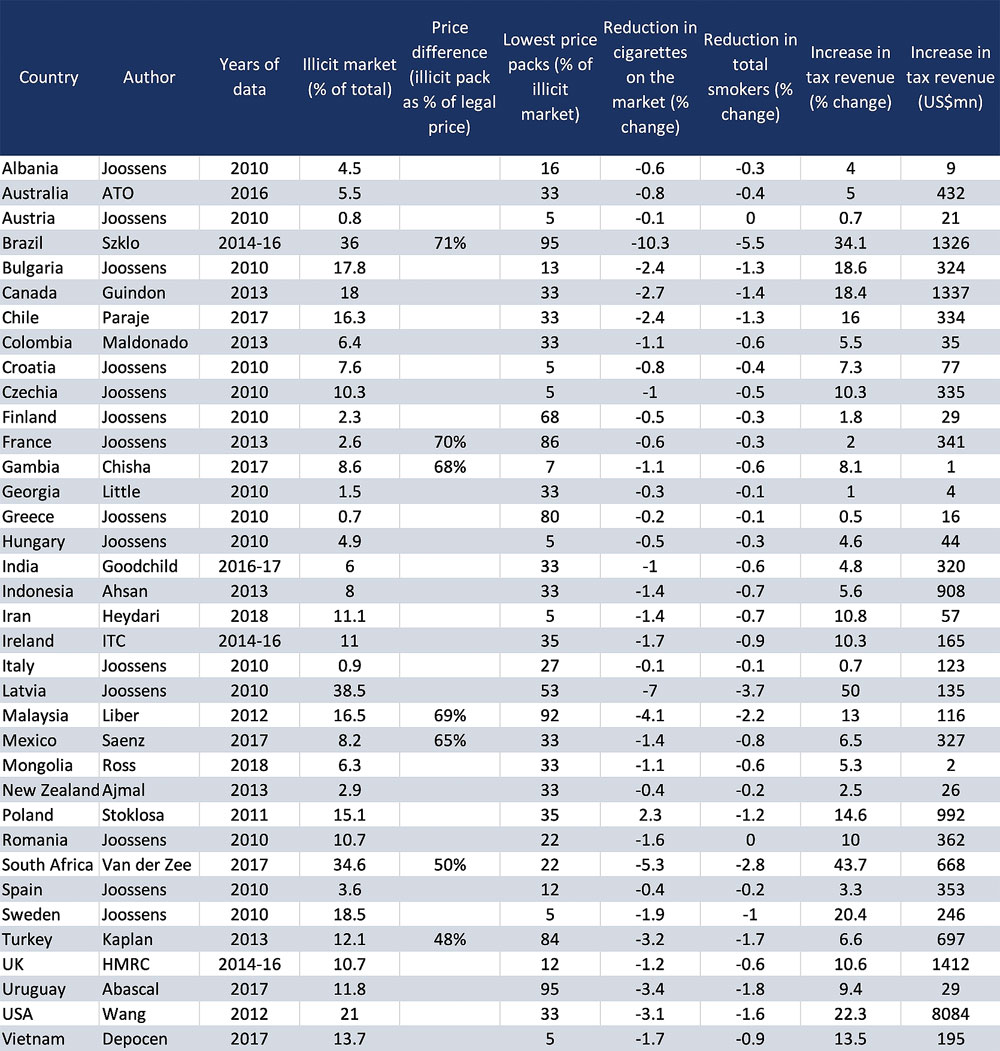
The authors identified 36 countries where an independent (non-industry sponsored) study of the illicit cigarette market was available, and developed a conceptual framework to describe how the elimination of illicit cigarettes might impact on demand, which was then applied to the sample countries. (For ease of calculation, the authors of the study assumed the complete elimination of illicit cigarettes.) Aside from achieving the primary purpose of assessing the potential quit rates and revenue impact, the paper also constitutes a useful summary of the most current estimates on the prevalence of illicit cigarettes across a spectrum of countries. These studies can be difficult and time-consuming to collate, making the data included in the study an invaluable resource. (A consolidated version of the key data points used in the study, as well as key findings, is referenced in Fig 1.)
Insight into illicit cigarette prevalence and pricing of illicit packs
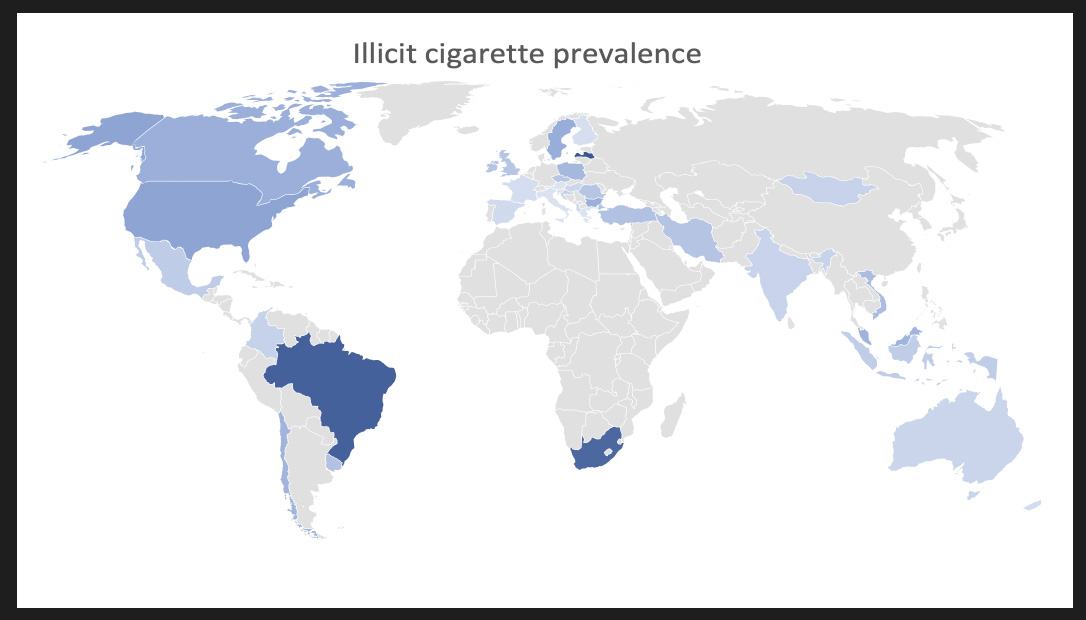
Consistent with the earlier Joossens study, the current study again finds an average prevalence of illicit cigarettes of around 11.2% of the market in the 36 countries sampled. Perhaps not surprisingly, countries like Brazil, Bulgaria, Chile, Malaysia, Poland, Sweden, South Africa (34.6%) and Latvia (38.5%) top the list of the sampled countries in terms of the prevalence of illicit cigarettes.
While data was not available for all of the countries covered by the study, it was also possible to establish an (updated) assessment of the average price differential between licit and illicit cigarettes. The price of illicit packs among these countries ranged from a relatively low 48% in Turkey to a high 71% of the price of legal packs in Brazil.
On average – across the 10 countries surveyed – illicit packs cost 63% of the price of legal packs, and with smokers of illicits having to incur a 59% increase in price if they were to switch to legal packs. The results are consistent with the earlier Joossens benchmark, which suggested that the price of illicit packs tended to be equivalent to the price of legal packs minus two-thirds of the tax (the data is referenced in Fig 1).
Impact on reducing consumption
Some illicit smokers may not necessarily experience a large price increase from the elimination of illicit cigarettes, and little is actually known about the choices smokers will make in the absence of illicit cigarettes. The study addresses this partly by segmenting the market into low and mid-price/high-price packs, with the expectation that smokers of the cheapest illicit packs are more likely to face a larger price increase.
About half of the reduction in cigarette consumption from a price increase is due to a decrease in the intensity of smoking, while the other half is due to cessation.
The impact of price increases on consumption is ultimately determined by the price elasticity of demand, with empirical studies indicating that such elasticities cluster around −0.4 in high-income countries (HICs) and −0.5 in low- and middle-income countries (LMICs). This means that a 10% increase in cigarette prices would reduce consumption by 4-5%. Smokers in LMICs tend to be more price sensitive, with lower income smokers having higher price elasticities than medium- and high-income smokers.
The study applies the following price elasticities: −0.8 for smokers of the lowest priced illicit packs in LMICs; −0.5 for other illicit packs in LMICs; −0.7 for lowest price illicit packs in HICs and −0.4 for other illicit packs in HICs.
Based on an average prevalence of illicit cigarettes of 11.2% of the market in the 36 surveyed countries, eliminating illicit cigarettes would reduce total cigarette consumption by 1.9%, representing 3.9 million fewer smokers in this sample of countries; and in countries where illicit cigarettes are >15% of the market, reduced consumption would amount to an average of 4.1%.
Analysis further suggests that 10% of illicit smokers would quit altogether in response to the higher prices due on legal packs.
Impact on additional tax revenues
The study broadly estimates that the global revenue potential from eliminating illicit cigarettes is about $47.4 billion today, compared with $31 billion in the earlier Joossens study.
As smokers switch to legal packs, governments of course also experience an increase in tax revenues.
The impact on tax revenues is calculated by multiplying the increase in legal cigarette consumption at the cheap and mid/high end of the market by the applicable tax per pack in US dollars. The gain in tax revenue is calculated after accounting for changes in consumption as illicit smokers switch to higher priced legal packs, while also recognising that some smokers will enter the legal market at different price points, thus impacting tax yields.
Eliminating illicit cigarettes in countries where illicit cigarettes are >15% of the market, would lead to tax revenues from the legal sale of cigarettes increasing by as much as 25.1%, representing an extra $19.9 billion across the countries surveyed.
Two key tax revenue findings stand out: in Brazil the additional tax revenues would constitute a 34.1% increase, to the tune of $1.326 billion, while in South Africa cutting out illicit cigarettes would result in a 43.7% increase in tax revenues worth $668 million.
Conclusion
The illicit cigarette market reflects a complex interplay between supply and demand, with an array of different country conditions.
Eliminating the illicit cigarette market is an important goal for public health, including global strategies such as the WHO Global NCD (non-communicable diseases) Action Plan. The positive impact of controlling illicit trade extends beyond health into other development areas such as good governance and justice. This study highlights the positive contribution that illicit countermeasures can make to demand reduction, while at the same time generating significant tax revenues, especially in countries with a high prevalence of illicit trade.
The relatively rich data source that collates the most recent academic and tax agency research – and the consolidated table included in this article – is likely to be particularly useful as a resource as part of the business case for stronger supply chain controls. The study provides a useful perspective for solution providers, with a strong fact base that supports the need for stronger controls over the cigarette supply chain, which includes the use of secure marks and tax stamps.
About the author: Telita Snyckers is an independent illicit trade expert. Key clients include the International Monetary Fund, after having previously worked as an Executive at the South African Revenue Service, a compliance manager with the tax man in Singapore and a Director with niche consulting firm Sovereign Border Solutions. She has a Masters Degree in Constitutional Law and Fundamental Rights, and has had work assignments in over 25 countries around the world. Her exposé on the role of big tobacco in fuelling illicit trade – Dirty Tobacco – was released in May 2020.
Subscriber content
Read the full article
Full access to Tax Stamp & Authentication News™ articles, newsletters and archives.