
Decathlon’s RFID Revolution


As the world’s largest sporting goods retailer – in addition to manufacturing its own sports products – Decathlon has revolutionised its operations over the past 10 years by implementing radio frequency identification (RFID) technology on every piece of merchandise in its vast inventory.
Before it moved into RFID, the $11 billion global retailer, with its sprawling network of stores (which today number over 2,080 stores in 56 countries and regions), was facing significant challenges in managing the logistics, inventory, labelling and tracking of the thousands of products it manufactured and sold.
To overcome these challenges, Decathlon decided to implement Electronic Product Code™-enabled RFID, in line with technology-agnostic GS1 standards, so as to be able to uniquely identify every product in its portfolio, anywhere in the world, and across any kind of supply chain.
In 2013, Decathlon became the first company to manufacture products incorporating RFID source tags for the purpose of tracking merchandise through its ecosystem. By 2014, RFID had been rolled out to all Decathlon processes, including warehouse and retail store inventory, earning the company recognition for the most extensive use of RFID at retail level.
By 2019, Decathlon had tagged 100% of its products – either on the item itself or its packaging – and was tracking these products through the entire supply chain, from factory to distribution centre to store.
Other brands sold by Decathlon
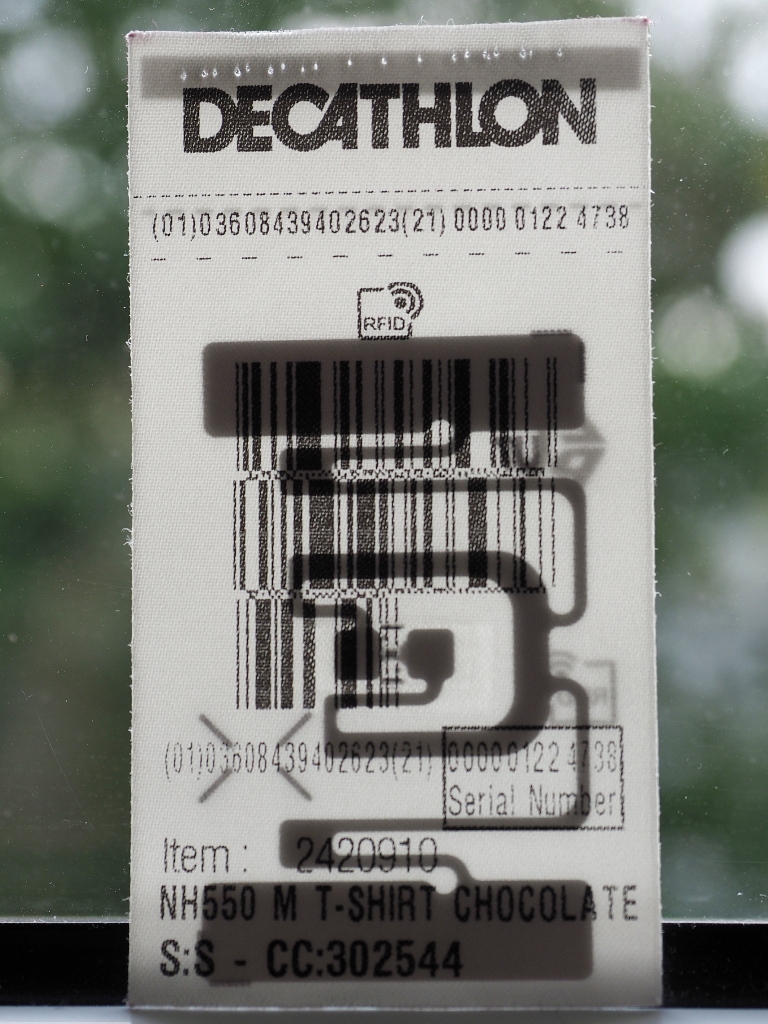
As far as non-Decathlon products are concerned (ie. those produced by other companies for sale in Decathlon stores), these are tagged with an RFID label at a Decathlon distribution centre. The label used for this purpose is a Tageos paper- based EOS-300 Monza R6-P RFID tag, measuring 54×34 mm, and specifically designed for Decathlon.
The label comes in the form of a double sticker: on the backing sheet, alongside the standard EOS-300 label, is a smaller non-RFID blank sticker printed and encoded with a unique identification number to aid logistics staff during the labelling process.
The R6-P chip inside the Tageos label provides enhanced security in the form of access and kill password controls to prevent unauthorised write access and allow deactivation of the chip. The kill password permanently disables the tag (kills it), which is useful in sectors such as retail, where RFID tags are often disabled during checkout. Such controls prevent potential reuse of the tag on a counterfeit item, for example.
‘We are not a luxury goods company, but we are facing more and more of these kinds of issues,’ said Hervé d’Halluin of Decathlon, speaking about counterfeit goods. ‘We evaluate which product could be subject to counterfeiting and put the right tag on the right products, depending on the risk.’ With 100% of its products now tagged, the company is focusing on connecting the tags with the GS1 Digital link solution, in order to engage with customers and for more efficient recycling processes.
GS1 Digital Link is a standardised structure allowing a single 2D barcode on a product to act as a multi-functional ‘gateway’, which does away with the need to apply multiple barcodes on one product. One of the key functions of GS1 Digital Link is to act as a consumer-facing web-based URL. While manufacturers and retailers can continue to use their established GS1 codes, GS1 Digital Link makes those codes web-capable and, for the first time, allows them to be used by customers – globally.
This means that different identifiers encoded in data carriers such as RFID tags can be expressed as web addresses leading consumers to information on the product itself, usage instructions, user forums, product authentication, traceability…the list is endless.
Subscriber content
Read the full article
Full access to Tax Stamp & Authentication News™ articles, newsletters and archives.