
Chile Launches Joint Tax/Customs Campaign to Tackle Illicit Cigarettes


It’s not all about new constitutions, riots and uncontrollable forest fires lately in Chile. There’s actually been some interesting news with respect to traceability, with press releases from both the tax authority, Servicio de Impuestos Internos (SII), and the national customs service, Aduanas de Chile.
First, let’s go back in time a little. As regular TSTN readers may remember, Chile launched a tobacco tax traceability project in 2019 called SITRAF (Sistema de Trazabilidad Fiscal), which SICPA eventually won after a very long tender process.
So far, the results have been positive, with over 3 billion cigarette boxes marked between May 2019-October 2022, and significant revenue increases recorded in Chile’s quarterly state budget execution report.
These results are in line with what the SII had initially hoped to recoup from a traceability and tax stamp system when it first started talking about implementing the system over a decade ago.
The figures also show that cigarette production has not decreased significantly, despite a constant, if not accelerated, reduction in consumption patterns (21.2% in 2016 versus 19.6% in 2020). The reduced consumption is due to stricter tobacco usage regulations and accompanying control mechanisms.
Illicit trade still a concern
Despite these positive results, illicit trade remains a concern in Chile. According to a survey conducted by MIDE UC in 2021, 16.1% of participants consumed illicit brands, of which 46% came from the north of Chile and only 14% from the much more heavily populated Santiago region. These figures drew the attention of Chile’s customs service.
Moreover, tax evasion from cigarette smuggling increased to $32 million over the first three quarters of 2022, compared to $31 million for the whole of 2021.
To address this continuing threat, at the end of November 2022, the SII distributed a press release to launch a joint SII/customs special plan to control the sale of counterfeit and contraband cigarettes. The main objective of the plan is to identify attributes that allow the detection of locations where counterfeits are marketed in order to seize them, apply the corresponding sanctions and discourage their further commercialization and smuggling.
Among the actions contemplated in the plan are site visits to control taxpayers according to their tax risk classification, the distribution of preventive informative mailings, the dissemination of the e-Verifica app, and the eventual expansion of controls across all regions of the country.
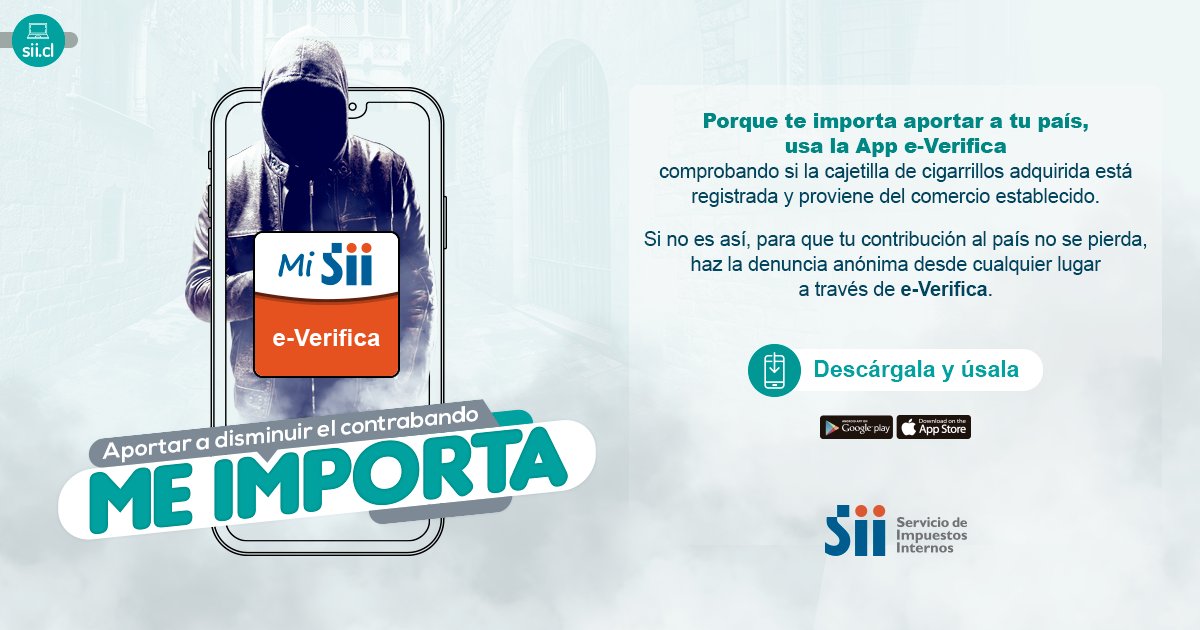
The visual advertising supporting the joint campaign carries the slogan ‘aportar a disminuir el contrabando me importa’, which translates to ‘I care about the reduction of smuggling’. Both the Director of Customs, Alejandra Arriaza, and SII Director, Hernán Frigolett, participated in a public demonstration of the technological devices that will be used in the field to verify the validity of cigarette packs and weed out counterfeits.
Hernán Frigolett emphasized that, ‘at the SII, we work to address situations that damage our tax system. This plan includes on-site inspections of over 400 specific taxpayers selected for having a history of selling counterfeit cigarettes in specific premises that will need to be inspected. It also includes sending over 15,000 preventive mailings to cigarette sellers, and the dissemination of the e-Verifica app, which allows individual citizens to quickly certify the validity of cigarettes being purchased and file complaints when appropriate.
‘All this is possible since the implementation of the tobacco traceability system, which provides us with key information for data analysis that serves as a basis for carrying out controls to verify the correct payment of specific cigarette tax, VAT and income tax.’
Alejandra Arriaza added: ‘we are working on control programs at the national customs service that allow us to protect the country and citizens from different types of crimes that can be committed in our sphere of influence. For that reason, today we are joining the SII in their fight for traceability of cigarettes due to the impact that this type of contraband has on tax evasion and crime.
‘Our goal is to achieve total traceability, so that the public is aware of the security systems, the importance of respecting them and that the corresponding taxes are paid. In this way, we also promote honest trade developed by companies and entrepreneurs, a sector that generates jobs and must be protected.’
The presentation concluded by specifying that the initial focus will be on the northern customs offices in the cities of Arica, Iquique, San Antonio and Antofagasta. Based on the results of this first stage of implementation, the reach of the special plan will be expanded, incorporating lessons learned from its initial application.
It should be noted that only the SII will be able to access the information generated by the traceability system, ensuring that both the devices used and the information contained therein cannot be accessed or modified by third parties.
Components of the SITRAF Traceability System
Chile’s SITRAF system utilises a secure 2D barcode, which is unique to each individual tobacco pack and contains information on the product, producer, destination, relevant dates, and specific tax to be paid.
Domestically produced cigarette packs for domestic consumption carry a directly printed security code applied on the production line. Imported packs, on the other hand, carry a paper-based tax stamp, affixed either before the products arrive in Chile or at the moment of import.
Exported products carry neither a direct code nor a tax stamp. The only requirement is for the products to be counted and information pertaining to the products to be captured in the database.
The directly printed codes and paper stamps carry multiple levels of security. The direct code is printed with security ink containing covert and forensic authentication elements.
The tax stamp on imported products carries authentication elements at overt, covert and forensic level, in addition to the unique identifier.
Although the stamps are referred to as ‘tax’ stamps, the direct codes and stamps do not serve as tax payment tools as such, but rather as tools for track and trace only. The respective excise tax is instead declared and paid by means of regular lodgment processes.
Data and risk analysis
All the data generated and collected by the system is stored on a dedicated central database, which is integrated with other relevant SII platforms, such as electronic invoicing and risk assessment systems, and a smartphone app for consumers.
Tax officials are directly linked to the risk assessment system. Thus, if certain anomalies are detected in cash flows, inventory levels, cost indicators or products in transit, a flag alert triggers, instigating a risk review or audit of the corresponding manufacturers and importers, or even of their providers or clients.
Verification and control
There are three different verification devices used within this programme:
1. A wireless, mobile, validation device for tax inspectors, which can both authenticate the code by detecting a covert marker embedded in it and retrieve the traceability information associated to the code in the database, to determine the product’s origin and compliance status.
2. A validating card with a double-polarisation filter to allow tax inspectors to authenticate the semi-covert features of the tax stamp, even in offline mode. When the filter is placed over the SII logo on the stamp, the colour of the logo changes.
3. A smartphone app for the general public, called e-Verifica. The SII launched this ‘in house’ app to allow consumers to verify and report cases of taxpayer non-compliance. In addition to returning traceability information stored in the central database, the app allows consumers to report non-compliant products and to upload pictures.
Subscriber content
Read the full article
Full access to Tax Stamp & Authentication News™ articles, newsletters and archives.