
The Current State of Illicit Trade in India

Despite great efforts at a global level, illicit trade has grown into a pandemic, and India is no exception.
According to a new report released by FICCI CASCADE (Federation of Indian Chambers of Commerce & Industry Committee Against Smuggling and Counterfeiting Activities Destroying the Economy), the illicit trade in five key industries (mobile phones, household and personal goods, packaged foods, tobacco products, and alcoholic beverages) succeeded in draining INR 2.6 trillion ($31.4 billion) from the Indian economy in FY2019- 20 – almost double that of five years earlier.
The report, titled ‘Illicit Markets: A Threat to Our National Interests’, is the third edition in a series. It provides a quantitative analysis of the value, scope and magnitude of illicit markets and their impact on legitimate domestic manufacturing industries and economies.
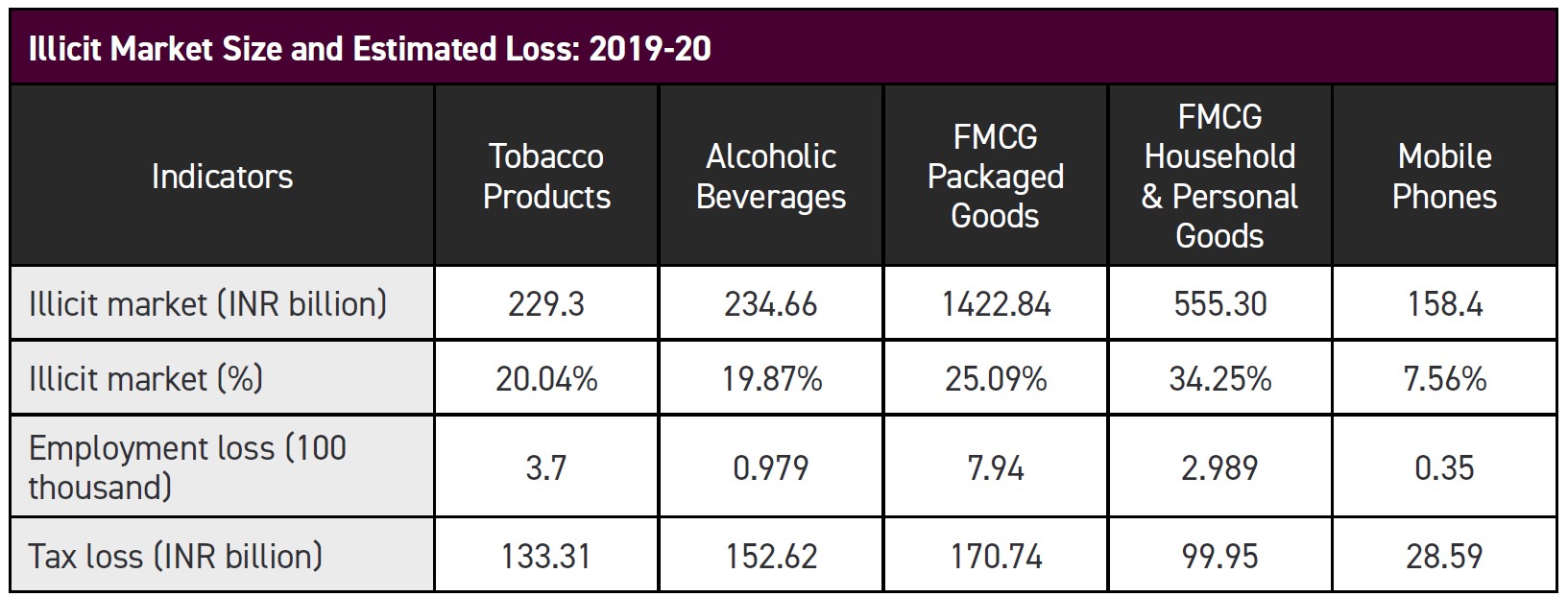
The report (which was presented at the Mascrade 2022 event organised by FICCI CASCADE in New Delhi in September, and sponsored by SICPA, Amazon, Johnson & Johnson and ITC Hotel) reveals that illicit trade in the five key industries caused the Indian exchequer to lose INR 585 billion ($7 billion) in tax revenues in 2019-20, as well as causing the loss of 1.6 million jobs (see table below).
As per the report, the two highly regulated and taxed industries, tobacco products and alcoholic beverages, accounted for nearly 49% of the overall tax loss to the government, even though their share of the illicit market in value terms was much lower than the FMCG industries.
Tobacco and alcohol estimates
Estimates show that the illegal market of tobacco products (bidis, smokeless tobacco, and cigarettes) increased from INR 218.11 billion in 2018-19 to INR 229.30 billion ($2.8 billion) in 2019-20, representing 20.04% of the illicit market. India is the third largest producer of tobacco leaf and second largest consumer of tobacco.
The illicit market of alcoholic beverages in India is gradually decreasing, from 23.88% in 2017-18 to 19.87% in 2019-20. Even in value terms, it is coming down, and was estimated at INR 234.66 billion in 2019- 20 – although the lockdowns and travel restrictions resulting from the COVID 19 pandemic affected overall consumption during that period.
According to IWSR data, alcohol consumption in India has sharply increased in the last three years, reaching 6.177 billion litres in 2020, from 5.376 billion litres in 2017. While the alcohol beverage industry is one of the most regulated sectors in India, experts still consider calculating real estimates to be very difficult, as illicit alcohol in India falls under the broad umbrella of unrecorded alcohol.
Although the illicit market in India has dramatically increased, it is still possible to tackle illicit trade with some success, especially in the regulated tax sector.
Whilst in the tobacco sector India is yet to implement FCTC Protocol measures, which call for secure track and trace systems, in the alcohol sector more than 22 states (including three union territories) are using approximately 22 billion tax stamps per annum. Over the last five years, almost one third of states using alcohol tax stamps have enhanced their existing systems with physical/digital solutions.
Recommendations
Illicit trade is a complex problem, with many factors having kept this activity going for a long time, said the report. To combat this menace, public and private sectors, law enforcement agencies, international organisations, and civil society need to cooperate. These stakeholders will only be able to combat this scourge through a collaboration that covers both political and technical aspects of illicit trade.
To this end, the report proposes a number of recommendations, including:
The need to strengthen domestic manufacturing and the ‘Make in India’ initiative so as to reduce reliance on imports to close the demand and supply gap.
Rationalisation of tariffs to reduce tax arbitrage.
Increasing consumer awareness.
Creating a conducive environment for innovation and strengthening intellectual property rights.
Harsher penalties and strengthened law enforcement.
International coordination and cooperation.
The report also recommends the leveraging of technologies. These include advanced technologies for customs authorities, such as drones, embedded sensor and actuator solutions in the transportation of assets, cargo shipment data mining with risk analytics, next-generation surveillance cameras, robotics, and non-intrusive inspection technologies.
www.ficcicascade.in/wp-content/uploads/2022/10/illicit-market-report-2022-NEW-LAYOUT-1.pdf
 Source: FICCI CASCADE.
Subscriber content
Read the full article
Full access to Tax Stamp & Authentication News™ articles, newsletters and archives.