
White Paper on Cannabis Data Capture Solutions Hardly Mentions Security Features


The Cannabis Work Group of AIM North America, the premier alliance for the automated data capture technologies industry, has released a white paper reviewing the use of automatic identification and data capture solutions (including barcodes, RFID, and NFC) for cannabis traceability.
But while the paper does a good job of describing the usefulness of different solutions in the cannabis sector, it almost completely omits to mention the importance of security features and secure environments for producing and applying such solutions to cannabis products.
The paper, titled ‘Track and Trace for the Cannabis Industry, from Cultivation to Consumer’ 1 was written for all members of the cannabis supply chain, namely farmers and growers, processors, manufacturers, distributors, dispensaries, and even consumers.
‘Growers, processors, and retailers are navigating significant challenges in a relatively new industry. The need to comply with traceability regulation adds a layer of complexity to what it is they do,’ said Elizabeth Sinclair, Cannabis Work Group Chair. ‘This white paper is a primer on the automatic identification and data capture (AIDC) technologies that will enable regulatory compliance and process efficiencies at scale as the cannabis industry grows.’
What is AIDC?
The white paper describes AIDC as a constellation of technologies used to design, encode, print, identify, verify, and record electronic information. It covers data-carrying technologies such as barcodes, RFID and NFC, and their related design and print software, printers, labels, infrastructure such as RFID readers – including smartphones and antennae – along with software/middleware, verifiers and vision systems.
AIDC technologies assist users with inventory accuracy, track and trace, loss prevention, visibility, and other business needs, by connecting the physical to the digital.
The paper states that while barcodes enable many different kinds of real-time data to be collected accurately and rapidly, often by means of a simple scan with a smartphone, it is radio frequency identification (RFID) that has made the most important inroads into the cannabis industry. This is because RFID carries certain advantages over barcodes as a tool for data collection, reporting and regulatory compliance.
With RFID, a reading device sends out a radio signal that is picked up by a tag with an attached or embedded transponder. The transponder then sends a return signal to the device to identify the tagged item.
The information stored on the tags always includes a serial number and may include other information such as sell by date, expiration date, lot number and other production data.
Some RFID tags can hold encrypted information, which is useful in the cannabis industry, says the paper, given that non- authorised readers would not be able to access the information in the tag, and any transactions would also be secured. Recently, protocols have been developed that allow password protection of all or parts of the data stored on a tag.
RFID tags are more expensive than barcodes, but the same tags can be used repeatedly, making them cost-efficient for most applications. And unlike barcodes, line of sight is not required to read an RFID tag – the readers ‘listen’ for data, rather than ‘look’ for it.
The two main types of RFID commonly used in the cannabis industry are RAIN RFID (the brand name for passive UHF RFID) and near-field communication (NFC).
RAIN RFID offers benefits specific to the cannabis industry, including the ability to read, at ranges of 10 metres or greater, hundreds of tags almost simultaneously. This enables thousands of plants to be inventoried in seconds, while at the same time allowing for individual plants to be easily identified.
There are several cannabis business systems in use today, such as METRC, BioTrack, MJFreeway and KindAgrosoft, which utilise pre-programmed, ready-to-use RFID tags.
The white paper also refers to Near Field Communication (NFC) as a form of RFID that has been driven by the evolution of smartphones. NFC has become commonplace, used by smartphones to communicate with other nearby electronic devices.
NFC applications are used, for example, to enhance the consumer experience, and give them visibility over entire product lifecycles, as well as provide brand protection through anti-counterfeiting capabilities, and enable supply chain traceability.
NFC works in a similar way to RAIN RFID: a device such as a smartphone transmits a radio signal to an NFC tag in order to initiate a response. However, NFC communicates within a very short read range, of 4cm or less.
The paper also refers to new AIDC technologies such as digital watermarks, which act like ‘invisible barcodes’.
A digital watermark can take the form of an advanced 2D data carrier integrated into packaging and labelling materials in such a way that it is repeated across the entire surface of an item, while remaining invisible to the naked eye. This creates a reliable and easy-to-scan optical capture system that doesn’t interfere with design aesthetics.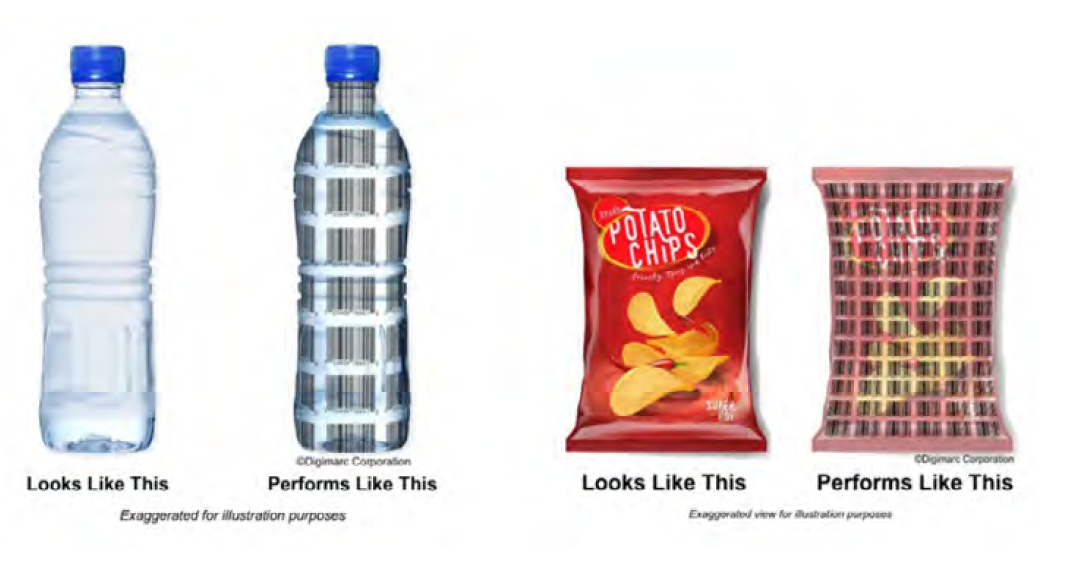
Effectively, watermarks can be ‘hidden’ within the image content of any consumer packaging, label design or other print media, or they can be applied in an overt manner similar to 2D barcodes. They can be scanned using commercially available barcode scanners throughout the supply chain, or via mobile devices for post-sales consumer applications.
Blockchain
While AIDC technologies are key to digitally identifying physical products, secure data sharing and validation are critical to establishing trust and transparency in the rapidly growing cannabis industry, says the white paper.
Unfortunately, seed-to-sale data is often siloed, with each participant in the industry only having access to their own data, which is why the industry needs to have in place a trackable chain of custody, from production to retail.
This is something that blockchain can provide, since distributed ledger technologies like blockchain can create a digital ecosystem that mimics a distributed supply chain.
Stakeholders can participate independently as nodes in the system, contributing data to provide value to the network, or consuming data to extract value from the network. This forms an immutable and distributed sense of truth behind a particular object, whether that be a raw material or final product.
Coupled with AIDC technologies, this creates a digital twin, accessible along the product’s journey, logging data immutably along the way.
Printing barcode and RFID labels
Printers are often used in connection with AIDC solutions to print barcodes and/or encode RFID labels, usually with variable, dynamic data, explains the white paper.
Variable data is a key concept for AIDC in the cannabis industry, as each item, for example a specific plant, shipping carton, or finished product, often must be uniquely identified. Variable data capabilities — and by extension, uniquely identified items — allow users to adhere to strict cannabis regulations and optimise business operations.
Three different types of printing technologies are commonly used: inkjet, laser and thermal printing, which the white paper goes on to describe in detail.
Thermal printers, in particular, not only print barcodes and text, but some models can also encode RFID chips embedded into labels. This allows users to simultaneously print traditional barcode labels and encode unique data into each one, thereby creating ‘smart labels’.
The paper also addresses the frequently asked question of why standard office printers can’t be used to print labels. It explains that standard printers are primarily designed to print sheets of plain text, whereas labels may call for the printing of colours, images and barcodes. This requires significantly more ink and makes office printers more expensive to operate than label printers – as well as being slower.
All good advice… but little mention of security features
While the white paper gives a thorough overview of AIDC components and how they can best serve cannabis traceability systems, very little reference is made to security features.
Using barcodes alone, without physical security features such as anti-copy protection, exposes the codes to cloning, with a cloned code ostensibly performing in the same way as a genuine code, thereby making it virtually impossible to differentiate between genuine and clone.
However, this downside is not mentioned in the white paper. What’s more, no reference is made to physical security features, such as optical effects and taggants, and how they can be used in conjunction with AIDC technologies.
Another concern lies with the description in the white paper of how RFID and barcode labels are printed. The paper goes into detail with regard to the main label printing methods used, ie. inkjet, laser and thermal printing (which are widely available methods not traditionally employed in security printing) without mentioning the secure conditions in which these labels need to be produced.
Given that the cannabis industry is already susceptible to illicit trade and malpractice by actors in the supply chain, RFID and barcode labels that are used to identify, capture and report cannabis information for regulatory compliance purposes, are prime targets for counterfeiters and tax evaders.
Therefore stringent security protocols need to be in place to control both the people and equipment that produce and distribute the labels, and the environment in which they are produced – something that the white paper overlooks entirely.
Subscriber content
Read the full article
Full access to Tax Stamp & Authentication News™ articles, newsletters and archives.