
Cannabis Tax Stamp Tweaks Proposed in Canada’s 2022 Budget


Canada’s 2022 budget has proposed potential changes to Canada’s federal excise tax system for cannabis, including allowing licensed cannabis producers to transfer excise duty stamps between them.
Under the current cannabis excise duty framework, packaged but unstamped cannabis products cannot be transferred between producers, and transferring excise duty stamps from one producer to another is also prohibited. These restrictions, while intended to ensure the security and integrity of the supply chain, have also led to inventory management issues and inefficiencies in the supply chain for the cannabis industry.
The 2022 budget therefore proposes to allow the Canada Revenue Agency (CRA) to approve certain contract-for-service arrangements between two licensed cannabis producers, which would permit the producers to:
Transfer stamps and packaged, but unstamped, products between them.
Stamp and enter cannabis products into the retail market that have been packaged by the other producer.
Pay the excise duty on cannabis products that were stamped by the other producer.
Canada’s tax stamp regime
Canada’s federal/provincial tax stamp regime for cigarettes, tobacco, cigars and raw leaf was introduced in 2011, by the CRA, as part of a raft of measures to address some of the worst levels of counterfeiting and smuggling of any developed country. The other measures included an improvement in oversight of raw leaf tobacco and an increase in auditing of tobacco supply chains.
In 2019, the CRA awarded a new five-year contract to Canadian Bank Note Company (with SICPA as sub-contractor), for the continued supply of tobacco-related tax stamps, together with an extension of the stamps to medical and recreational cannabis.
Both the tobacco and cannabis stamps carry the same design, with similar informational elements and security features.
While the stamps are available in both a ‘federal’ version (marked ‘CAN’) and a suite of provincial versions, the CRA has sole authority over the stamp design, manufacture and distribution, which includes the authority to limit the quantity of stamps issued and to whom. This has resulted in a uniform stamp design across all states, with different colours and abbreviations (eg. ‘AB’ for Alberta and ‘MB’ for Manitoba’) used to differentiate the stamps.
The stamps provide proof of tax payment at either federal level only, or at federal and provincial level, depending on whether the province in which the product is sold has adopted the new regime (which is not mandatory at provincial level). However, only one stamp needs to be applied to each product, not two.
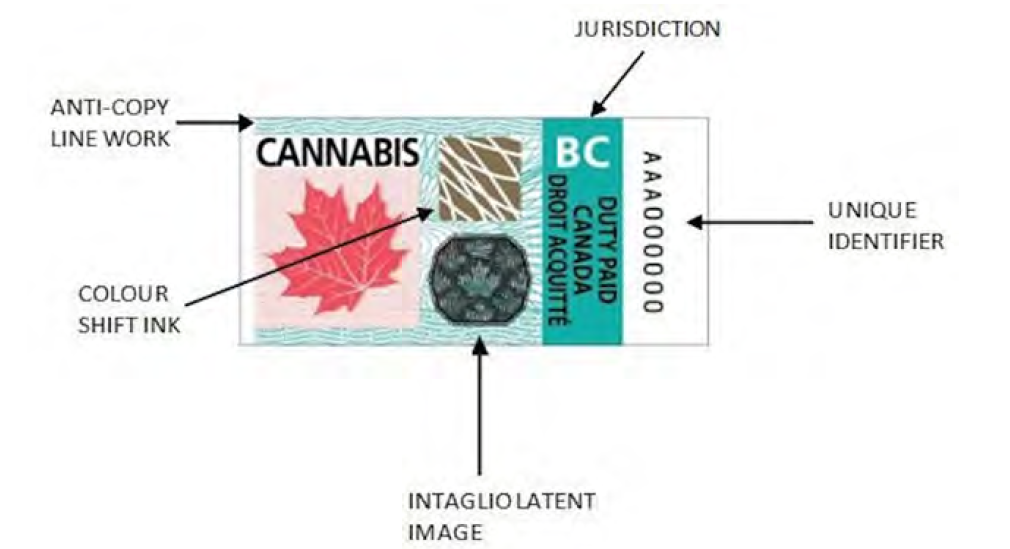 © Canada Revenue Agency.
Apart from the colours and abbreviations denoting jurisdiction, the other information on the stamps includes the type of product (ie. cigarettes in packs of 20 and 25; tobacco in three different weights; cigars; raw leaf, and cannabis), an alphanumeric unique identifier, and the duty-paid status.
The stamps have a layered security design that uses overt, covert and forensic features. The visible features include:
Anti-copy linework in the image of a maple leaf on the lefthand side of the stamp. The feature makes replication by photocopying extremely difficult, as the quality and clarity of the linework would not carry over to a copied document.
Colour-shifting ink in the square in the upper middle section.
An intaglio latent image beneath the colour- shifting ink, which creates unique tactility and visual effects, and in which the letter ‘C’ is visible upon minor movement of the stamp.
UV visible ink that fluoresces under a commercially available black light.
The main covert feature is an invisible encrypted machine-readable verification code for enforcement agencies, which can only be detected with a dedicated scanning device. The stamps are also required to act as tamper-evident seals by being placed over the opening of the product packaging.
Since the stamps can only be ordered from one source, this allows CRA to establish a nationwide database of who is ordering how many stamps and for which product. This information is shared with the provinces, and they can use it when auditing their registrants.
When stamps are ordered for a particular province, CRA will check that the manufacturer is on a provincial list of registered tobacco companies before releasing the stamps. If they are not on the list, they do not get the stamps.
Subscriber content
Read the full article
Full access to Tax Stamp & Authentication News™ articles, newsletters and archives.