
Securikett IoT Platform and Labels at Heart of New Packaging Recycling Project

The Austrian pilot project ‘Digi-Cycle’ – supported by the Austrian drinks industry to facilitate householding recycling of beverage containers through a rewards scheme – took place last August and September. Central to the pilot, which is part of a series of initiatives for waste management and recycling that will be signed into law, were tamper-evident labels and a system for generating limitless UIDs by Austrian security solutions provider Securikett.
Digi-Cycle is a digital incentive system for the separate collection of beverage packaging, with rewards offered to increase waste separation and recycling by householders. It was run by resource management pioneers Saubermacher and Altstoff and took place in the district of Gnas in southeastern Styria. The objective of the pilot, in which every sixth household participated, was to provide insights into the concept of a voluntary collecting bonus for end consumers willing to recycle.
At the heart of the scheme was an app, with which the code on the bottle or beverage can, and the respective collection container, is scanned. Securikett’s contribution included the creation of the codes through its proprietary IoT platform Codikett and the production of tamperproof labels with a newly developed recyclable adhesive.
Codikett is modular system for product identification and has been proven in the global market for many years. It generates a near limitless number of secure unique identifiers in a matter of seconds. Querying the coding system, which is based on cryptographic processes, delivers results just as fast.
It enables independent participants in the manufacturing chain to download and deploy large volumes of security codes quickly and traceably, the idea coming from the requirements of the European regulation on tobacco product traceability.
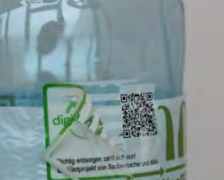 Digi-Cycle (© Securikett).
‘Imagine having to search a large database for every code on a beverage bottle in order to activate the collecting bonus via the internet. That would take far too long with millions of packages in circulation that need to be recycled,’ said Dr Marietta UlrichHorn, CEO of Securikett, highlighting the scope of the IoT solution.
For the physical side of the scheme, Securikett developed tamper-evident QR code labels for application to a variety of different packaging materials – glass, aluminium and PET beverage containers – using a novel adhesive. By using a special security effect in the label, any detachment of the label is immediately visible, says Securikett. At the same time, the adhesive is water-soluble, allowing the recycling process to proceed undisturbed.
Digi-Cycle is being supported by leading organisations in the Austrian drinks industry, including Brau Union Österreich, Rauch, Red Bull, Vöslauer and Coca-Cola Österreich. It forms part of a raft of measures under the Austria Waste Management Act and Packaging Ordinance, aspects of which include:
Deposits on disposal beverage containers as of 1 January 2025.
Obligations for electronic marketplaces and fulfilment service providers as of 1 January 2023. Sellers must comply with legal requirements concerning the collection and recycling of packaging material, disposable plastic products, waste electrical equipment and device batteries. This means that marketplaces and fulfilment service providers will need to exclude sellers from the platform in the event of noncompliance.
Plastic packaging is to be reusable or recyclable as of 2030.
In household collection, all plastic packaging is to be collected separately throughout Austria, and a new model for the collection of commercial packaging is to regulate the assumption of transport costs within the scope of producer responsibility.
Producer responsibility is extended to raising the level of awareness of and eliminating littering from certain single-use plastic products (this is usually done by the takeback system).
Digi-Cycle for single-use deposit and separate collection.
Whilst the Digi-Cycle pilot was applied only to drinks containers, a major benefit is that the technology can be extended to include numerous products, including non-food packaging, batteries and electrical appliances.
Subscriber content
Read the full article
Full access to Tax Stamp & Authentication News™ articles, newsletters and archives.