
Emerging Technologies – Direct Marking Solutions


While direct marking could be considered as an opportunity for traceability solutions, it could also be viewed as a threat to physical tax stamps.
On the other hand, the ISO 22382 tax stamp standard (Guidelines for the content, security, issuance and examination of excise tax stamps) describes the usability of direct marking technology for tax stamps.
It advises tax authorities to consider the option of printing relevant taxation information directly onto the taxable product itself or onto its primary packaging, as an alternative approach to using a separate material tax stamp.
In this article, we will therefore consider direct marking as a complementary solution which could expand the size of the overall tax stamp and traceability business. We will segment direct marking into different categories as this may guide us towards further solutions.
The article aims to identify those areas in traceability businesses where opportunities may be found. The Tax Stamp & Traceability Forum™ (TSTF), held in May 2022, provided an interesting overview, so we should begin there.
The evidence from TSTF 2022
Perspectives presented at TSTF 2022 can be used to guide this discussion.
A presentation from SICPA noted that ‘one solution does not fit all’, meaning that there are different technologies for tax stamps (paper-based and direct marking), and that in some circumstances, direct marking could be the best choice, provided that material-based security is used to protect it against misuse, duplication, or counterfeiting.
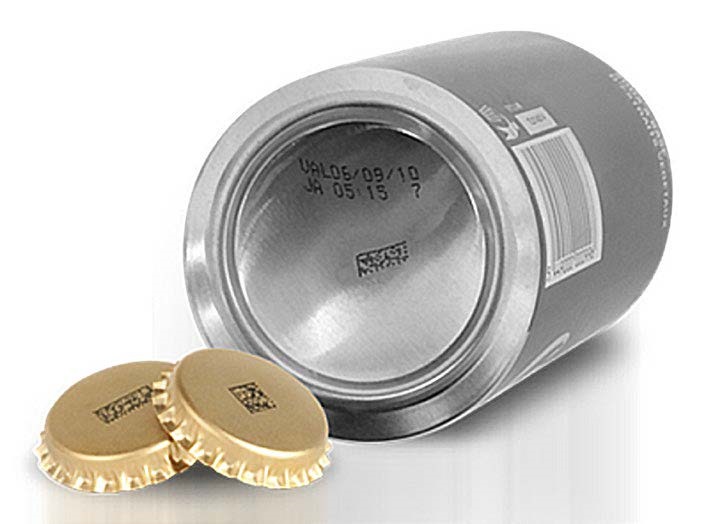
The OPTEL Group presented digital marking as having the potential to take track and trace further, with the suggestion that this opportunity could be 10x the size of existing markets. While there are challenges in terms of speed and cost, OPTEL suggested that, together with stamps, this could provide a continuum of stronger solutions.
Although physical labels can be seen as secure, they add cost and application time, while direct product marking is seen as the opposite of this – unless material- based security features are integrated in the marking. However, direct marking has the additional benefit of contributing to sustainability – printed barcodes can be used not just for track and trace solutions but also to mark the packaging for recycling, without adding additional materials to the waste stream.
As sustainability is becoming an increasingly important focus, this last point is an important one to consider as an emerging technology and will be picked up as we consider the different types of direct marking.
The different types of direct marking
When considering these emerging technologies, it is useful to segment them so as to identify the opportunities. In amongst these technologies are well-known data formats such as data matrix codes and alphanumeric characters, but also formats that lead us to consider emerging and different opportunities.
It is useful to start with established formulas and then lead into the more emerging modalities.
On-package marking
This is probably the most established and recognisable type of direct marking for traceability solutions. It is commonly printed directly on the packaging using technologies such as inkjet and thermal transfer.
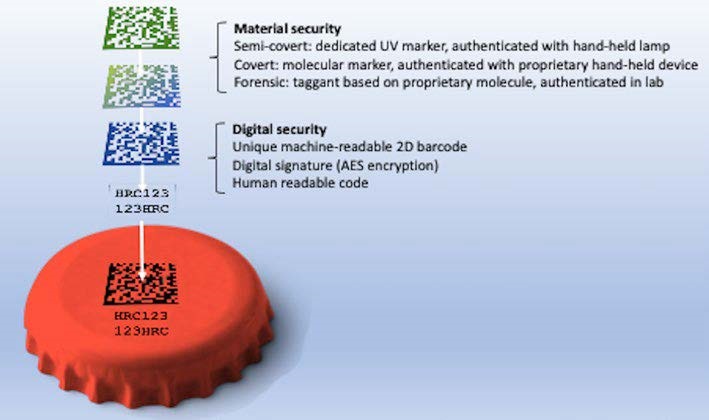
The direct marking proposed by SICPA consists of a 2D barcode printed on the product packaging using inkjet printers and proprietary security inks.
These inks provide various levels of authentication, including semi-visible UV fluorescence revealed through lamps, invisible markers revealed through hand- held inspection devices, and forensic taggants that are detected through analytic laboratory equipment.
But we should also consider some of the alternative technologies emerging here.
A good example of this is the Giesecke+Devrient SIGN® technology for brand protection, as featured in Authentication & Brand News™ (ABN) September 2022. This works by embossing a micro-optic feature onto cardboard or paper packaging and, as such, it becomes an optically variable feature.
The use of embossing is an interesting feature of direct marking, and we will return to that with other examples.

On-item marking
This is again an established technology with batch codes and expiry dates printed directly onto bottles, but innovations on this theme were presented at TSTF 2022 by Securikett.
Their CODIKETT® technology laser etches a 2D barcode onto a glass bottle that is linked to a printed code on a tax stamp. This is an interesting example of a two-step verification process linking stamp to item.

The HolyGrail 2.0 consortium provides another example of embossing technology, placing the Global Trade Item Number (GTIN) in 2cm² tiles over a plastic item. This is not serialised coding but provides a route for plastic sorting to facilitate recycling. It points the way towards sustainability and was reviewed in TSTN October 2021.
Randomness can provide a route to uniqueness for future on-item marking, with academic research providing a number of examples. CandyCodes (see image at top) from the University of California (ABN May 2022) mark pharmaceutical tablets with a random array of edible, coloured sprinkles. Colorado State University is investigating the use of random variation in surface hardness of high-value metal parts on a micro scale, as a route to mass serialisation.
In-item marking
This is a primary example of emerging digital marking technology, but real examples already exist that we can build upon. Here, we should consider the field of embedded electronics, such as the use of NFC-enabled chips integrated in identity documents and smart labels. One recent example shows where this technology could lead.
In July 2022, soccer team FC Köln played host to AC Milan in an event dubbed the Innovation Game. Identiv Inc and collectID together provided NFC-enabled garment tags that were embedded in a special edition football scarf for the event, enabling both entry to the game and smartphone access to premium content. For high-value brand awareness to item-level tagging, it is easy to see where this could lead.
Advertent and inadvertent marking
The above examples all illustrate codes that are intentionally placed on or in the item. There is, however, the potential to use the randomness of features that are a function of the manufacturing process to register a unique code for the product. This could be an emerging route to the traceability of products created by 3D printing (also known as additive manufacturing).
Fanciful examples abound, often emerging from academia using 3D printers to produce patterns within items. A more realistic example comes from the increasing use of technology to produce metal parts for aerospace and automotive applications. The surfaces of these often exhibit random features, a potential example of inadvertent direct marking of objects.
Code reading for automation
One of the legacies of the pandemic has been an increasing emphasis on warehouse and factory automation. Implicit in this is the ability to identify and verify items within the process. This would be a fruitful area to explore as a complement to item level marking.
Subscriber content
Read the full article
Full access to Tax Stamp & Authentication News™ articles, newsletters and archives.