
Completing the Circle
Did you see the hard hitting video Greenpeace created on the amount of plastic waste the UK sends to other countries every year? It shows a plastic Boris Johnson drowning in a wave of bottles, containers and packets.
The real Boris Johnson, speaking ahead of COP 26 last November, said recycling plastic materials ‘is not the answer’ and it ‘doesn’t begin to address the problem’.
It is a big problem and the figures on the waste we generate are damning. More than 2.5 billion tonnes are produced by the European Union every year. To combat this, the EU’s legislation on waste management is being updated to promote a more sustainable circular economy that extends the life cycle of products. It considers sharing, leasing, reusing, repairing, refurbishing and recycling existing materials and products for as long as possible.
The circular economy presents a $4.5 trillion business opportunity for companies that concentrate on rethinking products and services using principles based on durability, renewability, reuse, repair, replacement, upgrades, refurbishment, and reduced material use. That is according to the World Business Council for Sustainable Development in its CEO Guide to the Circular Economy.
Full circle
It is also a key focus for European-wide approaches. In March 2020 the European Commission made proposals on more sustainable product design, reducing waste and empowering consumers (such as a right to repair) in its new circular economy action plan.
This included a specific focus on resource intensive sectors, such as electronics and ICT, plastics, textiles and construction. A year later a resolution was adopted on measures to achieve a carbon-neutral, environmentally sustainable, toxic-free and fully circular economy by 2050.
Industries are also seeing greater emphasis on Extended Producer Responsibility (EPR). It is being adopted by many countries around the world across a broad range of products and materials and incentivises better, more sustainable decisions at the product design stage. They include making it easier for products to be reused or recycled at their end of life. It also places on producers the financial cost of managing products once they reach end of life.
Retailers representing 62% of clothing placed on the UK market, as well as some of the leading charities, reuse and recycling businesses, are making commitments too. They have signed up to WRAP’s Textiles 2030. It focuses on how to redesign, reuse and recycle products to displace negative environmental impacts and use resources more efficiently, extending the lifecycle of products.
Action for change
These legislative and industry-led campaigns, along with others like them around the world, are driving action to minimise waste, reduce environmental impact, address climate change, water and land use, and take a fully rounded view of design and development where possible.
In a true circular economy, there is no waste. But what does that mean and what should companies be considering?
First steps
For operations and organisations the easiest and clearest first step towards a circular economy is recycling. But recycling is the least sustainable in terms of profitability and resource efficiency. When something is recycled it is broken down into its base materials and made into something entirely new. This process can be energy intensive and involve the addition of new materials.
When something is reused, however, it stays in its current state for either the same or a different purpose.
Reuse is something consumers are slowly becoming aware of through organisations such as the Ellen McArthur Foundation. It promotes the work of operations such as Gerrard Street, which has pioneered a subscription service for its modular headphones. It recovers and recycles headphones at the end of their life, while the modular design allows 85% of components to be reused. The durable products have standardised designs to reduce the need for virgin materials.
And many of us will have seen news of Starbuck’s decision to phase out its disposable cups by 2025. Initial suggestions are that every customer either uses their own mug or borrows a ceramic or reusable to-go mug from their local Starbucks via a deposit scheme.
Understanding the impact
These initiatives are great improvements on the way we have been doing things, but what impact are they actually having? This is where measurement becomes so important – in particular for products that focus on reuse.
Reuse requires reverse logistics, cleaning, inspection, and refill facilities, with total costs that can actually be higher than conventional processes, even when the cost of recycling is included.
In a true circular economy, manufacturers and their supply chain partners will need to be able to uniquely capture, identify, and automatically share information about products, assets, locations and more, while adhering to global standards.
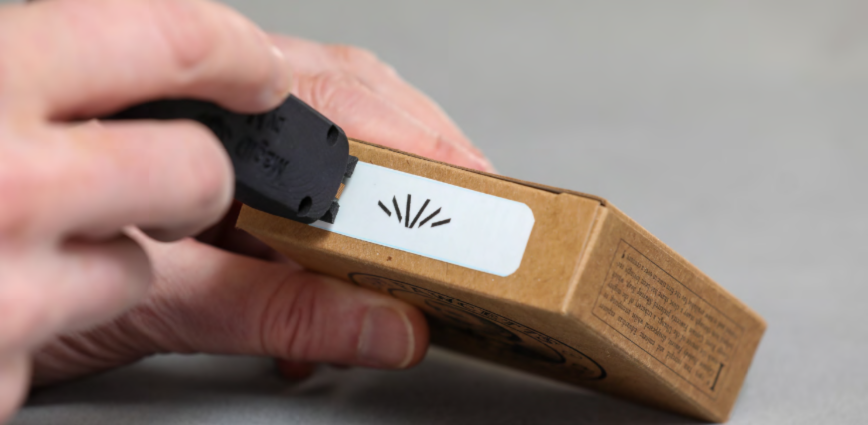
One way to achieve this is with the recently launched, patented MagID technology from MagVision. MagID offers an affordable, robust, and highly customisable solution.
It prints unique codes in magnetic ink – the same process used for the automatic sorting of bank cheques.
Codes can be concealed inside packaging, below labels, or even over-printed. MagVision uses the very latest in magnetic sensing technology to read the codes even when they are covered up. Codes are managed by a secure and flexible track and trace platform, which can also use QR codes or RFID tags. In this way the platform can track items along their life journey, giving precise data on how often and where items are reused. At the end of the life of the product MagID has virtually no environmental impact.
Is it time you started or reviewed your commitment to a circular economy?
Subscriber content
Read the full article
Full access to Tax Stamp & Authentication News™ articles, newsletters and archives.