
The Global Use of Tax Stamps – Africa

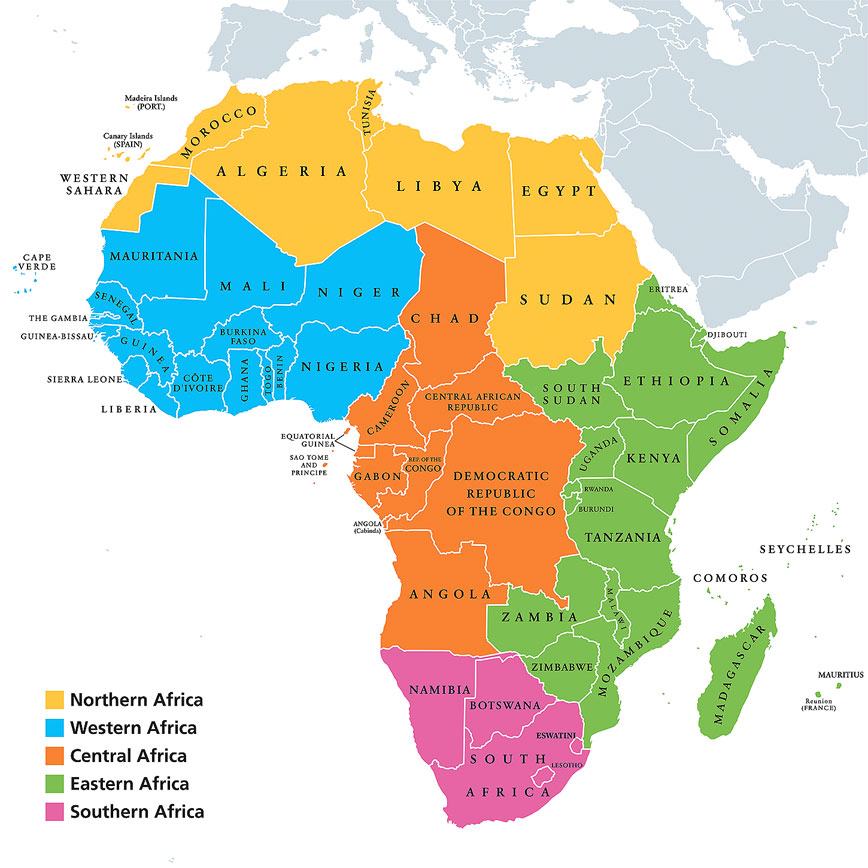
We kick off 2021 with a new series on the use of tax stamps and their associated track and trace systems in different regions of the world – starting with Africa. The series provides a summary of the quantitative and qualitative analysis of tax stamp usage, together with country profiles, which formed a significant part of Reconnaissance’s recently released report ‘Tax Stamps & Traceability: A Market Analysis and Technical Update’.
Africa is the world’s least developed continent, both economically and in terms of tax stamp usage. Ten years ago (when the previous Tax Stamp Report was released) very few tax stamp programmes were in operation in Africa compared to other regions, but Africa was nevertheless foreseen to become the most active region in terms of tax stamp adoption.
So, did this actually happen? In terms of countries adopting tax stamps for the first time, Africa did indeed emerge at the top of the list, with six countries implementing new programmes (namely Cameroon, Ghana, Liberia, Mozambique, Sudan and Togo). Meanwhile, countries such as Botswana and South Africa managed to reach the tender-issuing stage, although South Africa cancelled its tender immediately following the bid submission deadline, and the Botswana tender was delayed.
On the other hand, a number of African countries that already had tax stamps in place, have continued extending their programmes to encompass production monitoring and traceability, as well as extending them beyond cigarettes and spirits to cover wine, beer, soft drinks, bottled water, and beyond. These countries include Mauritius, Democratic Republic of the Congo (DR Congo), Kenya, Rwanda, Tanzania and Uganda.
In addition, the 21 African nations (out of a total of 61 nations worldwide) that are party to the WHO FCTC Protocol to Eliminate Illicit Trade in Tobacco Products must introduce secure track and trace systems on tobacco products by 2023 – if they don’t have them in place already (which most of them don’t).
So, yes, one could say that Africa has become – and is likely to remain – one of the most active regions for new and extended tax stamp and track and trace programmes in the years to come.
In volume terms, tax stamp usage in Africa for cigarettes is projected to grow to 7.4 billion by 2023, based on cigarette consumption levels and tax stamp programmes currently in operation. The corresponding figure for spirits stamps is 159.4 million. However, more stamps are currently being used on wine than on spirits, with 200 million projected for 2023.
Central Africa
The Central African region comprises countries that include Angola, Cameroon, Central African Republic, Chad, Congo, DR Congo, Equatorial Guinea, Gabon, and Sao Tome and Principe. While Chad, Congo and Gabon are party to the WHO FCTC Protocol – but do not currently use tax stamps – Cameroon and DR Congo do use tax stamps but are not party to the Protocol.
Cameroon first adopted tax stamps in 2012, and today they are used on tobacco and spirits. The stamps are provided by De La Rue and incorporate multilevel security features and a unique 2D code for traceability. Following the introduction of the programme, Cameroon saw its tax revenues increase by 100% over a three-year period.
In 2020, DR Congo introduced a fiscal marking and traceability system on tobacco, alcohol, fuels, soft drinks, drinking water, vehicles, cosmetics, body care, and household goods. A 10-year contract was awarded to SICPA for the provision of the technology solution and its operation.
The DR Congo solution includes paper-based stamps and directly printed secure codes, similar to the EGMS system implemented in Kenya. The fiscal marks are activated directly on high-speed automated manufacturing lines using production monitoring equipment, while on manual, low-speed lines and imported products they are activated through an electronic declaration process.
East Africa
This region is essentially composed of the six members of the East African Community (EAC): Burundi, Kenya, Rwanda, Tanzania, South Sudan and Uganda. Four of these members (Kenya, Rwanda, Tanzania and Uganda) have comprehensive tax stamp and traceability systems in place – extending over multiple product groups. No other countries in East Africa use tax stamps.
In 2013, Kenya introduced its Excisable Goods Management System (EGMS), provided by SICPA, including multilevel security tax stamps and remote automated monitoring of domestic production lines.
In 2016, the tax stamps were upgraded with serialised QR codes for cigarettes, as well as wine, spirits, ready-to-drink alcoholic beverages and beer.
The EGMS rapidly led to an increase in the size of the legitimate cigarette market, with the largest increase coming from imported cigarettes, which rose by an incredible 4,728% in 2014. Furthermore, a 76% increase in legitimate cigarette and cigar sales from 2013-16 was reported. In 2016-17, excise tax revenues on beer and tobacco grew again by 13.3%, while revenue on spirits grew by 22.7%.
The EGMS was expanded in 2019 to include bottled water, juice, soda, energy drinks and other non-alcoholic beverages. For these products the fiscal marks consist of a secure 2D barcode printed directly on the packaging by production monitoring equipment connected in near-real-time with a central database.
In 2017, Rwanda migrated from simple cigarette and alcohol tax stamps with no traceability features to stamps with a unique identifying code for track and trace, provided by Madras Security Printers.
This was followed, in 2019, by the launch of the government’s Made in Rwanda programme, involving the extension of the cigarette and alcohol traceability system to a wide range of other products, such as milk, cosmetics, honey and rice, which were required to carry unique quality marks as opposed to tax stamps.
In 2019, Tanzania introduced its Electronic Tax Stamp programme, provided by SICPA. The programme was initially applied to cigarettes, spirits, wine and beer and includes tracking and tracing and production monitoring capabilities.
In a second phase, the programme was extended to domestic and imported flavoured water and carbonated drinks, and will be completed with fruit juice, vegetable juice, bottled water, films and music products.
According to Tanzanian media: ‘excise tax collections on domestic spirits rose by a cool 74.4% (an increase of Sh13.8 billion – $128 million) during the first quarter of 2020 compared to a similar period in 2018 before the ETS had been rolled out’.
In 2019, Uganda launched a tax stamps and traceability (provided by SICPA) on beer, spirits, wine, soda, mineral water and tobacco products. Tobacco products carry a standard-sized, paper-based stamp, while wine, spirits and beer kegs carry a long stamp placed as a seal over the bottle/keg. As for imported beer, soda and mineral water, these carry a round stamp, while local beer, soda and mineral water carry a directly printed unique secure mark.
The programme resulted in a 270% increase in the number of active taxpayers. Production volumes of existing taxpayers grew significantly, along with tax collections, especially in the water and spirits categories. Due to the success of the programme, the Uganda Revenue Authority decided to extend the programme to products such as sugar and cement.
North and West Africa
Demand for cigarettes is much higher in North than West Africa – in particular in Algeria, Egypt, Libya, Morocco, and Tunisia – and West Africa acts as a conduit to these countries. While they represent less than 20% of the continent’s population, these five North African countries smoke almost 60% of its cigarettes. Only Egypt, Morocco and Sudan use tax stamps in North Africa.
Egypt has been using tax stamps for a number of years on both cigarettes and spirits. It introduced a new tax stamp in 2014 with enhanced features, including a hologram and barcoded unique identifier.
The new tax stamps are provided by Security Print Solutions (SPS), an Authentix company, along with Excel Systems. The programme includes the installation of bespoke track and trace system hardware and software in the tax authority’s offices.
When the programme began, SPS printed and supplied 3 billion stamps for deployment on hundreds of local tobacco manufacturing lines – which increased to 6 billion in 2018-19 commensurate with a 121% increase in tobacco tax revenue collection.
Morocco was the first country in Africa to establish – in 2010 – a single fiscal marking and secure track and trace platform for multiple product categories, including cigarettes, spirits, wine, mineral water, soft drinks and beer. The prime contractor for the system was (and still is) SICPA.
The fiscal marks currently applied to the different products in the platform include paper-based tax stamps for cigarettes, wine, spirits, as well as for all imported products, and secure 2D barcodes directly printed on bottles and cans of local beer, water and soft drinks.
The contract with SICPA was last renewed in 2019 after a public tender, introducing new features such as a solution allowing citizens to scan and authenticate tax stamps via a smartphone application.
Sudan uses tax stamps on cigarettes and shisha tobacco. The introduction of the programme, just a few years ago, led to a 67% increase in tax revenue. The stamps, which are provided by De La Rue, incorporate multilevel security features and a unique 2D code for traceability.
Moving to West Africa, this region mainly comprises the 15 members of ECOWAS (Economic Community of West African States), namely: Benin, Burkina Faso, Cape Verde, The Gambia, Ghana, Guinea, Guinea Bissau, Ivory Coast, Liberia, Mali, Niger, Nigeria, Senegal, Sierre Leone and Togo. In fact, the only country in this region which is not a member of ECOWAS is Mauritania.
In 2017, ECOWAS regional experts validated a finance-led draft directive for establishing a system for authenticating, monitoring, tracking, tracing and fiscally verifying domestic and imported tobacco products sold on ECOWAS territory.
The directive was further intended to ensure regional compliance with the track and trace provisions of the WHO FCTC Protocol (indeed, 11 out of 15 ECOWAS states have already ratified the Protocol, making this region the ‘epi-centre’ of African parties to this health treaty).
The track and trace project was not, however, adopted by most ECOWAS members, with one reason for the delay being that members were waiting to see what technical directives would come from the FCTC Secretariat.
In the meantime, Nigeria announced its individual intention to pursue the adoption of a tax stamp and traceability programme, while Ghana, Liberia and Togo actually implemented such programmes (see below case studies). In addition, Burkina Faso and Ivory Coast introduced a direct fiscal marking and traceability scheme based on the Codentify marking system originally developed and patented by Philip Morris International. No other countries in West Africa currently use tax stamps or traceability systems.
In 2018, Ghana introduced tax stamps on tobacco products, wine, spirits, beer, soft drinks and water, which led to an immediate increase in excise tax collections on imported goods, with some domestic manufacturers increasing their tax payments by up to five-fold. Customs duties grew by more than 100% and more than $30 million per year was collected in excise taxes.
Then in 2020, De La Rue signed a five-year contract with Ghana Revenue Authority for supplying the stamps for all product categories. The solution includes physical tax stamps with a mix of layered security features and the inclusion of a unique 2D barcode. The stamps are supplied together with a software solution for order management and reporting and include secure apps for smartphone use.
In the second quarter of 2020, Liberia Revenue Authority awarded a tax stamp contract to Madras Security Printers for tobacco products, liquor, wine, beer and non-alcoholic beverages. The stamps include anti-copy QR codes and a track and trace solution that extends from point of origin to point of sale.
In 2020, Togo introduced an automated production monitoring, secure fiscal marking and traceability system, on cigarettes, spirits, wine, beer, soft drinks (including juices) and bottled water. The system, which is provided by SICPA, involves the application of either paper-based tax stamps or directly applied secure tax marks (depending on the type of product to be marked) on unit-level items.
Southern Africa
Southern Africa is embraced by two politico-economic unions: the Southern African Development Community (SADC) – with 16 member states (Angola, Botswana, Comoros, DR Congo, Eswatini, Lesotho, Madagascar, Malawi, Mauritius, Mozambique, Namibia, Seychelles, South Africa, Tanzania, Zambia, Zimbabwe) – and a smaller union nestled within the SADC called the Southern African Customs Union (SACU), composed of five states (Botswana, Eswatini, Lesotho, Namibia and South Africa).
So far only five members of the SADC are party to the WHO FCTC Protocol (Comoros, Eswatini, Madagascar, Mauritius, Seychelles), with only one of these (Mauritius) using tax stamps. Other countries in Southern Africa that use stamps are Malawi, Mozambique and Zambia.
Mauritius has been using stamps on cigarettes since 2008 and on spirits since 2013. In 2020, the stamps were extended to wine and beer.
The stamps incorporate a unique identifying code for traceability purposes. While the cigarette and spirits stamps are paper-based, the wine and beer stamps are made from a polymer substrate more suited to wet environments. Customs officers use a smartphone application to scan and validate the unique codes.
An international tender process is carried out every two years, with Holostik being the successful bidder in 2017, for the supply of 114 million cigarette stamps, together with a fully automated online ordering, issuance and track and trace platform.
In 2017, Mozambique introduced a new tobacco tax stamp programme as the first phase in a three-phase process – followed by wine and spirits and finally beer and ready-to-drink packaged beverages.
The stamps are provided by OpSec Security and carry over 20 security features at overt, covert and forensic level, with the main overt feature being a copper holographic stripe. The stamps also carry an alphanumeric number that is unique to each stamp and replicated in a 2D code.
The track and trace element of the programme is provided by the OpSec InSight platform, which tracks stamps from manufacture and shipment, through to usage by over 200 manufacturers and importers.
One year after the launch of the programme, wine and spirits excise revenues grew by 85% and tobacco products by 24%.
Although South Africa does not use tax stamps on cigarettes or any other excisable products, it does use what it calls a ‘diamond stamp’, which is a rudimentary mark imprinted on the top of tobacco packs. Unfortunately, the stamp – which is also used in Botswana – offers no control over, or substantive insights into, either the tax status or legitimacy of packs.
In 2019, the South African Revenue Service (SARS) published an RFP for a fiscal marking, production monitoring and track and trace solution for tobacco products, However, the RFP was cancelled in mid-2020, amid news that SARS was restarting the process from scratch because ‘there were too many questions around the track and trace RFP in the market’.
It was previously foreseen that SACU members, at least, would follow in the steps of South Africa with regard to tobacco control programmes. However, following South Africa’s cancellation of its track and trace tender, the other SACU countries may well decide to move ahead with implementing their own systems without waiting for South Africa.
In the next part of this series, we will move the focus to the Middle East.
Subscriber content
Read the full article
Full access to Tax Stamp & Authentication News™ articles, newsletters and archives.