
The Global Use of Tax Stamps – Middle East


In last month’s Tax Stamp & Traceability News™, we launched a new series on the use of tax stamps and associated track and trace systems in different regions of the world, starting with Africa. This month, we shift the focus to the Middle East.
The majority of Middle Eastern countries do not use tax stamps, either because of no or low alcohol consumption or because it is not common practice to levy excise duties.
This situation is however changing in that, since 2017, the six countries of the Gulf Cooperation Council (GCC) – namely Bahrain, Kuwait, Oman, Qatar, Saudi Arabia and UAE – have been intensifying efforts to increase non-oil revenues as part of a major shift in tax policy that includes the introduction of VAT, as well as excise tax, on tobacco and sugary drinks. As a result of this shift, the UAE and Saudi Arabia have introduced tax stamps on tobacco products, and other GCC countries could likely follow suit.
In addition to the GCC, other countries in the region that use tax stamps are Iran and Yemen for cigarettes, Syria for spirits (the consumption of alcohol is allowed in Syria) and Turkey for cigarettes, spirits, wine and beer. Between them, they used 7.2 billion stamps for cigarettes and 88.9 million stamps for spirits in 2018, and this is projected to increase to 8.3 billion cigarette stamps and decrease to 78.8 million spirits stamps by 2023. (NB: the tax stamp volumes mentioned here are based on annual cigarette and spirits consumption data obtained from GlobalData.)
What’s more, six countries in the Middle East – namely Iran, Iraq, Kuwait, Qatar, Saudi Arabia and Turkey – are party to the WHO FCTC Protocol to Eliminate Illicit Trade in Tobacco Products, which means that by 2023 they will be required to implement a secure track and trace system on tobacco products sold in their territory.
In terms of specific country use cases, UAE and Saudi Arabia currently employ tax stamp programmes provided by De La Rue.
The UAE was the first GCC state to introduce excise tax on soft drinks and cigarettes in 2017, in a bid to implement new sources of state income in the wake of rapidly declining oil prices. It was also the first GCC state to introduce excise tax stamps, through the newly formed Federal Tax Authority.
The current contract is held by De La Rue for an initial five-year term, which includes a secure order management process, full track and trace for tobacco products and in-field authentication. The current annual tax stamp volumes produced are 350 million tobacco stamps and an estimated 1.5 billion soft drink stamps.
UAE was also the first country in the world to introduce tax stamps on e-cigarettes (and shisha), in 2019.
In 2019, De La Rue signed a five-year contract with the Kingdom of Saudi Arabia’s General Authority of Zakat and Tax (zakat is an obligatory annual payment made under Islamic law for charitable and religious purposes) to implement and operate a tax stamp and secure track and trace solution for all tobacco products and soft drinks sold in the Kingdom. The solution is intended to ensure that the country has a robust excise tax scheme in place and is tackling illicit trade directly, as well as ensure that Saudi Arabia complies with the FCTC Protocol.
Moving to Iran, although over the past few decades, trade with Iran has been sanctioned by different countries (notably the United States), some tobacco manufacturers were nevertheless able to obtain a licence to export cigarettes to Iran. The licence allowed them to buy cigarette stamps from the Iranian government tobacco monopoly, via a third party and apply them – at their factories – to cigarettes for sale in Iran. The stamps were (and still are) produced by the Iranian printing company Pardazesh Tasvir Rayan.
From 2017, however, the Iranian government implemented measures to halt all cigarette imports and to meet the entire domestic demand through local production. Consequently, by 2018, the Ministry of Industries, Mining and Trade reported that all cigarette imports had ceased. However, this did not mean that no foreign cigarettes at all were entering Iran, as smuggling was at one point reported to be as high as 40%.
Today, international tobacco manufacturers, including JTI and, more recently, Philip Morris have local agreements/operations in place for producing and selling their products in Iran, at much more affordable prices – which should have the effect of reducing the demand for smuggled foreign product.
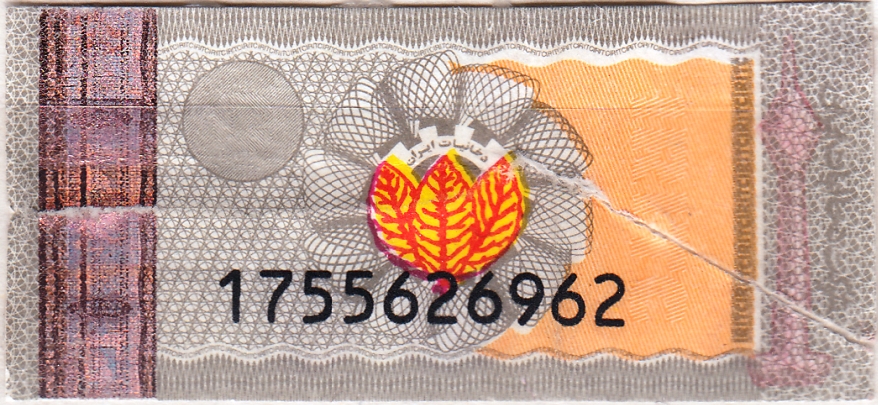 An Iranian tobacco stamp. Source: www.tax-stamps.com.
Turkey has one of the highest tobacco tax rates in the world. It was also the first country in the world to implement one single technology to securely monitor all excisable tobacco, spirits, wine and beer products. In 2007, Turkey’s Banderole Product Monitoring System (BUIS) for tobacco, spirits, wine and beer was introduced by the Turkish Revenue Administration to monitor the production, import and distribution of these excisable goods. The system was (and still is) provided by SICPA.
A new generation BUIS was launched in 2015, with several key changes that included upgraded tax stamps, the consumer as a ‘final auditor’, and a new export marking system to prevent the sale of export cigarettes on the domestic market.
The upgraded stamps (which are used on tobacco products, spirits, wine and beer kegs) incorporate authentication and verification features for all stakeholders. The stamps are equipped with a multi-layered security mechanism, where information- and material-based security features are combined into an integrated solution for authentication and traceability.
Domestic beer products carry a secure unique code which is directly printed onto the bottle cap or bottom of the beer can. Imported beer products carry coded beer stickers. In addition, export cigarettes carry an invisible mark which is directly printed onto the pack during production.
Overt and semi-covert material-based security is provided by an optical feature which comprises colour-shift and dual-polarisation effects. These effects appear on two logos on each tax stamp: those of the Revenue Administration and the Tobacco and Alcohol Market Regulatory Authority ‘TAPDK’ (each logo carries different types of secure ink technology).
The information-based security comes in the form of two serialised 2D barcodes, one superimposed on the other.
The first code is a visible secure QR code that can be read by consumers with a smartphone app; the second is an underlying covert (invisible) datamatrix code that can be read through inspection devices reserved for official use only. Both codes are further secured by material security features in the form of an optically active motif printed within the QR code, and a covert marker embedded within the invisible ink used to print the datamatrix.
The Revenue Administration reported that BUIS had led to a significant increase in the detection of illegal products. For example, between 2017-2018, around 62 million packs of smuggled cigarettes and 1.4 million bottles of smuggled alcoholic beverages (which is about 1.3 million litres) were seized.
This article is based on the new report ‘Tax Stamps & Traceability: A Market Analysis and Technical Update,’ containing comprehensive country and market analyses and technology reviews on this growing and evolving industry. Click here to view the report.
Subscriber content
Read the full article
Full access to Tax Stamp & Authentication News™ articles, newsletters and archives.