
Illicit Tobacco Trade ‘Down Under’ Goes Local

‘Necessity (crisis) is the mother of all invention’, Plato, the ancient Greek Philosopher, aptly noted over 2,000 years ago. Crisis consistently brings out the best and, unfortunately, also often the very worst in humanity. When faced with an urgent need or a necessity, humans have shown to be very adaptive and innovative to figure out how to secure what is needed.
The COVID-19 pandemic has shown us that this old proverb sadly also holds true for the illicit tobacco trade.
In this article, we examine the illicit tobacco trade in Australia and how it is continuing to evolve. We look at what continues to drive smokers to seek illicit tobacco, but also what criminal networks did when looking to source and traffic illicit tobacco products into Australia during the pandemic.
Scale of Australian illicit tobacco trade
The illicit trade in tobacco continues to progress at a rather high rate and seems to be accelerating. There are various reports and studies for the illicit tobacco trade in Australia.
KPMG has been providing estimates on illicit tobacco markets for over a decade. They are based on empty discarded pack studies and help provide a good measure for the amount of illicit tobacco products present in a city, market, state or country. While these studies are industry funded and therefore often criticized, the correlation of KPMG data, real-world conditions and tax collection data continues to show that KPMG’s reports are a rather reliable indicator of illicit trade.
The Australian Parliament House (APH) quoted that ‘the KPMG 2019 report shows a steady increase in the illicit tobacco market for the years to 2018, with a significant increase between 2018 and 2019. The 2019 KPMG study also shows that the fall in domestic tobacco sales was offset by the estimated increase in illicit tobacco consumption, resulting in a small increase in overall tobacco consumption from 2018 to 2019’.
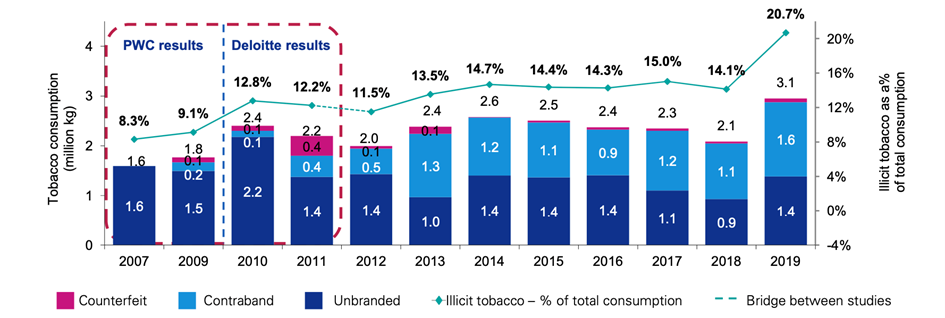
The significant increase in 2019 ballooned the illicit market from 14.1% to 20.7%; in other words, one out of every five packs was found to be illicit. In comparison, KPMG estimates that the illicit market in the 27 European Union member states is somewhere around 7.8% – a drastic difference.
The growth of the Australian illicit tobacco market was likely caused by the very aggressive taxation strategy implemented to reduce tobacco consumption. Australia, in 2010, increased its cigarette taxes by 25% and then, starting in 2016, increased the cigarette tax by 12.5% every year from 2013-2019.
As a result of these successive tax increases, a pack of cigarettes today costs an average of AUD 35 per pack ($25). And while the smoking rate in Australia has dropped from 17.87% to 13.30% of the population, it also created a massive black market estimated to have cost the Australian taxpayer AUD 1.7 billion in lost revenue in 2017.
The Australian government responded to the illicit market problem with decisive action and established the Illicit Tobacco Taskforce (ITTF), a multi-agency group that combines the operational, investigative and intelligence capabilities of the Australian Border Force, Australian Tax Office, Department of Home Affairs, Australian Criminal Intelligence Commission, Australian Transaction Reports and Analysis Centre, and the Commonwealth Director of Public Prosecutions. But as we have discussed in previous issues of Tax Stamp & Traceability News™, once an illicit market has been created it becomes very hard to suppress.
Australia offers a very interesting case study on how criminals and the black market adapt when faced with enforcement challenges and, in 2020, with supply challenges. While the 2019 KPMG report already indicated that half of Australia’s illicit market was made up of illicit whites, recent seizure data indicates that this trend was drastically accelerated by the COVID-19 pandemic.
Looking at the seizure data made public by the Australian Tax Office (ATO) and Australian Border Force (ABF), we see the steady increases of illicit tobacco products being trafficked into the country (ABF) and cigarettes being produced and smuggled domestically (ATO).
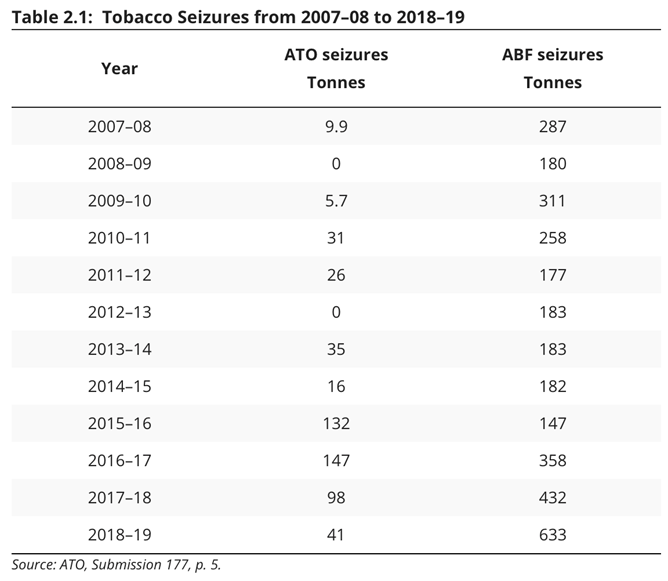
Both the seizure data and the KPMG data show that contraband tobacco being smuggled into Australia until 2020 was the main driver of illicit tobacco as the illicit market continued to grow. But even prior to 2020, criminal networks had already started to invest more heavily in the production of homegrown illicit whites or unbranded product, called chop chop.
Then in 2020, as shipment and supply routes got disrupted and as Australia sealed its borders through various shutdowns to neighboring countries, criminal organizations needed to get creative to be able to supply their illicit market demand.
They therefore capitalized on the investments and nascent chop chop production facilities already built, and they supercharged them. To overcome increased enforcement efforts and closed borders, criminals started to increasingly grow tobacco domestically in Australia.
And the most current seizure numbers clearly show that. Since its establishment in 2018, the ITTF has seized and destroyed more than 264 tonnes of illicit tobacco and over 540 million cigarettes. More importantly, the ATO, since 2018, has located and destroyed more than 118 tonnes of illicit tobacco crops. Most notably, of those 118 tonnes, over 50 tonnes of illicit crops were found and destroyed in early 2021 alone.
The ATO, in response to these recent developments, has issued various statement and public service announcements to alert the public of these criminal schemes and ask for tips and cooperation by the public.
The ATO has asked the public to ‘report any activity that could indicate the production of illicit tobacco, including intense labour production between November and May, suspicious inquiries about land for lease, unexplained use of water resources or large crops of leafy plants that resemble cabbage and have pink flowers’.
Most fascinating, growing tobacco in Australia has been illegal for more than a decade and the Australian government has not issued a license since 2006. Growing illicit tobacco also carries a maximum penalty of up to 10 years’ imprisonment. Yet criminals continue to persist, driven by the massive illicit profit potential.
Lessons to be learned and the way forward
Australia is one of the most heavily regulated tobacco markets in the world. According to the WHO MPOWER score, Australia has implemented almost all tobacco control measures WHO recommends or prescribes. Yet it has one of the highest illicit trade markets of developed nations.
Part of the reason for this is that tobacco prevention and illicit trade prevention are not linked in the WHO MPOWER model – or, more accurately, illicit trade is not a factor in that tobacco control model. However, aggressive taxation policy and other tobacco control measures can trigger or increase black markets.
Australia, for example, with its very aggressive taxation strategy to discourage use, has created a pricing umbrella under which the illicit market has plenty of room to operate.
The WHO reports that 77.5% of a pack of cigarettes can be equated to taxes. That translates to a whopping AUD 27 ($19) in potential tax avoidance or illicit profit per pack. To put that in perspective, the smuggling of a single tractor trailer of illicit whites has an illicit profit potential of AUD 12 million ($9 million). That provides an irresistible incentive to criminals to cash in, especially when the product can be homegrown.
Other nations are well advised to review their taxation policy and ensure that, while taxation can be used to discourage tobacco use, it needs to be balanced to minimize the unintended consequence of the significant increase or creation of a robust black market.
On the flip side and in response, Australia has implemented a suite of enforcement tools at its disposal and recommended by experts. It established the ITTF to provide a comprehensive and cohesive enforcement strategy, it increased various penalties and prohibited the cultivation of domestic tobacco. Australia is aggressively enforcing not only against homegrown tobacco, but also the continued attempts to import illicit tobacco.
According to the latest data, the ABF seized 512 million cigarettes in 2020-2021, a 36% increase from the previous year. In addition, ABF seized 748 tonnes of loose-leaf tobacco, which was attempted to be illegally imported, compared to 167 tonnes the previous year.
Yet, besides all its enforcement efforts, Australia has not implemented a tobacco excise tax stamp regime. While stamps themselves won’t stop illicit actors from producing illicit tobacco products, they will provide important tools to proof excise tax evasion and help law enforcement to quickly verify the authenticity of products. In combination with effective penalties, these become an increasingly powerful tool.
The development and evolution of the illicit tobacco market in Australia is a brilliant case study that shows how illicit markets can be created or drastically grown as unintended consequences of a well-intentioned, but ill-executed tobacco prevention strategy. Not only does the illicit market deprive Australia of billions in tax revenue every year, but it also undermines public health policy.
About 20% of the market is illicit now. That means that one in five smokers did not only not quit but are now exposed to product that was produced in a much less regulated and less controlled environment and is potentially even more harmful. Illicit trade also undermines crucial tobacco youth prevention efforts by creating new shopping avenues for the underaged.
Australia also highlights that once an illicit market is firmly established or greatly expanded, it becomes very difficult, very costly, and very lengthy to combat.
Finally, the Australian illicit market yet again highlights the flexibility, creativity, ingenuity and adaptability of the illicit market. When faced with supply interruptions and increased border enforcement they simply increased local production of chop chop.
It will be important for the technology industry, government, and law enforcement to match their innovations and adaptions by constantly re-examining existing enforcement models, tactics, and technologies to combat these evolving threats.
Sven Bergmann is the founder and CEO of Venture Global and advises brand owners, technology providers and governments on anti-counterfeit strategies, programs and technologies. Send your comments to [email protected].
Subscriber content
Read the full article
Full access to Tax Stamp & Authentication News™ articles, newsletters and archives.