
Illicit Trade in Southeast Asia – Malaysia’s Upgraded Tax Stamp Programme

In the February issue of Tax Stamp & Traceability News™, we launched a series of articles by Chander S Jeena, on the illicit tobacco trade in Southeast Asia and how it is being dealt with. This month we continue the series with an update on the situation in Malaysia.
According to the study Illicit Tobacco in the Asia-Pacific Region: Causes and Solutions, by Retail Trade and Brand Advocacy, the total tax loss estimated across 19 monitored markets in the Asia-Pacific region was over $5.8 billion in 2017, with nearly 50% of this occurring in just two markets: Australia and Malaysia.
Malaysia’s geography, with its extensive coastline and porous jungles, poses significant challenges for anti-smuggling enforcement. According to estimates, more than 50% of illicit cigarettes in Malaysia enter through the country’s ports and ‘rat lanes’ (or ‘lorong tikus’, in Malay), which are relatively unmonitored paths into the country used as entry or exit points for illegal migrants or smugglers.
In addition to this illicit movement, the flow of illegal cigarettes into Malaysia is spreading beyond its borders. In Australia, over 40% of illicit cigarettes either originate from or are transshipped through Malaysia. According to the international law enforcement consultant and founder of the Illicit Tobacco Strike Team of the Australian Border Force, Rohan Pike, ‘the Malaysian government can look into enhancing cross-border intelligence sharing and surveillance to identify and close rat lanes. Advance technologies such as drones, state-of-the-art scanners, and CCTVs can also be deployed at suspected entry points.’ According to a 2019 study by AC Nielsen, entitled Illicit Cigarette Study (ICS), approximately 62% of the total tobacco market in Malaysia belongs to criminal gangs. The study showed an uptrend in the consumption of contraband cigarettes over the past four years and reported that 88% of illegal cigarettes did not carry tax stamps, while the remaining 12% carried counterfeit stamps, thereby indicating a weakness in the enforcement of tax stamp usage (see Fig 1).
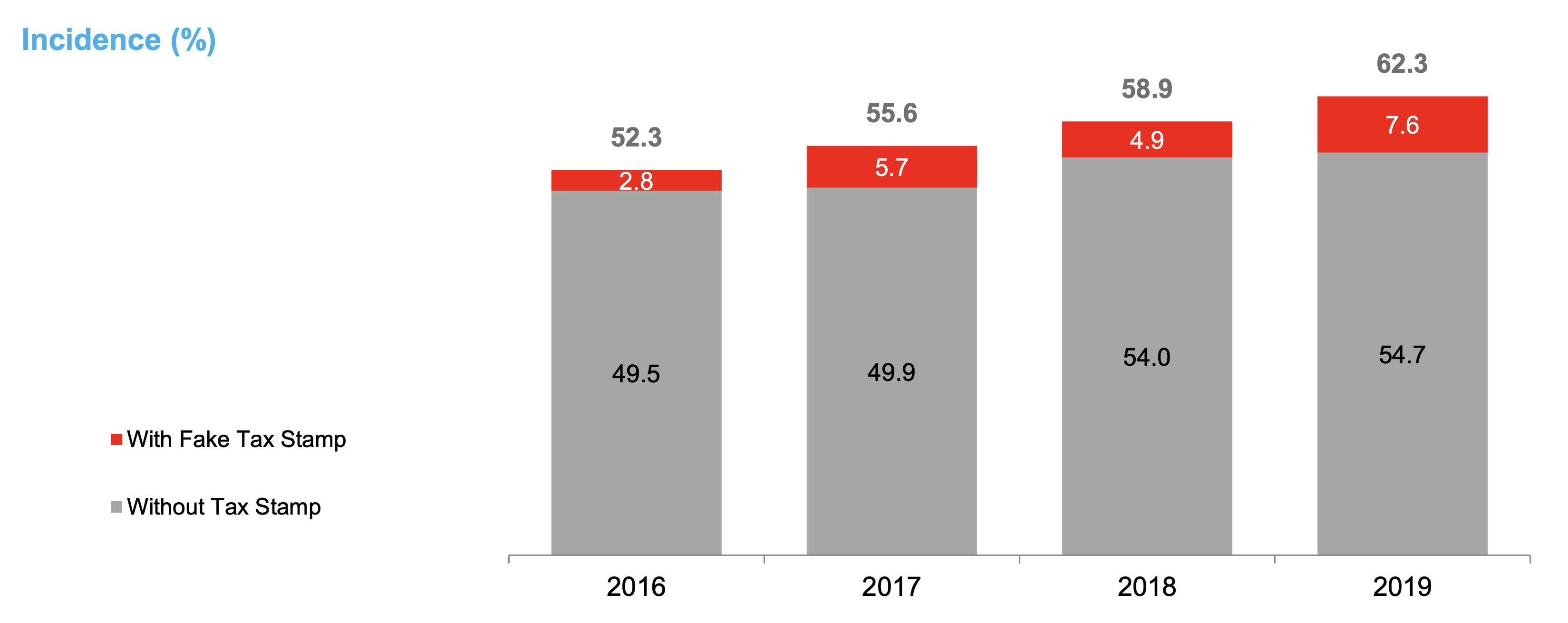 Fig 1 – tax stamp breakdown of illegal cigarettes (source: AC Nielsen Illicit Cigarette Study, 2019).
A key factor contributing to the current increased level of illicit tobacco trade in the country has surely been the +40% tax increase that was implemented, in one go. This massive tax hike compares to previous, smaller increases of 7-10% per year which were able to be introduced in parallel with a gradual reduction in illicit trade, thereby illustrating that with the correct control measures in place, it was possible to implement (reasonable) tax increases without impacting illicit trade.
Malaysia’s tax stamps
Since 2005, Malaysia has been using two types of tax stamps: blue for duty-paid products and red for the duty-free market. The most recent tax stamps were launched in December 2019 for alcohol and in May 2020 for tobacco products, using the same colour scheme as the previous stamps but with an upgraded design and security features, as well as the inclusion of a unique QR code with in-built digital anti-reproduction security, for traceability purposes.
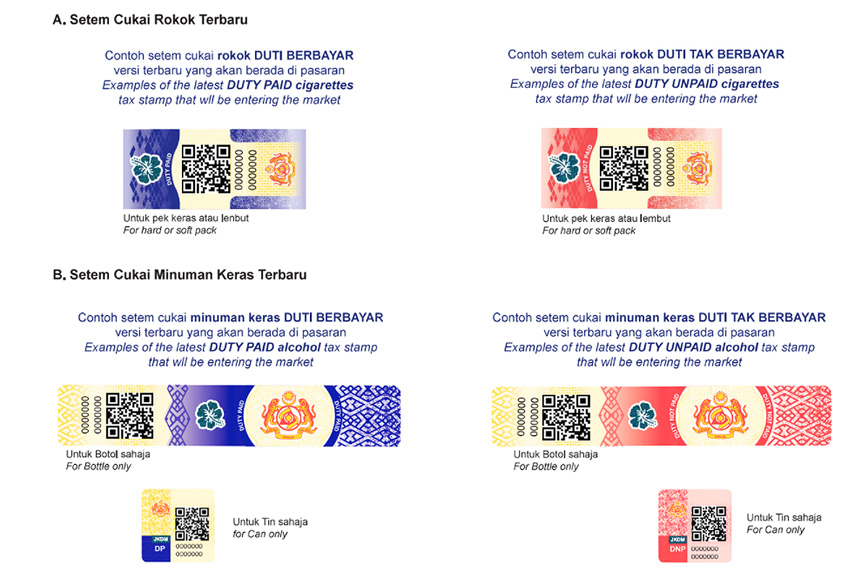 Malaysia' new tax stamps
For liquor products, two different sizes of tax stamps are used: a conventional 16mm x 90mm size for bottles, and a 25mm x 25mm square-shaped stamp for cans (which replaces the previous round stamps). All of these tax stamps can be verified via a smartphone using the appropriate application.
The next article in this series will look at Cambodia.
Subscriber content
Read the full article
Full access to Tax Stamp & Authentication News™ articles, newsletters and archives.